
Bizhan Khodabandeh
Author of The Day the Klan Came to Town
Works by Bizhan Khodabandeh
Associated Works
The Assimilated Cuban's Guide to Quantum Santería (2016) — Cover artist, some editions — 121 copies, 11 reviews
Sunspot Jungle: Volume Two: The Ever Expanding Universe of Fantasy and Science Fiction (2018) — Illustrator — 22 copies
Tagged
Common Knowledge
There is no Common Knowledge data for this author yet. You can help.
Members
Reviews
(Full disclosure: I received a free e-ARC for review through Edelweiss. Trigger warning for racist violence.)
Named after Andrew Carnegie (who donated a library for the honor), Carnegie, Pennsylvania is a small borough that's part of Pittsburgh metropolitan area. On August 25, 1923, it was the site of "Karnegie Day," during which 10,000-30,000 members of the KKK - many imported from other states, like West Virginia and Kentucky - descended on the borough for a celebration of violence, show more terror, and white supremacy. The Klan targeted Carnegie because it was majority Catholic; their intended victims were Black, Irish, Italian, Sicilian, Jewish, Chinese, and Armenian, in keeping with Klan 2.0's new and expanded list of "undesirables." They also arguably had the blessing of local law enforcement, which looked the other way.
The diverse citizenry of Carnegie were abandoned to defend themselves - and so they did. Using guns, knives, bats, fire, bricks, and rocks, they coordinated and launched a counteroffensive, driving the Klan from their borough. The resistance killed one Klan member during the battle and injured many others.
Sadly, like so may acts of resistance (and oppression), Carnegie's victory over the Klan was largely lost to history - a near-inevitability foretold by Freeman near the story's end. Indeed, in the afterward, author Bill Campbell relates that "Research wasn’t easy. A chapter or two in a monograph here and there, a brief mention in some old articles. Oddly enough, the actions of the Klan and government officials that day have been chronicled. All we really know about the people who fought them is that they were 'Irish and others.'" Wikipedia's entry on "Karnegie Day" is a paltry two sentences, nestled in Carnegie, PA's article.
THE DAY THE KLAN CAME TO TOWN is thus "a fictionalized account of an actual historical event" - but one that's no less compelling for its fabrications (or maybe educated guesses is a better term?). It's damn exhilarating to see people from different marginalized groups band together to fight a common enemy (if not the real enemy?: which is just to say that poor white working class folks need to get their heads out of their collective asses and see that the actual enemy isn't working class black and brown people - or other "nonwhites," which in the 30s included the Irish and Italians - but the politicians and billionaires who use hate, othering, and in group/out group membership to distract from the ever-widening wealth gap and erosion of democracy.)
Still, the volume is necessarily slim, and I can't help but wish we had more details about what transpired that day.
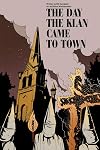
I mostly enjoyed Khodabandeh's artwork, though I won't be the first or last to comment on his tendency to give everyone weirdly oversized hands. The black and white is striking, though a part of me wishes THE DAY THE KLAN CAME TO TOWN was rendered in full color, to help counter our tendency to dismiss this stuff as having occurred in the "distant past." show less
Named after Andrew Carnegie (who donated a library for the honor), Carnegie, Pennsylvania is a small borough that's part of Pittsburgh metropolitan area. On August 25, 1923, it was the site of "Karnegie Day," during which 10,000-30,000 members of the KKK - many imported from other states, like West Virginia and Kentucky - descended on the borough for a celebration of violence, show more terror, and white supremacy. The Klan targeted Carnegie because it was majority Catholic; their intended victims were Black, Irish, Italian, Sicilian, Jewish, Chinese, and Armenian, in keeping with Klan 2.0's new and expanded list of "undesirables." They also arguably had the blessing of local law enforcement, which looked the other way.
The diverse citizenry of Carnegie were abandoned to defend themselves - and so they did. Using guns, knives, bats, fire, bricks, and rocks, they coordinated and launched a counteroffensive, driving the Klan from their borough. The resistance killed one Klan member during the battle and injured many others.
Sadly, like so may acts of resistance (and oppression), Carnegie's victory over the Klan was largely lost to history - a near-inevitability foretold by Freeman near the story's end. Indeed, in the afterward, author Bill Campbell relates that "Research wasn’t easy. A chapter or two in a monograph here and there, a brief mention in some old articles. Oddly enough, the actions of the Klan and government officials that day have been chronicled. All we really know about the people who fought them is that they were 'Irish and others.'" Wikipedia's entry on "Karnegie Day" is a paltry two sentences, nestled in Carnegie, PA's article.
THE DAY THE KLAN CAME TO TOWN is thus "a fictionalized account of an actual historical event" - but one that's no less compelling for its fabrications (or maybe educated guesses is a better term?). It's damn exhilarating to see people from different marginalized groups band together to fight a common enemy (if not the real enemy?: which is just to say that poor white working class folks need to get their heads out of their collective asses and see that the actual enemy isn't working class black and brown people - or other "nonwhites," which in the 30s included the Irish and Italians - but the politicians and billionaires who use hate, othering, and in group/out group membership to distract from the ever-widening wealth gap and erosion of democracy.)
Still, the volume is necessarily slim, and I can't help but wish we had more details about what transpired that day.
I mostly enjoyed Khodabandeh's artwork, though I won't be the first or last to comment on his tendency to give everyone weirdly oversized hands. The black and white is striking, though a part of me wishes THE DAY THE KLAN CAME TO TOWN was rendered in full color, to help counter our tendency to dismiss this stuff as having occurred in the "distant past." show less

This had a really unique art style with some truly amazing moments. I could just sit and stare at the pictures for ages. The story I found to be a little uneven. I get it, it's based on a children's story encouraging kids to be brave and search for truth and adventure, but the Little Black Fish came off as kind of... dickish. A lot of the time.
In an interesting moment in history in 1923, the citizens of Carnegie, Pennsylvania, fought back with force when the Ku Klux Klan picked their small town for a demonstration of their white supremacy. Unfortunately, this fictionalized narrative of the event gets tangled up in extended flashbacks for one character set in Sicily and Italy and barely introduces the rest of its jumble of Carnegie residents. The page-by-page flow was confusing and muted the excitement of the climactic show more confrontation for me. show less
The cover is well done. The artist used one character with many characters sketched into one while the main character is bravely facing the amelioration of characters.
The story is fantastic. The adventures of little black fish is similar to our own life experiences. The use of a black female fish is well thought out. Since, our society holds back women and people of color from venturing out to seek her own path to gain amazing and memorable life experiences and learning from them. A show more wonderful graphic novel. I hope to see more work from this writer and artist. Well done. show less
The story is fantastic. The adventures of little black fish is similar to our own life experiences. The use of a black female fish is well thought out. Since, our society holds back women and people of color from venturing out to seek her own path to gain amazing and memorable life experiences and learning from them. A show more wonderful graphic novel. I hope to see more work from this writer and artist. Well done. show less
Awards


You May Also Like
Associated Authors
Statistics
- Works
- 2
- Also by
- 5
- Members
- 79
- Popularity
- #226,896
- Rating
- 3.9
- Reviews
- 6
- ISBNs
- 3