
Jeremy Tiang
Author of State of Emergency
Works by Jeremy Tiang
Salesman 1 copy
Associated Works
Invisible Kitties: A Feline Study of Fluid Mechanics or The Spurious Incidents of the Cats in the Night-Time (2024) — Translator, some editions — 58 copies, 3 reviews
Durians are Not the Only Fruit: Notes from the Tropics (2013) — Translator, some editions — 6 copies
Tagged
Common Knowledge
- Birthdate
- 1977-01-17
- Gender
- male
- Occupations
- writer
translator - Awards and honors
- Translator in Residence, London Book Fair
Translator-in-Residence, Princeton University - Nationality
- Singapore
- Birthplace
- Singapore
- Places of residence
- Singapore
New York, New York, USA - Associated Place (for map)
- New York, USA
Members
Reviews

First line: Mollie Remedios died in the explosion that tore apart MacDonald House on 10 March 1965.
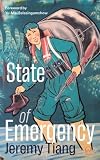
State of Emergency is the story of an extended family over the course of sixty years of turbulent Southeast Asian history. Each chapter is told from the point of view of a different person, which adds depth and perspective. The book opens with Jason looking back over his life from a hospital bed: the death of his sister from an Indonesian guerilla bombing, his wife's sudden disappearance show more leaving him with young twins, and his relationship with his children. The second chapter is told from Siew Li's perspective: being imprisoned as a middle schooler for being a Communist, Jason visiting her in prison and their subsequent marriage, and her flight to the jungle. Every chapter adds another layer to the picture, a different perspective of the same family. The result is an impressive interlocking story with fantastic pacing.
I was tempted to speed through the book, as I was pulled along with the story, but the writing made me want to slow down and savor the language and imagery. I loved Tiang's writing and will definitely look for more of his work, although there isn't a lot. He's a translator and author of a book of short stories, in addition to this novel, which won the Singapore Literature Prize in 2018. I have not read a lot of literature from Singapore or Malaysia, so this was a welcome find. show less
State of Emergency is the story of an extended family over the course of sixty years of turbulent Southeast Asian history. Each chapter is told from the point of view of a different person, which adds depth and perspective. The book opens with Jason looking back over his life from a hospital bed: the death of his sister from an Indonesian guerilla bombing, his wife's sudden disappearance show more leaving him with young twins, and his relationship with his children. The second chapter is told from Siew Li's perspective: being imprisoned as a middle schooler for being a Communist, Jason visiting her in prison and their subsequent marriage, and her flight to the jungle. Every chapter adds another layer to the picture, a different perspective of the same family. The result is an impressive interlocking story with fantastic pacing.
I was tempted to speed through the book, as I was pulled along with the story, but the writing made me want to slow down and savor the language and imagery. I loved Tiang's writing and will definitely look for more of his work, although there isn't a lot. He's a translator and author of a book of short stories, in addition to this novel, which won the Singapore Literature Prize in 2018. I have not read a lot of literature from Singapore or Malaysia, so this was a welcome find. show less
Rating: 4.25* of five
The Publisher Says: Siew Li leaves her husband and children in Tiong Bahru to fight for freedom in the jungles of Malaya. Decades later, a Malaysian journalist returns to her homeland to uncover the truth of a massacre committed during the Emergency. And in Singapore, Siew Li's niece Stella finds herself accused of being a Marxist conspirator.
Jeremy Tiang's debut novel dives into the tumultuous days of leftist movements and political detentions in Singapore and Malaysia. show more It follows an extended family from the 1940s to the present day as they navigate the choppy political currents of the region. What happens when the things that divide us also bind us together?
I RECEIVED A DRC FROM THE PUBLISHER VIA NETGALLEY. THANK YOU.
My Review: What happens when a woman dedicates herself to The Cause (whichever one it might be)? The kind of dedication that requires her to leave family behind, the way men have for millennia? She gets special treatment, in the worst sense of the words "special" when she is caught by the apparatus of state repression. That apparatus crushes communist cadres for the British Empire, then the state that became Malaysia, because heaven knows we can't have people thinking they have rights, deserve consultation on the way they'll be governed, any of that disorderly democratic foolishness! The people don't know (ever, according to their rulers) what is good for them! We'll have to lock 'em up and torture 'em for a while. How long? Who asked you, foreigner, to butt into our business?! Hand over some money so we can torture a few people you don't like, shut up and go away.
Authoritarians all have their eyes on the same hymnal, their hands in the same pot, and their souls AWOL. Doesn't matter the name of their "belief/political system" because they in themselves do not change.
Now that you're all ready for the read...understand that the prose is good but simple (Something heavy was settling onto her, an unpleasant awareness that the world was aslant and she was at the higher end. What could she do?), the characters are good but simple, the world they want to create is good but simple. I learned a good deal about the Emergency, something I wasn't very familiar with compared to the contemporaneous Viet Cong insurgency against the French. Unsurprising from a US reader...and also clear proof British propaganda efforts to keep the monster of American public opinion far away from the fraying Empire's horrific abuses.
There are six loosely linked PoVs in the story. It isn't the smoothest narrative technique but, for this time-hopping story, it works to the advantage of the tale of the Emergency as it develops and resonates through this clan's life. You'll need to be aware of who is addressing you to fully invest in their story, but it is not made difficult for you by Author Tiang. No unusual demands on your concentration are made, no mid-narrative jumps or other such Woolfian stuff; making it into Orlando: A Biography is not his aim.
I found its structure and its voice very easy to immerse myself into, allowing new information to settle into the places I lacked it. I was surprised to learn that women would be aware of what awaited them but still join the rebels. Sexist assumptions are hard to shed, clearly. Very much an ongoing project and welcome to find it reinforced here.
I'm ready for Author Tiang's next book whenever it comes. He has that thing no one can teach: Seeing his story through to its own ends. Nothing forced or misplaced. I'd've bestowed that fifth star had he done a tad bit more to signal how the interconnections really worked, but that isn't a full-star-off offense. show less
The Publisher Says: Siew Li leaves her husband and children in Tiong Bahru to fight for freedom in the jungles of Malaya. Decades later, a Malaysian journalist returns to her homeland to uncover the truth of a massacre committed during the Emergency. And in Singapore, Siew Li's niece Stella finds herself accused of being a Marxist conspirator.
Jeremy Tiang's debut novel dives into the tumultuous days of leftist movements and political detentions in Singapore and Malaysia. show more It follows an extended family from the 1940s to the present day as they navigate the choppy political currents of the region. What happens when the things that divide us also bind us together?
I RECEIVED A DRC FROM THE PUBLISHER VIA NETGALLEY. THANK YOU.
My Review: What happens when a woman dedicates herself to The Cause (whichever one it might be)? The kind of dedication that requires her to leave family behind, the way men have for millennia? She gets special treatment, in the worst sense of the words "special" when she is caught by the apparatus of state repression. That apparatus crushes communist cadres for the British Empire, then the state that became Malaysia, because heaven knows we can't have people thinking they have rights, deserve consultation on the way they'll be governed, any of that disorderly democratic foolishness! The people don't know (ever, according to their rulers) what is good for them! We'll have to lock 'em up and torture 'em for a while. How long? Who asked you, foreigner, to butt into our business?! Hand over some money so we can torture a few people you don't like, shut up and go away.
Authoritarians all have their eyes on the same hymnal, their hands in the same pot, and their souls AWOL. Doesn't matter the name of their "belief/political system" because they in themselves do not change.
Now that you're all ready for the read...understand that the prose is good but simple (Something heavy was settling onto her, an unpleasant awareness that the world was aslant and she was at the higher end. What could she do?), the characters are good but simple, the world they want to create is good but simple. I learned a good deal about the Emergency, something I wasn't very familiar with compared to the contemporaneous Viet Cong insurgency against the French. Unsurprising from a US reader...and also clear proof British propaganda efforts to keep the monster of American public opinion far away from the fraying Empire's horrific abuses.
There are six loosely linked PoVs in the story. It isn't the smoothest narrative technique but, for this time-hopping story, it works to the advantage of the tale of the Emergency as it develops and resonates through this clan's life. You'll need to be aware of who is addressing you to fully invest in their story, but it is not made difficult for you by Author Tiang. No unusual demands on your concentration are made, no mid-narrative jumps or other such Woolfian stuff; making it into Orlando: A Biography is not his aim.
I found its structure and its voice very easy to immerse myself into, allowing new information to settle into the places I lacked it. I was surprised to learn that women would be aware of what awaited them but still join the rebels. Sexist assumptions are hard to shed, clearly. Very much an ongoing project and welcome to find it reinforced here.
I'm ready for Author Tiang's next book whenever it comes. He has that thing no one can teach: Seeing his story through to its own ends. Nothing forced or misplaced. I'd've bestowed that fifth star had he done a tad bit more to signal how the interconnections really worked, but that isn't a full-star-off offense. show less
This is a sweeping novel about a family during the tumultuous period from the end of WWII through the end of colonialism and the founding of Malaysia and Singapore and the political ramifications that continued for decades. The novel begins simply, with a boy on his way home from school seeing a girl at a protest and talking to her. They begin a relationship that will eventually lead to marriage and two children, but his life as an English-speaking schoolboy on his way to a job in the civil show more service is a long way from hers as a Chinese-speaking communist who is detained for her views and never entirely safe in this new country. As she disappears and her children grow up without her, her absence affects them into adulthood, when her son decides to find out what happened.
I know very little about the history of that part of Asia and Tiang's novel does a fantastic job of informing the Western reader about the events and factors that formed Singapore and Malaysia, from the British treatment of suspected insurgents during the Malayan Emergency, to the methods used to repress dissent, especially from communist groups. And while the history was fascinating, Tiang also weaves a very human story about family and the connections between people. An impressive debut novel and I hope to see more by Tiang. show less
I know very little about the history of that part of Asia and Tiang's novel does a fantastic job of informing the Western reader about the events and factors that formed Singapore and Malaysia, from the British treatment of suspected insurgents during the Malayan Emergency, to the methods used to repress dissent, especially from communist groups. And while the history was fascinating, Tiang also weaves a very human story about family and the connections between people. An impressive debut novel and I hope to see more by Tiang. show less
65/2021. State of Emergency : a novel, by Jeremy Tiang, is mostly set in Singapore and Malaysia before, during, and after independence. It focusses on the Singaporean and Malayan Chinese communities' political relationships with the state, especially the suppressed history of repression against anyone left of centre, told through the actions of one woman and the reactions rippling outwards through her extended family. It's surprisingly honest, and I note that the author lives in the US not show more Singapore. Before I read this I'd only encountered Tiang as a translator, and a good one, but he's a skilled storyteller too.
The putative protagonist is Siew Li a Chinese Singaporean woman who becomes involved in leftist politics, is detained without trial, and subsequently flees Singapore to make a new life and a second family in Malaysia and Thailand. The supporting characters are her two husbands, her children, her niece, and one old school friend. As you might expect under the circumstances, sometimes Siew Li is more revealed by her absence than her presence. It's hard to read about history repeating itself in the worst ways but Tiang captures the complexities by examining events with an unflinching eye as he weaves his fiction through reality.
Tiang is clear about the overt and covert political violence of authoritarian British colonialism on British subjects in South-East Asia, including events such as the Batang Kali massacre, and the overt and covert political violence of authoritarian Singaporean government on Singaporean citizens. But his characters also compare their experiences of this repression with the effects of foreign and domestic terrorism, and Japanese military occupation, which made it easier for British colonialism to be spun as comparatively "benevolent", especially by the local English-educated Singaporean politicians and administrators who took and held power after Independence. Tiang is as honest about internal divisions, especially those of class and culture and race.
And anyone who doesn't believe a clean tidy state such as Singapore could have such a messy dirty history can google for repeat detainee Linda Chen, and the world's longest political detainee Chia Thye Poh (never arrested or charged or convicted, but detained and disappeared for decades despite being a legitimately elected Member of Parliament).
An extremely impressive first novel.
Quotes
Political prisoner of the British Empire, detained without trial (for two years): "She was detained indefinitely - no indication at all if she'd ever be released. It wasn't fair, a girl of fifteen with everything still to come." (While she's imprisoned her boyfriend, in his late teens, willingly does his National Service conscripted for two years into the British military. Ironically the same military avoided conscripting Black and Asian men in the UK because racism.)
Decolonisation the profitable way: "The Tourist Board waited with impatience for the British to withdraw so their military base, already surrounded by every imaginable security feature, could be turned into a fine new airport."
State of Emergency: "No one could afford a proper war, it was far too soon after the last one. The small skirmishes and localised terror kept everyone on their toes."
Good title for a novel: "the possibility of justice". show less
The putative protagonist is Siew Li a Chinese Singaporean woman who becomes involved in leftist politics, is detained without trial, and subsequently flees Singapore to make a new life and a second family in Malaysia and Thailand. The supporting characters are her two husbands, her children, her niece, and one old school friend. As you might expect under the circumstances, sometimes Siew Li is more revealed by her absence than her presence. It's hard to read about history repeating itself in the worst ways but Tiang captures the complexities by examining events with an unflinching eye as he weaves his fiction through reality.
Tiang is clear about the overt and covert political violence of authoritarian British colonialism on British subjects in South-East Asia, including events such as the Batang Kali massacre, and the overt and covert political violence of authoritarian Singaporean government on Singaporean citizens. But his characters also compare their experiences of this repression with the effects of foreign and domestic terrorism, and Japanese military occupation, which made it easier for British colonialism to be spun as comparatively "benevolent", especially by the local English-educated Singaporean politicians and administrators who took and held power after Independence. Tiang is as honest about internal divisions, especially those of class and culture and race.
And anyone who doesn't believe a clean tidy state such as Singapore could have such a messy dirty history can google for repeat detainee Linda Chen, and the world's longest political detainee Chia Thye Poh (never arrested or charged or convicted, but detained and disappeared for decades despite being a legitimately elected Member of Parliament).
An extremely impressive first novel.
Quotes
Political prisoner of the British Empire, detained without trial (for two years): "She was detained indefinitely - no indication at all if she'd ever be released. It wasn't fair, a girl of fifteen with everything still to come." (While she's imprisoned her boyfriend, in his late teens, willingly does his National Service conscripted for two years into the British military. Ironically the same military avoided conscripting Black and Asian men in the UK because racism.)
Decolonisation the profitable way: "The Tourist Board waited with impatience for the British to withdraw so their military base, already surrounded by every imaginable security feature, could be turned into a fine new airport."
State of Emergency: "No one could afford a proper war, it was far too soon after the last one. The small skirmishes and localised terror kept everyone on their toes."
Good title for a novel: "the possibility of justice". show less
Awards


You May Also Like
Associated Authors
Statistics
- Works
- 4
- Also by
- 20
- Members
- 91
- Popularity
- #204,135
- Rating
- 3.7
- Reviews
- 5
- ISBNs
- 9
- Languages
- 1