
Matthew A. Russell
Author of Mining the Social Web: Analyzing Data from Facebook, Twitter, LinkedIn, and Other Social Media Sites
About the Author
Matthew A. Russell is a computer scientist who lives in Franklin, Tennessee
Works by Matthew A. Russell
Mining the Social Web: Analyzing Data from Facebook, Twitter, LinkedIn, and Other Social Media Sites (2011) 172 copies, 4 reviews
Tagged
Common Knowledge
- Gender
- male
Members
Reviews
Mining the Social Web: Data Mining Facebook, Twitter, LinkedIn, Google , GitHub, and More by Matthew A. Russell
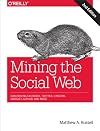
Mining the Social Web (2nd Edition) by Matthew A Russell is a book for a relatively small niche. Most users of the social web (Twitter, Facebook, etc) won't have the programming expertise to follow the technical details and most programmers won't be interested in the data which come from the social web. I'm still on the fringes of target audience set, with a long history of involvement in the social web and a decent grasp of Python. I have also recently been wanting to learn how to show more programmatically extract some data from Twitter; not full-scale mining but certainly a desire to dig below the surface.
I haven't tried and tested every snippet of information in the book. However, for the material where I did dig deeper (Twitter) it provided the keys I needed to unlock some of the barriers that had previously obstructed me. It is worth skimming through the whole book to soak in the wider concepts but, if you are interested in one or more of the social web gateways discussed and want to start exploring it programmatically, it gets both thumbs up. show less
I haven't tried and tested every snippet of information in the book. However, for the material where I did dig deeper (Twitter) it provided the keys I needed to unlock some of the barriers that had previously obstructed me. It is worth skimming through the whole book to soak in the wider concepts but, if you are interested in one or more of the social web gateways discussed and want to start exploring it programmatically, it gets both thumbs up. show less
 This review was written for LibraryThing Early Reviewers.
Mining the Social Web: Data Mining Facebook, Twitter, LinkedIn, Google , GitHub, and More by Matthew A. Russell
The social web is a phenomenon of our times when the web started to reflect our interactions and communications.
Who speaks to whom, who says what about what, how many people talk about what. Information that marketers want, the information underlying the altmetrics movement in academia, and it would appear, the various security agencies.
Mapping out interactions is not new, the Republic of Letters project did much the same by analysing the correspondence of eighteenth century savants, but it show more is both the scale of the social web and the complexities of the analyses made possible by cheap processing power.
This book covers the major social networks such as Twitter, LinkedIn, Facebook, and Google+, with an emphasis on Twitter. The author also discusses mailbox corpus creation and analysis, and the analysis of semantic web data, and also interestingly, GitHub as a social platform.
This book is not a book for the dilettante. More than half the text consists of Python code and the reader really needs to work with the code examples to gain full value from the book. The book also provides a rapid introduction to OAuth, and ranges over topics as diverse as simple text analysis, cluster analysis, natural language processing, and the use of applications such as MongoDB.
This is however a very good book for anyone seeking to work with the social web and would serve as a very useful primer or as a textbook for a module on data mining. The code examples are clear and nicely structured, making them easy to follow and work with. show less
Who speaks to whom, who says what about what, how many people talk about what. Information that marketers want, the information underlying the altmetrics movement in academia, and it would appear, the various security agencies.
Mapping out interactions is not new, the Republic of Letters project did much the same by analysing the correspondence of eighteenth century savants, but it show more is both the scale of the social web and the complexities of the analyses made possible by cheap processing power.
This book covers the major social networks such as Twitter, LinkedIn, Facebook, and Google+, with an emphasis on Twitter. The author also discusses mailbox corpus creation and analysis, and the analysis of semantic web data, and also interestingly, GitHub as a social platform.
This book is not a book for the dilettante. More than half the text consists of Python code and the reader really needs to work with the code examples to gain full value from the book. The book also provides a rapid introduction to OAuth, and ranges over topics as diverse as simple text analysis, cluster analysis, natural language processing, and the use of applications such as MongoDB.
This is however a very good book for anyone seeking to work with the social web and would serve as a very useful primer or as a textbook for a module on data mining. The code examples are clear and nicely structured, making them easy to follow and work with. show less
This review was written for LibraryThing Early Reviewers.Mining the Social Web: Data Mining Facebook, Twitter, LinkedIn, Google , GitHub, and More by Matthew A. Russell
This book covers the major social networks. The code is written in Python, which isn't my thing, but it is clear enough that it's easy to figure out what is being done so that the concepts transfer to another language. I myself was only interested in the Twitter content, but it's nice to know that with this book I have a starting reference to other social network platforms if ever I need them.
This review was written for LibraryThing Early Reviewers.Mining the Social Web: Analyzing Data from Facebook, Twitter, LinkedIn, and Other Social Media Sites by Matthew A. Russell
This book uses Python code to demonstrate the techniques of scraping popular social media sites, and then goes on to show what can be done with that data in bulk. There are additional notes about some principles of data mining and web technologies that add detail and value to the book. because it's an e-book, syntax coloring makes the sample code especially readable.
This review was written for LibraryThing Early Reviewers.You May Also Like


Statistics
- Works
- 6
- Members
- 252
- Popularity
- #90,784
- Rating
- 3.4
- Reviews
- 5
- ISBNs
- 28
- Languages
- 1
