
Peter Stone (10)
Author of The Luck of the Draw: The Role of Lotteries in Decision Making
For other authors named Peter Stone, see the disambiguation page.
About the Author
Peter Stone is an Assistant Professor of Political Science at Stanford University.
Works by Peter Stone
Tagged
Common Knowledge
There is no Common Knowledge data for this author yet. You can help.
Members
Reviews
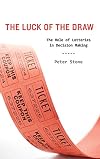
The author provides a thoughtful general analysis of decision by lottery. According to his lottery principle, a lottery is a defensible way of making a decision when it is important that bad reasons be kept out of the decision. This principle seems to be intuitively true and the first part of the book, where the author discusses what lotteries can do, is quite informative.
However, it doesn't take an entire book to enounce such a simple principle, so the author moves on to potential show more applications for lotteries: allocative justice in part II and political selection by lot (sortition) in part III. Part II in fact constitutes about half of the entire book. It focuses quite narrowly on moral political philosophy, going back and forth on how the lottery principle relates to theories of justice, John Rawls in particular. The author discusses questions which I imagine to be of interest only to professional philosophers.
Part III, which deals with sortition, is also a bit disappointing. The author basically just concedes that sortition is a more complex question than allocative justice. He then makes a few side-remarks but fails to discover any particularly meaningful problems. The concluding chapter of the book where he returns to the lottery principles itself was more interesting. I can recommend this book to readers interested in lottery and moral philosophy, but not to readers interested in sortition. show less
However, it doesn't take an entire book to enounce such a simple principle, so the author moves on to potential show more applications for lotteries: allocative justice in part II and political selection by lot (sortition) in part III. Part II in fact constitutes about half of the entire book. It focuses quite narrowly on moral political philosophy, going back and forth on how the lottery principle relates to theories of justice, John Rawls in particular. The author discusses questions which I imagine to be of interest only to professional philosophers.
Part III, which deals with sortition, is also a bit disappointing. The author basically just concedes that sortition is a more complex question than allocative justice. He then makes a few side-remarks but fails to discover any particularly meaningful problems. The concluding chapter of the book where he returns to the lottery principles itself was more interesting. I can recommend this book to readers interested in lottery and moral philosophy, but not to readers interested in sortition. show less
Statistics
- Works
- 2
- Members
- 10
- Popularity
- #908,815
- Rating
- 4.0
- Reviews
- 1
- ISBNs
- 163
- Languages
- 5