
Margaret L. Lial (1927–2012)
Author of Trigonometry
About the Author
Works by Margaret L. Lial
Essentials of College Algebra (10th Edition) (The Lial/Hornsby/Schneider College Algebra Series) (2006) 13 copies
Finite Mathematics and Calculus with Applications, Books a la Carte Edition (9th Edition) (2011) 9 copies
Trigonometry Plus NEW MyMathLab with Pearson eText -- Access Card Package (10th Edition) (Lial/Hornsby/Schneider/Daniels) (2012) 2 copies
Introductory and Intermediate Algebra Plus Pearson MyLabs Math with Pearson eText -- Access Card Package (6th Edition) (2017) 2 copies
Finite Mathematics with Applications In the Management, Natural, and Social Sciences (12th Edition) (2018) 2 copies
Intermediate Algebra, 3rd Printing, plus MyMathLab Student Access Kit (10th Edition) (2008) 2 copies
Algebra for College Students Value Pack (includes Algebra Review Study & MyMathLab/MyStatLab Student Access Kit ) (6th Edition) (2007) 2 copies
Finite Mathematics and Calculus with Applications Books a la Carte Plus MyMathLab Package (10th Edition) (2016) 1 copy
Finite Mathmatics 1 copy
Finite Mathematics, Books a la Carte Plus MyLab Math Access Card Package (11th Edition) (2015) 1 copy
Beginning Algebra, Vol. 2, 10th Edition (Custom Edition for Middlesex Community College) (2008) 1 copy
Mathematics with Applications In the Management, Natural, and Social Sciences, Books a la Carte (12th Edition) (2018) 1 copy
Finite Mathematics, Books a la Carte Plus MML/MSL Student Access Code Card (for ad hoc valuepacks) (10th Edition) (2011) 1 copy
Trigonometry, Books a la Carte Edition plus MyLab Math with Pearson eText -- Access Card Package (11th Edition) (2016) 1 copy
College Algebra and Trigonometry and Precalculus, 2nd edition, annotated instructor's edition, (2001) 1 copy
Essentials of College Algebra, Loose-Leaf Edition Plus MyLab Math with Pearson eText -- 18 Week Access Card Package (2019) 1 copy
Precalculus, Books a la Carte Edition plus MyLab Math with Pearson eText -- Access Card Package (6th Edition) (2016) 1 copy
Finite Mathematics with Applications In the Management, Natural, and Social Sciences - 11th Edition (3 copies) (2013) 1 copy
Student Solutions Manual to accompany College Algebra and Trigonometry and Precalculus (2nd Edition) (2000) 1 copy
Student's Solutions Manual for Calculus with Applications and Calculus with Applications, Brief Version (2016) 1 copy
College Algebra, Books a la Carte Edition plus MyLab Math with Pearson eText -- Access Card Package (12th Edition) (2016) 1 copy
Intermediate Algebra, Books a la Carte Edition, Plus Mylab Math -- Access Card Package (2015) 1 copy
College Algebra plus MyLab Math with Pearson eText -- Access Card Package (12th Edition) (2016) 1 copy
MyLab Math with Pearson eText -- Standalone Access Card -- for Prealgebra (6th Edition) (2017) 1 copy
MyLab Math with Pearson eText -- Standalone Access Card -- for Intermediate Algebra (11th Edition) (2017) 1 copy
Intermediate Algebra, Books a la Carte Plus MyLab Math -- Access Card Package (11th Edition) (2017) 1 copy
Developmental Mathematics: Basic Mathematics and Algebra Plus MyLab Math -- Title-Specific Access Card Package (4th Edition) (2017) 1 copy
Introductory & Intermediate Algebra with Integrated Review Plus MyMathLab -- Title-Specific Access Card Package (6th Edition) (2018) 1 copy
MyLab Math with Pearson eText -- Standalone Access Card -- for Introductory & Intermediate Algebra (6th Edition) (2017) 1 copy
Introductory Algebra, Books a la Carte Version Plus MyLab Math -- Access Card Package (11th Edition) (2017) 1 copy
Essential Mathematics CD-ROM 1 copy
Finite Mathematics and Calculus with Applications Books a la carte Edition (10th Edition) (2016) 1 copy
INTRODUCTORY ALGEBRA 1 copy
Tagged
Common Knowledge
- Canonical name
- Lial, Margaret L.
- Legal name
- Lial, Margaret Louise
- Birthdate
- 1927-03-22
- Date of death
- 2012-03-16
- Gender
- female
Members
Reviews
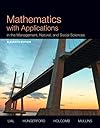
This is, in my opinion, the worst mathematics textbook at this level I have ever encountered. Basically, in stretching from Algebra I to Calculus I in less than 900 pages of main text, this tries to do too much. Here is a list of particular issues I have, which I stopped adding to less than half-way through:
- A serious lack of set theory basis, so that solving an equation is no different from solve for a variable. (There is no concept of solution set)
- Intercepts are treated as values, not show more points
- They encourage by example negative lead coefficients in denominators
- There is a missing introduction of basic functions leading to no clear development of transformations in graphing.
- The integrated My Math Lab material misleads students by not using parentheses in logarithms
- The modeling of exponential growth with P(t) = Pe^(rt) is artlessly handled so that the concept of r relating to percentage growth over unit of time is lost.
Commonly as with other texts of this content and era, intercepts are not required to be point notation and this confuses students later, says, with axis of symmetry. Value or linear equation?
The textbook author and integrated My Math Lab content does not sufficiently differentiate from natural base e or other base models. In a specific problem, both natural base and calculated base should be accepted but they are not. e as a base could be the first pass by a student
reading page 193 of the book. The base-e solution is not accepted. (Also four decimals of accuracy is unnecessary. Three would be better. Specifically, three decimals makes it easier to point students to various online calculators when they don't have a TI or equivalent. Basically, it would be best to use this book only when TI-83 or -84 is required) show less
- A serious lack of set theory basis, so that solving an equation is no different from solve for a variable. (There is no concept of solution set)
- Intercepts are treated as values, not show more points
- They encourage by example negative lead coefficients in denominators
- There is a missing introduction of basic functions leading to no clear development of transformations in graphing.
- The integrated My Math Lab material misleads students by not using parentheses in logarithms
- The modeling of exponential growth with P(t) = Pe^(rt) is artlessly handled so that the concept of r relating to percentage growth over unit of time is lost.
Commonly as with other texts of this content and era, intercepts are not required to be point notation and this confuses students later, says, with axis of symmetry. Value or linear equation?
The textbook author and integrated My Math Lab content does not sufficiently differentiate from natural base e or other base models. In a specific problem, both natural base and calculated base should be accepted but they are not. e as a base could be the first pass by a student
reading page 193 of the book. The base-e solution is not accepted. (Also four decimals of accuracy is unnecessary. Three would be better. Specifically, three decimals makes it easier to point students to various online calculators when they don't have a TI or equivalent. Basically, it would be best to use this book only when TI-83 or -84 is required) show less
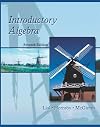
Been a while since that high school algebra class? And now you're up against a college admission exam or a math placement exam and need a refresher? This book is structured so that it can be used in a classroom setting or as a book for individual, self-paced study. The text begins with real numbers and goes through quadratic equations, or roughly the equivalent of a junior high or high school Algebra I class. It's easy to use, easy to learn from, and each module builds upon the last.
But if show more you have a math whiz kid in the family, hide the book. They seem to find it quite funny that Mom at 40-something is struggling to relearn the algebra that they mastered in their sleep! :-) show less
But if show more you have a math whiz kid in the family, hide the book. They seem to find it quite funny that Mom at 40-something is struggling to relearn the algebra that they mastered in their sleep! :-) show less
easy to understand basic calculations but not to the level of a student at 9th grade.

I took trigonometry this year and my boyfriend gave me this book. It was very helpful.
You May Also Like


Associated Authors
Statistics
- Works
- 186
- Members
- 1,369
- Popularity
- #18,785
- Rating
- 2.8
- Reviews
- 8
- ISBNs
- 541