

Richard Davies (11)
Author of Extreme Economies: 9 Lessons from the World’s Limits
For other authors named Richard Davies, see the disambiguation page.
Works by Richard Davies
Extreme Economies: What Life at the World's Margins Can Teach Us About Our Own Future (2020) 50 copies, 1 review
Tagged
Common Knowledge
- Gender
- male
Members
Reviews
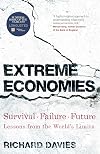
Economics books are frequently dry. This one is not. Richard Davies, the former economics editor of The Economist, surveys 9 economies that have or are experiencing extreme stressors to see what we can learn about markets. The case studies are fascinating, both in general and in the details (want to learn about prison currencies or how refugees subvert cashless economies?)
Davies believes in the concept of markets in general--and he takes obvious delight in the way refugees and prisoners show more thwart attempts to stop markets for necessities--but he is not doctrinaire. Markets can fail, and less regulation is not more. The running theme is that while governments can misregulate the market, government also has the power to develop and support it. In Kinshasa, the market fails because the state is corrupt and lacks trust, leading to a cycle of corruption and weakness. In Glasgow, social capital was destroyed, leading to worse outcomes for its people than in other de-industrializing cities.
In Santiago, meanwhile, slavish devotion to Chicago economics has lowered absolute poverty, but has caused skyrocketing inequality, and its voucherized education system is a shambles. (It's worth noting that since the book was completed, major protests have rocked Santiago, and economic reforms have been promised.)
The book definitely reads like an Economist writer wrote it, but is none the worse for it.
If I were to offer any criticisms, it's that he ignores an element in Japan's aging: the birth rate has plummeted, in part because of ingrained sexism and poor support for families. Japanese women have responded to this incentive by not having children. Also, while he tempers his enthusiasm for technology in the section on Tallinn, he still comes off as a bit of a booster who's a little too quick to wave off job losses or the potential for misuse of technology. If I could give this 4.5 I would, but it was too enjoyable to round down. show less
Davies believes in the concept of markets in general--and he takes obvious delight in the way refugees and prisoners show more thwart attempts to stop markets for necessities--but he is not doctrinaire. Markets can fail, and less regulation is not more. The running theme is that while governments can misregulate the market, government also has the power to develop and support it. In Kinshasa, the market fails because the state is corrupt and lacks trust, leading to a cycle of corruption and weakness. In Glasgow, social capital was destroyed, leading to worse outcomes for its people than in other de-industrializing cities.
In Santiago, meanwhile, slavish devotion to Chicago economics has lowered absolute poverty, but has caused skyrocketing inequality, and its voucherized education system is a shambles. (It's worth noting that since the book was completed, major protests have rocked Santiago, and economic reforms have been promised.)
The book definitely reads like an Economist writer wrote it, but is none the worse for it.
If I were to offer any criticisms, it's that he ignores an element in Japan's aging: the birth rate has plummeted, in part because of ingrained sexism and poor support for families. Japanese women have responded to this incentive by not having children. Also, while he tempers his enthusiasm for technology in the section on Tallinn, he still comes off as a bit of a booster who's a little too quick to wave off job losses or the potential for misuse of technology. If I could give this 4.5 I would, but it was too enjoyable to round down. show less
Extreme Economies: What Life at the World's Margins Can Teach Us About Our Own Future by Richard Davies
I'm not sure that I am convinced by Davies's thesis that studying extreme economies is useful for understanding and developing policies for the rest of the world. Davies doesn't go into enough detail to seriously argue this.
However, I really enjoyed this book as a hybrid between economics and travel. Much like visiting a market in a foreign country can teach you a lot about the local culture, by looking through the economic lens, Davies reveals some fascinating details that are not apparent show more to the unaided eye. It is certainly a unique twist on the travelogue.
The last chapters, on aging in Japan, technology in Estonia, and inequality in Chile, are the weakest. (The first two are too generic and familiar, while good argument about education in Chile is not laid out with sufficient detail to be convincing.) But I did like the summary at the end. The book is probably also a decent introduction to economics, as Davies goes out of his way to highlight and explain many of the basic concepts.
> Tax is collected at least once a day in Kinshasa, and many areas have both a morning and an afternoon tax. The rate is high – officially 54 per cent of profits – but what really hurts are all the extra undocumented payments. A restaurateur who runs a cafe and supermarket explains: "Every day I pay tax, and I must pay a bribe in exchange for a receipt for the tax I have just paid, and then I am forced to offer a 'bon prix' on the tax official’s lunch."
> People hold both dollars and francs in their wallets: the dollar to store value over time, and francs for small daily transactions. When shoppers go to the market or a restaurant, for example, they first stop to buy some francs from the exchange trader who will be sitting outside.
> Kinshasa destroys the notion that free markets naturally bounce back or have some self-righting property – a town, city or country can get stuck in a rut and stay there. The result is a megacity with the infrastructure of a village. Home to 10 million people and located on the bank of the world’s most reliable river, it lacks clean water, irrigation and proper sewerage
> Glasgow is an extreme economy because no other city in the twentieth century experienced a decline as severe. To see this, consider the highs and lows. In the late nineteenth century Glasgow was seen as the "Second City of Empire", and in many ways began to outpace the UK’s capital, leading London in art, design and architecture as well as engineering, innovation and trade. Some even referred to it as a "modern Rome". Yet a century later, shipping was gone, unemployment rife and in Calton, a Glaswegian suburb, male life expectancy was just 54. show less
However, I really enjoyed this book as a hybrid between economics and travel. Much like visiting a market in a foreign country can teach you a lot about the local culture, by looking through the economic lens, Davies reveals some fascinating details that are not apparent show more to the unaided eye. It is certainly a unique twist on the travelogue.
The last chapters, on aging in Japan, technology in Estonia, and inequality in Chile, are the weakest. (The first two are too generic and familiar, while good argument about education in Chile is not laid out with sufficient detail to be convincing.) But I did like the summary at the end. The book is probably also a decent introduction to economics, as Davies goes out of his way to highlight and explain many of the basic concepts.
> Tax is collected at least once a day in Kinshasa, and many areas have both a morning and an afternoon tax. The rate is high – officially 54 per cent of profits – but what really hurts are all the extra undocumented payments. A restaurateur who runs a cafe and supermarket explains: "Every day I pay tax, and I must pay a bribe in exchange for a receipt for the tax I have just paid, and then I am forced to offer a 'bon prix' on the tax official’s lunch."
> People hold both dollars and francs in their wallets: the dollar to store value over time, and francs for small daily transactions. When shoppers go to the market or a restaurant, for example, they first stop to buy some francs from the exchange trader who will be sitting outside.
> Kinshasa destroys the notion that free markets naturally bounce back or have some self-righting property – a town, city or country can get stuck in a rut and stay there. The result is a megacity with the infrastructure of a village. Home to 10 million people and located on the bank of the world’s most reliable river, it lacks clean water, irrigation and proper sewerage
> Glasgow is an extreme economy because no other city in the twentieth century experienced a decline as severe. To see this, consider the highs and lows. In the late nineteenth century Glasgow was seen as the "Second City of Empire", and in many ways began to outpace the UK’s capital, leading London in art, design and architecture as well as engineering, innovation and trade. Some even referred to it as a "modern Rome". Yet a century later, shipping was gone, unemployment rife and in Calton, a Glaswegian suburb, male life expectancy was just 54. show less
Lists
Awards

Statistics
- Works
- 2
- Members
- 102
- Popularity
- #187,250
- Rating
- 4.2
- Reviews
- 2
- ISBNs
- 47
- Languages
- 3