
Martin Clayton (2)
Author of The Cultural Study of Music: A Critical Introduction
For other authors named Martin Clayton, see the disambiguation page.
Works by Martin Clayton
Time in Indian Music: Rhythm, Metre, and Form in North Indian Rag Performance (2000) 16 copies, 2 reviews
Tagged
Common Knowledge
- Gender
- male
- Education
- School of Oriental and African Studies, University of London (B.A.|1988|Ph.D|1993)
- Occupations
- professor
ethnomusicologist - Organizations
- Durham University
- Nationality
- UK
- Associated Place (for map)
- UK
Members
Reviews
Time in Indian Music: Rhythm, Metre, and Form in North Indian Rag Performance (Oxford Monographs on Music) by Martin Clayton
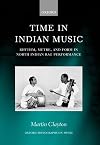
This is perhaps the fourth or fifth time I have attempted this book, and the first time I managed to read it through to the end. I approached this work with great expectations of finally understanding how tal (rhythm) and voice interacted in Hindustani music, from a fresh and hopefully systematic Western methodology. Alas, I cannot say it worked. From the first chapter, there seems to be a welter of musicological terms whose precise meaning is difficult to make out, such as rhythm, surface show more rhythm, metre, beat, accent, pulse, and variations and combinations with other words; and then an equally profuse set of terms from the Hindustani side. I do not think the book convincingly sorts out the precise meaning of each of the terms, and how they interact; nor is the reader left with a better understanding of how these work with the voice or raga in Hindustani performances. Perhaps the really useful pieces are the list of tal types which gives a ready reckoner of their 'theka' or basic pattern of strokes, in Example 5.1, and a Venn diagram in Example 12.1 showing 'rhythm' as the enveloping category, inside which are nested 'pulse', 'periodicity', and 'metre' in descending order of hierarchy. However, the author's strenuous attempts to correlate Western terminology with the Hindustani tradition seem only to complicate our understanding; it may have been more effective if it had been developed as a straightforward description of the Hindustani concepts and 'theory', without trying to correlate with the Western, or trying to demonstrate some obscure 'hypothesis' of the author (e.g., instrumental styles are influenced by the vocal, but only to a partial extent, which seems to me to be pretty self-evident). show less
Reviewed by Richard K. Wolf in Asian Music 34/2 (Spring/Summer 2003), 133-139.

Reviewed by Ben Krakauer in Asian Music 45/2 (Summer/Fall 2014). DOI: 10.1353/amu.2014.0005
Lists
culture (1)
You May Also Like
Associated Authors
Statistics
- Works
- 6
- Members
- 102
- Popularity
- #187,250
- Rating
- 2.8
- Reviews
- 3
- ISBNs
- 60
- Languages
- 3