
Hugh Craig (1)
Author of Style, computers, and early modern drama : beyond authorship
For other authors named Hugh Craig, see the disambiguation page.
Works by Hugh Craig
Associated Works
Tagged
Common Knowledge
- Legal name
- Craig, David Hugh
- Other names
- Craig, D. H.
Members
Reviews
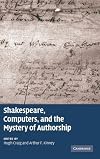
Review: Shakespeare, Computers, and the Mystery of Authorship Edited by Hugh Craig and Arthur F. Kinney; 2009, Cambridge University Press, 234 pp. graphs, glossary of terms, index.
________________________
The key points in the book considered here, both good and bad, can be explained in only a page or two. The authors, Professor Hugh Craig and Professor Arthur F. Kinney, start from entirely reasonable premises which follow the same basic principles used intuitively and without the aid of show more computers for well more than fifty years by other analysts of Early Modern English texts. A notable example is Caroline Spurgeon's work in Shakespeare's Imagery and It Tells Us, (1935) where she wrote,
Professors Craig and Kinney put it this way:
The rest of the text is devoted to showing that this is in fact the case. Properly applied, the principles can indeed reveal what seems to be compelling evidence of reliably distinguishing the provenance of two or more authors' texts—even, it should be stressed, when the author of a text is not known at all or is by an author who is one among a number of disputed candidates.
So much for the valid part of this work.
Unfortunately, the authors take and apply these valid principles in an attempt to support, by implication, other prior and utterly preposterous claims that have nothing more than dodgy folkloric traditions underpinning them—and one or both of the authors seem to believe that, because their analysis is based on computer-driven statistical programs which sort and compare vast sets of Early Modern English texts, their extended thesis is also no less adequately founded than the primary principle as stated above. For they state, emphatically, “...the core purpose of the study, the defining of Shakespearean authorship.” (emphasis added). Specifically, they “hope to bring a similar level of confidence to the question of the Shakespearean authorship of Edward III; Arden of Faversham; the Additions to The Spanish Tragedy; the Hand-D Addition to Sit Thomas More; Edmond Ironside; the Folio King Lear ; and Henry VI, Parts 1 and 2 .” (p. xvii)
But “computational stylistics” or the computer-aided mining of sets of texts for statistical comparisons and contrasts of the frequency of usage of terms and phrases and tell-tale punctuation forms cannot, by itself, make an author out of someone who was never able to read or write in the first place—no matter how vast may be the data-sets. This problem is never directly addressed as far as I can tell; apart from a brief passing parenthetical mention of the potential theoretical weaknesses, when they write, “The question of whether we have made the right judgments in choosing among the possible procedures, and in setting various parameters, is quite another matter" (p. xviii) (emphasis added) it is left behind in the dust. But, indeed, the question of whether the authors have made the right judgments in choosing among the possible procedures, and in setting various parameters, is not only quite another matter, it is practically the central and key matter. Within “setting various parameters,” the authors have blithely included as their presupposition a fiercely disputed claim: that Shaksper of Stratford on Avon is correctly identified as having been the true and rightful author of the texts usually attributed to an author we refer to as “William Shakespeare”, variously spelled. For Shaksper's ability to read and write at all is still disputed and there is no good evidence to support it.
In taking Shaksper of Stratford as the presupposed rightful author of “William Shakespeare's” works, professors Craig and Kinney demonstrate that the amazing analytical power of cutting-edge computer technology is no proof against preposterous nonsense—as though that were not quite obvious anyway. The authors here have failed to take adequate account of the dangers and risks of what, in the realm of computer data-collection and analysis, goes by the phrase, “garbage-in, garbage-out.” By that failing, they've reduced sound and valid principles according to which an author's personality is typically revealed in his or her texts to what is, in the case of indentifying Shaksper of Stratford as a writer, virtual junk-status. For, while it is indeed interesting if, for example, Edward III was the product of a collaborative effort, making William Shaksper of Stratford-upon-Avon one of the collaborators is nothing but computer-aided foolishness.
_________________________
(Professor Hugh Craig did not respond to an e-mail query seeking some clarifications of his views.) show less
________________________
The key points in the book considered here, both good and bad, can be explained in only a page or two. The authors, Professor Hugh Craig and Professor Arthur F. Kinney, start from entirely reasonable premises which follow the same basic principles used intuitively and without the aid of show more computers for well more than fifty years by other analysts of Early Modern English texts. A notable example is Caroline Spurgeon's work in Shakespeare's Imagery and It Tells Us, (1935) where she wrote,
“I believe it to be profoundly true that the real revelation
of the writer's personality, temperament and quality of
mind is to found in his works, whether he be dramatist or
novelist, describing other people's thoughts or putting down
his own.
“In the case of a poet, I suggest that it is chiefly through his
images that he, to some extent unconsciously, 'gives himself
away.'” (p. 4)
Professors Craig and Kinney put it this way:
“Computational stylistics offers abundant evidence that
writers leave subtle and persistent traces of a distinctive
style through all levels of their syntax and lexis. This
brings to the fore a central paradox of language. Speakers
and writers share the words they use in a given language.
They could not communicate otherwise. Yet from that
common set speakers and writers make individual selections
that persist across all their uses of the language. They create
a personal and identifiable style from within the common
language. Computational analysis reveals the richness of
this variation within the dialogue of Shakespeare and his
contemporaries.” ( p. xvi)
The rest of the text is devoted to showing that this is in fact the case. Properly applied, the principles can indeed reveal what seems to be compelling evidence of reliably distinguishing the provenance of two or more authors' texts—even, it should be stressed, when the author of a text is not known at all or is by an author who is one among a number of disputed candidates.
So much for the valid part of this work.
Unfortunately, the authors take and apply these valid principles in an attempt to support, by implication, other prior and utterly preposterous claims that have nothing more than dodgy folkloric traditions underpinning them—and one or both of the authors seem to believe that, because their analysis is based on computer-driven statistical programs which sort and compare vast sets of Early Modern English texts, their extended thesis is also no less adequately founded than the primary principle as stated above. For they state, emphatically, “...the core purpose of the study, the defining of Shakespearean authorship.” (emphasis added). Specifically, they “hope to bring a similar level of confidence to the question of the Shakespearean authorship of Edward III; Arden of Faversham; the Additions to The Spanish Tragedy; the Hand-D Addition to Sit Thomas More; Edmond Ironside; the Folio King Lear ; and Henry VI, Parts 1 and 2 .” (p. xvii)
But “computational stylistics” or the computer-aided mining of sets of texts for statistical comparisons and contrasts of the frequency of usage of terms and phrases and tell-tale punctuation forms cannot, by itself, make an author out of someone who was never able to read or write in the first place—no matter how vast may be the data-sets. This problem is never directly addressed as far as I can tell; apart from a brief passing parenthetical mention of the potential theoretical weaknesses, when they write, “The question of whether we have made the right judgments in choosing among the possible procedures, and in setting various parameters, is quite another matter" (p. xviii) (emphasis added) it is left behind in the dust. But, indeed, the question of whether the authors have made the right judgments in choosing among the possible procedures, and in setting various parameters, is not only quite another matter, it is practically the central and key matter. Within “setting various parameters,” the authors have blithely included as their presupposition a fiercely disputed claim: that Shaksper of Stratford on Avon is correctly identified as having been the true and rightful author of the texts usually attributed to an author we refer to as “William Shakespeare”, variously spelled. For Shaksper's ability to read and write at all is still disputed and there is no good evidence to support it.
In taking Shaksper of Stratford as the presupposed rightful author of “William Shakespeare's” works, professors Craig and Kinney demonstrate that the amazing analytical power of cutting-edge computer technology is no proof against preposterous nonsense—as though that were not quite obvious anyway. The authors here have failed to take adequate account of the dangers and risks of what, in the realm of computer data-collection and analysis, goes by the phrase, “garbage-in, garbage-out.” By that failing, they've reduced sound and valid principles according to which an author's personality is typically revealed in his or her texts to what is, in the case of indentifying Shaksper of Stratford as a writer, virtual junk-status. For, while it is indeed interesting if, for example, Edward III was the product of a collaborative effort, making William Shaksper of Stratford-upon-Avon one of the collaborators is nothing but computer-aided foolishness.
_________________________
(Professor Hugh Craig did not respond to an e-mail query seeking some clarifications of his views.) show less
You May Also Like
Associated Authors
Statistics
- Works
- 2
- Also by
- 2
- Members
- 11
- Popularity
- #857,861
- Rating
- 4.0
- Reviews
- 1
- ISBNs
- 9