
Sean. Callery
Author of Scholastic Discover More: Titanic
Sean. Callery is Sean Callery (2). For other authors named Sean Callery, see the disambiguation page.
Series
Works by Sean. Callery
Rocks, Minerals, and Gems: The Definitive Visual Catalog of the Treasure Beneath Your Feet (2016) 331 copies, 1 review
The Magic School Bus Presents: Wild Weather: A Nonfiction Companion to the Original Magic School Bus Series (2014) 194 copies
I Wonder Why There's a Hole in the Sky and Other Questions About the Environment (2008) 90 copies, 1 review
Extreme Lights Out 1 copy
Tagged
Common Knowledge
There is no Common Knowledge data for this author yet. You can help.
Members
Reviews

Like the analogously named books about World War I and World War II, inter alia, this small book on the Titanic is replete with excellent pictures, entertaining fact-boxes, and reader-friendly infographics. Sean Callery is a journalist and teacher who has written about the Titanic before, and here contributes to the “50 Things” series with an excellent, photo-filled history.
The Titanic was the largest ocean liner ever made when it was built in 1912. It sank early on the morning of April show more 15, 1912 on its maiden voyage, however, after colliding with an iceberg on the way from Southampton on the south coast of England, to New York City.
Disasters always capture our imaginations. Andrew O’Connell, an editor with the Harvard Business Review Group, has written about the phenomenon, and summarized our fixation in an interview:
“Well, disaster stories are great. . . . you always want to know how they’re going to end, you know, what’s going to happen. But even more than that, they’re really great to read because you put yourself in the place of the person who’s been lost in the woods, or knocked overboard, or whatever it is. And you think . . would I be able to survive that, would I have the grit, or would have the strength. But even more is the question of, would I be able to make some of those difficult choices that people in disasters often have to make. And the moral stakes, if they’re really high, they can make a story incredibly gripping.”
For these reasons and more, few people don’t find the story of the Titanic fascinating. The Washington Post reported in 2012:
"There are more than 100 Titanic-related museums and monuments worldwide, and on March 31 [2012], Belfast added another to the list, unveiling a $150 million tourist center on the slipway where the Titanic was built from 1909 to 1911."
More than 1500 people lost their lives in the disaster.
The wreckage was not discovered until late 1985. Since then thousands of objects have been retrieved and studied.
The author puts the tragedy in context by including background on the state of transportation and technology at the time, and on the demand for transatlantic voyages by both emigrants and by wealthy vacationers.
He reviews the process of constructing the Titanic and explains how it was powered - it used 750 tons of coal a day!
He also provides an overview on who the passengers were, especially interesting because of the cost of the trip. There were 2,223 people on board the ship. A first-class ticket (of which 325 were sold) cost 870 pounds, the equivalent of about $100,000 today. Some of these passengers brought their own staff along as well. There were also 284 second-class passengers who paid approximately $585 in today’s dollars, and the rest, 708 people, were in third class, or “steerage,” for which they paid around $365 each. These third-class passengers came from at least 20 countries, and many did not speak English. They were confined below behind locked gates with armed guards, and permitted on deck for only one hour a day. Third-class passengers also shared only two bathrooms, one for men and one for women. Additionally, there were 891 crew members.
The author lists some of the cargo the ship was carrying, including 3,000 bags of mail, 12 cases of ostrich feathers for fancy hats, 79 goats’ skins, and even a car, belonging to a first-class passenger. Callery explains how the passengers passed the time and what they ate (for example, the ship carried 40,000 eggs). (You can see more on a list of interesting facts about the Titanic here.)
The topic of icebergs is also given coverage.
Some of the better-known passengers are profiled in a “Who’s Who” at the end of the book. A glossary is also at the back.
Evaluation: There is good reason for the continuing popularity of books and television series and movies about the Titanic - the disaster aspect, the shipwreck angle, the class conflicts, the famous people aboard, and the romances, to name a few. Titanic, the 1997 American epic romance-disaster film starring Leonardo DiCaprio and Kate Winslet was the first film to reach the billion-dollar mark, remaining the highest-grossing film of all time until 2010. Before that, the 1955 book A Night to Remember about the disaster was, and still is, hugely successful.
The author of “50 Things” found many ways to include engrossing aspects of this subject, and all the photographs add immeasurably to the story. There are many more gripping aspects of what happened that could not be included in this short format, so it will undoubtedly inspire readers to dig deeper. At minimum, I don’t think anyone is going to be bored by the history lessons in this book. show less
The Titanic was the largest ocean liner ever made when it was built in 1912. It sank early on the morning of April show more 15, 1912 on its maiden voyage, however, after colliding with an iceberg on the way from Southampton on the south coast of England, to New York City.
Disasters always capture our imaginations. Andrew O’Connell, an editor with the Harvard Business Review Group, has written about the phenomenon, and summarized our fixation in an interview:
“Well, disaster stories are great. . . . you always want to know how they’re going to end, you know, what’s going to happen. But even more than that, they’re really great to read because you put yourself in the place of the person who’s been lost in the woods, or knocked overboard, or whatever it is. And you think . . would I be able to survive that, would I have the grit, or would have the strength. But even more is the question of, would I be able to make some of those difficult choices that people in disasters often have to make. And the moral stakes, if they’re really high, they can make a story incredibly gripping.”
For these reasons and more, few people don’t find the story of the Titanic fascinating. The Washington Post reported in 2012:
"There are more than 100 Titanic-related museums and monuments worldwide, and on March 31 [2012], Belfast added another to the list, unveiling a $150 million tourist center on the slipway where the Titanic was built from 1909 to 1911."
More than 1500 people lost their lives in the disaster.
The wreckage was not discovered until late 1985. Since then thousands of objects have been retrieved and studied.
The author puts the tragedy in context by including background on the state of transportation and technology at the time, and on the demand for transatlantic voyages by both emigrants and by wealthy vacationers.
He reviews the process of constructing the Titanic and explains how it was powered - it used 750 tons of coal a day!
He also provides an overview on who the passengers were, especially interesting because of the cost of the trip. There were 2,223 people on board the ship. A first-class ticket (of which 325 were sold) cost 870 pounds, the equivalent of about $100,000 today. Some of these passengers brought their own staff along as well. There were also 284 second-class passengers who paid approximately $585 in today’s dollars, and the rest, 708 people, were in third class, or “steerage,” for which they paid around $365 each. These third-class passengers came from at least 20 countries, and many did not speak English. They were confined below behind locked gates with armed guards, and permitted on deck for only one hour a day. Third-class passengers also shared only two bathrooms, one for men and one for women. Additionally, there were 891 crew members.
The author lists some of the cargo the ship was carrying, including 3,000 bags of mail, 12 cases of ostrich feathers for fancy hats, 79 goats’ skins, and even a car, belonging to a first-class passenger. Callery explains how the passengers passed the time and what they ate (for example, the ship carried 40,000 eggs). (You can see more on a list of interesting facts about the Titanic here.)
The topic of icebergs is also given coverage.
Some of the better-known passengers are profiled in a “Who’s Who” at the end of the book. A glossary is also at the back.
Evaluation: There is good reason for the continuing popularity of books and television series and movies about the Titanic - the disaster aspect, the shipwreck angle, the class conflicts, the famous people aboard, and the romances, to name a few. Titanic, the 1997 American epic romance-disaster film starring Leonardo DiCaprio and Kate Winslet was the first film to reach the billion-dollar mark, remaining the highest-grossing film of all time until 2010. Before that, the 1955 book A Night to Remember about the disaster was, and still is, hugely successful.
The author of “50 Things” found many ways to include engrossing aspects of this subject, and all the photographs add immeasurably to the story. There are many more gripping aspects of what happened that could not be included in this short format, so it will undoubtedly inspire readers to dig deeper. At minimum, I don’t think anyone is going to be bored by the history lessons in this book. show less
My first grade son came home with this book from his school library, but he only spent a few minutes thumbing through it. There are plenty of pictures that grabbed his attention, like the diagram of a submarine or the entire full page spread of guns used during WWII. Most of the pages have pictures of people or places that did not excite a seven year old.
On the other hand, if you do commit to reading every word on the page and there are plenty for a picture book, then I would bet you will show more learn something new about this era or war. I would recommend this book for older elementary students to high school. This book is packed with facts. It could be a useful reference tool or a great way to refresh your WWII trivia facts. Overall I enjoyed it as an adult reader, but don't recommend it for younger children/students. show less
On the other hand, if you do commit to reading every word on the page and there are plenty for a picture book, then I would bet you will show more learn something new about this era or war. I would recommend this book for older elementary students to high school. This book is packed with facts. It could be a useful reference tool or a great way to refresh your WWII trivia facts. Overall I enjoyed it as an adult reader, but don't recommend it for younger children/students. show less
This book gives brief explanations about issues regarding our planet. It also gives solutions to help make it better.
This is a great book for 5-8 year olds. It gives just the right amount of detail and explains the issues so they can understand.
This would be a great book to use with a unit over the earth. It would also a great way to get the children thinking about how they can help the earth.
This is a great book for 5-8 year olds. It gives just the right amount of detail and explains the issues so they can understand.
This would be a great book to use with a unit over the earth. It would also a great way to get the children thinking about how they can help the earth.
World War II A visual history of the world’s darkest days by Sean Callery is appropriate for all grade levels. The focus of the book is WWII. The scope of the book is from the path leading to the war to the post war era. The book is surprisingly in-depth for a picture book. While, it contains a lot of pictures it also contains a considerable amount of information as well. It covers not just the battles but also: the home front, the technology and weaponry, POW’s, the Holocaust and a show more variety of other topics associated with the war. Given the depth of the book, the focus and scope seem reasonable.
As to the organization of the book, it is divided into 5 sections. The sections have subsections and both have headings. The sections are: what led to the war, the European theater, the pacific theater, the African and middle eastern theater, lastly the end of the war and the post war era in that order. The three middle sections overlap in terms of time but there is a partial chronology in terms of the sections as well as a topical organization. The sections themselves are largely organized chronologically and topically too. Each section is framed with essential questions like: what was life like for wartime refugees ? and why did some Jewish families go into hiding? Most sections the information is presented as a timeline with pictures and text. I think this would be a good book to use in lessons on WWII but especially as an introduction for a class timeline project.
As to the format, there is a table of contents, an index and even a glossary of key terms the reader may be unfamiliar with. The table of contents has the sections and subsections listed the titles are very succinct, explicit and focused. The index is rather short but still very useful in directing the reader in their search of key topics. The glossary while also short covers those terms the reader might not be able to figure from context. The words are bolded which helps the reader to find them but there is no pronunciation guide which I feel is a flaw as some of the words are not English. The text size is reasonable that the reader should have no difficulty. There were end pages but they have very limited information so they don’t really contribute much to the book which I think is also a flaw.
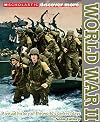
As to the visual display, the book is large. The cover is of soldiers disembarking from boats into the ocean. It is an intriguing and dynamic image which I think would invite readers to peruse this book. There is inserted information both pictures and text between sections and subsections. There are a number of side bars throughout the book which give additional information about the topic under discussion, they are usually interesting. As this is a visual history book there are a lot of photographs, illustrations and diagrams. The text in the book all have some visual image associated with them. There are also some tables with relevant information, they are clearly organized and add some scope to the associated material. There is a map showing the theatres of war but I feel that it would have been more informative if there were additional maps with more detail. However, overall this book is very visually appealing.
As to the style of the book, it is clearly organized. The language is more appropriate for secondary students though many of the passages would be readily understood by elementary students. The language of the book is very descriptive. It is in some instances very concise. In others instances it is vivid and emotionally evoking. It varies depending on the passage. The tone of the book is conversational. There is some expectation that the reader is at least somewhat familiar with the basics of WWII history but not so much that someone new to the topic could not follow along.
I believe the book is fairly accurate; there were several consultants on the book . Foremost was Terry Charman Senior Historian of the Imperial War Museum, London. Despite the author’s limited qualifications, he has written several books for children and teaches elementary school, according to www.seancallery.co.uk. Consequently, I feel he has some authority. The publication date is this year so the information is likely up to date with current scholarship. The book seems fairly objective presenting the material without making judgments. The book presents facts not opinions. There is no attempt to sway the reader to some viewpoint or other. The only concern I have is sources, while the visuals are sourced, other than listing the consultants, there are no sources listed for the textual information. I know the book is fairly accurate based on my own knowledge of WWII history. Someone else less familiar with the subject would have little more than that it was published by Scholastic, which suggest but does not guarantee creditability, to go by.
I am familiar with a good deal of the topics in this book and none of that material is made up. Consequently, I would assume this holds true for the other information in the book. That being said, it is a non-fiction book not a blended book so I would say there is no made up material. There is a good deal of information covering a wide range of topics within the scope of WWII. The structure is reasonably complex as there are layers to the organization. There is a little amount of narrative text, the text is largely expository. The book does use diction as a literary device fairly often. There is an invisible author’s voice which is fairly strong in the text. As this is a visual history there is an abundant amount of visual material.
I really liked this book. It covered a wide range of topics associated with WWII. The information was sufficiently in-depth given the large scope. It was logically organized and easily understandable for a young reader to follow but complex and detailed enough to engage an older reader. My main misgiving is the lack of sources. However, even with that I would recommend this book. show less
As to the organization of the book, it is divided into 5 sections. The sections have subsections and both have headings. The sections are: what led to the war, the European theater, the pacific theater, the African and middle eastern theater, lastly the end of the war and the post war era in that order. The three middle sections overlap in terms of time but there is a partial chronology in terms of the sections as well as a topical organization. The sections themselves are largely organized chronologically and topically too. Each section is framed with essential questions like: what was life like for wartime refugees ? and why did some Jewish families go into hiding? Most sections the information is presented as a timeline with pictures and text. I think this would be a good book to use in lessons on WWII but especially as an introduction for a class timeline project.
As to the format, there is a table of contents, an index and even a glossary of key terms the reader may be unfamiliar with. The table of contents has the sections and subsections listed the titles are very succinct, explicit and focused. The index is rather short but still very useful in directing the reader in their search of key topics. The glossary while also short covers those terms the reader might not be able to figure from context. The words are bolded which helps the reader to find them but there is no pronunciation guide which I feel is a flaw as some of the words are not English. The text size is reasonable that the reader should have no difficulty. There were end pages but they have very limited information so they don’t really contribute much to the book which I think is also a flaw.
As to the visual display, the book is large. The cover is of soldiers disembarking from boats into the ocean. It is an intriguing and dynamic image which I think would invite readers to peruse this book. There is inserted information both pictures and text between sections and subsections. There are a number of side bars throughout the book which give additional information about the topic under discussion, they are usually interesting. As this is a visual history book there are a lot of photographs, illustrations and diagrams. The text in the book all have some visual image associated with them. There are also some tables with relevant information, they are clearly organized and add some scope to the associated material. There is a map showing the theatres of war but I feel that it would have been more informative if there were additional maps with more detail. However, overall this book is very visually appealing.
As to the style of the book, it is clearly organized. The language is more appropriate for secondary students though many of the passages would be readily understood by elementary students. The language of the book is very descriptive. It is in some instances very concise. In others instances it is vivid and emotionally evoking. It varies depending on the passage. The tone of the book is conversational. There is some expectation that the reader is at least somewhat familiar with the basics of WWII history but not so much that someone new to the topic could not follow along.
I believe the book is fairly accurate; there were several consultants on the book . Foremost was Terry Charman Senior Historian of the Imperial War Museum, London. Despite the author’s limited qualifications, he has written several books for children and teaches elementary school, according to www.seancallery.co.uk. Consequently, I feel he has some authority. The publication date is this year so the information is likely up to date with current scholarship. The book seems fairly objective presenting the material without making judgments. The book presents facts not opinions. There is no attempt to sway the reader to some viewpoint or other. The only concern I have is sources, while the visuals are sourced, other than listing the consultants, there are no sources listed for the textual information. I know the book is fairly accurate based on my own knowledge of WWII history. Someone else less familiar with the subject would have little more than that it was published by Scholastic, which suggest but does not guarantee creditability, to go by.
I am familiar with a good deal of the topics in this book and none of that material is made up. Consequently, I would assume this holds true for the other information in the book. That being said, it is a non-fiction book not a blended book so I would say there is no made up material. There is a good deal of information covering a wide range of topics within the scope of WWII. The structure is reasonably complex as there are layers to the organization. There is a little amount of narrative text, the text is largely expository. The book does use diction as a literary device fairly often. There is an invisible author’s voice which is fairly strong in the text. As this is a visual history there is an abundant amount of visual material.
I really liked this book. It covered a wide range of topics associated with WWII. The information was sufficiently in-depth given the large scope. It was logically organized and easily understandable for a young reader to follow but complex and detailed enough to engage an older reader. My main misgiving is the lack of sources. However, even with that I would recommend this book. show less
Awards


You May Also Like
Associated Authors
Statistics
- Works
- 70
- Members
- 2,969
- Popularity
- #8,589
- Rating
- 3.6
- Reviews
- 10
- ISBNs
- 258
- Languages
- 10