
Ed Simon (2)
Author of Pandemonium: A Visual History of Demonology
For other authors named Ed Simon, see the disambiguation page.
Works by Ed Simon
Associated Works
Tagged
Common Knowledge
- Canonical name
- Simon, Ed
- Gender
- male
- Education
- Lehigh University (Ph.D|2017)
Carnegie Mellon University (MA|2007)
Washington & Jefferson College (BA|2006) - Occupations
- writer
- Organizations
- Carnegie Mellon University
- Nationality
- USA
- Birthplace
- Pittsburgh, Pennsylvania, USA
- Places of residence
- Pittsburgh, Pennsylvania, USA
- Associated Place (for map)
- Pittsburgh, Pennsylvania, USA
Members
Reviews
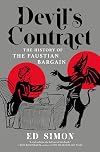
The story of Faust, and the moral of the story, is part of our cultural spine. It’s not just the devil taken literally. It has to do with our sense of right and wrong and our willingness or unwillingness to suspend it for gain or ambition.
While Marlowe’s and Goethe’s Faust are the archetypes, the bargain takes so many forms as to be an almost constant possibility. There are very minor bargains that we all make — telling little white lies, for example, that save us from embarrassments show more or uncomfortable situations or that turn sick days into vacation days from work. It’s a bit grandiose to call those deals with the devil, but they are on the spectrum, just at the faint, pale end.
Then there are the bigger ones. Politicians who trade principles for power. Spouses who cheat. Businessmen who push unfair advantages with partners and customers. None of those things are shocking, they are almost taken-for-granted. Deals with the devil are part of the way things work.
And the history of our dealings with the devil. Simon is as much historian as he is sociologist or literary critic, and he takes us through a cultural history of Faustian bargains, beginning, in western history, with the Bible, with the story of the Fall and with the temptations of Christ.
It’s not though until we get to more modern times that an actual “contract” with the devil becomes a centerpiece. Simon notes that the “coven”, in a witches’ coven, derives from the word “covenant” denoting an explicit agreement between the witch and the devil. He also notes the infernal irony of witch trials and accusations, that it is the sanctimonious accusers who more likely have made a deal with the devil.
Simon goes on through the explicit tellings of the Faust story by Marlowe and Goethe, and then by Thomas Mann in the propitious context of Nazi Germany. Given how he has related the Faustian bargain to everyday compromises of our senses of right and wrong, Faust becomes iconic, an icon we can see in ourselves rather than just as a cautionary tale.
In his final chapters, Simon paints a dark, even apocalyptic picture of our own times, concluding that we are living in a “Faustocene” age, where we have in fact institutionalized deals with the devil, in our economic systems, our scientistic and meaning-free models of knowledge and reality, in our technological idolatry, and in our growing embrace of an authoritarianism that is frighteningly comfortable for its beneficiaries.
Whether you share his apocalyptic mood or not, there is homework to take away.
The constant presence of the bargain is overwhelming. It isn’t just in the moments when we tell the white lie, cheat at a game, etc. It’s more pervasively in our participation in institutions, practices, and structures of power and wealth, when we take advantage of whatever power or wealth we have to gain more power and wealth, knowing or at least being responsible for knowing that it is at someone else’s expense.
It’s in the normal practices of everyday consumer life when we buy products from companies that mistreat and underpay their employees, or when we buy and eat food products from companies that pollute the soil and water and that treat animals with unspeakable cruelty, all out of our sight.
The deal that Faust made with the devil was clear and out in the open. The ones we make on an everyday basis are not. They are shielded, implicit, even automatic.
And the deal that Faust made was clear in another way. Faust knew better. In some versions he was even warned by God or an angel of God. The bargain the devil offers Faust is a temptation away from something Faust knows to be right and good, whether that is God and faith or just plain old right as opposed to wrong.
By contrast, do we always know when we are making the bargain? When the devil is in the institutions, practices, and structures of our lives, do we even see him there? show less
While Marlowe’s and Goethe’s Faust are the archetypes, the bargain takes so many forms as to be an almost constant possibility. There are very minor bargains that we all make — telling little white lies, for example, that save us from embarrassments show more or uncomfortable situations or that turn sick days into vacation days from work. It’s a bit grandiose to call those deals with the devil, but they are on the spectrum, just at the faint, pale end.
Then there are the bigger ones. Politicians who trade principles for power. Spouses who cheat. Businessmen who push unfair advantages with partners and customers. None of those things are shocking, they are almost taken-for-granted. Deals with the devil are part of the way things work.
And the history of our dealings with the devil. Simon is as much historian as he is sociologist or literary critic, and he takes us through a cultural history of Faustian bargains, beginning, in western history, with the Bible, with the story of the Fall and with the temptations of Christ.
It’s not though until we get to more modern times that an actual “contract” with the devil becomes a centerpiece. Simon notes that the “coven”, in a witches’ coven, derives from the word “covenant” denoting an explicit agreement between the witch and the devil. He also notes the infernal irony of witch trials and accusations, that it is the sanctimonious accusers who more likely have made a deal with the devil.
Simon goes on through the explicit tellings of the Faust story by Marlowe and Goethe, and then by Thomas Mann in the propitious context of Nazi Germany. Given how he has related the Faustian bargain to everyday compromises of our senses of right and wrong, Faust becomes iconic, an icon we can see in ourselves rather than just as a cautionary tale.
In his final chapters, Simon paints a dark, even apocalyptic picture of our own times, concluding that we are living in a “Faustocene” age, where we have in fact institutionalized deals with the devil, in our economic systems, our scientistic and meaning-free models of knowledge and reality, in our technological idolatry, and in our growing embrace of an authoritarianism that is frighteningly comfortable for its beneficiaries.
Whether you share his apocalyptic mood or not, there is homework to take away.
The constant presence of the bargain is overwhelming. It isn’t just in the moments when we tell the white lie, cheat at a game, etc. It’s more pervasively in our participation in institutions, practices, and structures of power and wealth, when we take advantage of whatever power or wealth we have to gain more power and wealth, knowing or at least being responsible for knowing that it is at someone else’s expense.
It’s in the normal practices of everyday consumer life when we buy products from companies that mistreat and underpay their employees, or when we buy and eat food products from companies that pollute the soil and water and that treat animals with unspeakable cruelty, all out of our sight.
The deal that Faust made with the devil was clear and out in the open. The ones we make on an everyday basis are not. They are shielded, implicit, even automatic.
And the deal that Faust made was clear in another way. Faust knew better. In some versions he was even warned by God or an angel of God. The bargain the devil offers Faust is a temptation away from something Faust knows to be right and good, whether that is God and faith or just plain old right as opposed to wrong.
By contrast, do we always know when we are making the bargain? When the devil is in the institutions, practices, and structures of our lives, do we even see him there? show less
My experience with Ed Simon's Devil's Contract: The History of the Faustian Bargain was uneven. For a while, I'd be highlighting passages, putting exclamation points next to interesting new ideas. Then, I'd find myself jotting notes like "Do I believe this?" or "And he's trying to say...?" I absolutely loved the moments when the book had me thinking and making connections I hadn't made before: for example, that one reading the Dead Sea Scrolls can bring one to the conclusion that mainstream show more Christianity (the historical narrative that one out) is, in fact, a Faustian bargain of sorts.
As a "collector" of Fausts—opera and play performances, books, museum art—I found that Devil's Contract was well worth the read despite its unevenness. I gave myself permission to speed up or slow down, depending on my own level of engagement and found my overall reading experience rewarding.
I received a free electronic review copy of this book from the publisher via NetGalley; the opinions are my own. show less
As a "collector" of Fausts—opera and play performances, books, museum art—I found that Devil's Contract was well worth the read despite its unevenness. I gave myself permission to speed up or slow down, depending on my own level of engagement and found my overall reading experience rewarding.
I received a free electronic review copy of this book from the publisher via NetGalley; the opinions are my own. show less

Rating: 1.5* of five
The Publisher Says: No Western religious concept has been as socially, culturally, economically, and politically significant as that of the apocalypse. Neither heaven and hell, nor sin and salvation, nor even God and the devil have merited the attention of billions of people in the manner that belief in the end of the world has. Apocalyptic thinking is riven by a fruitful—and at times dangerous—binary between the hopes for a coming millennium when all shall be show more perfected or of a fiery deluge when the earth shall be destroyed.
The Dove and the Dragon is the first comprehensive history of Western apocalypticism. Ed Simon introduces a new system for classifying movements concerned with the end of history, between hopeful, millennial "doves" and violent, apocalyptic "dragons." This framing connects a seemingly disparate phenomenon, from medieval millennialism {SIC} to modern Marxism, Reformation apocalypticism to contemporary techno-utopianism. Expected groups are considered, but unexpected phenomena are interpreted through the lens of apocalypticism as well to argue that those that have often been classified as "secular" still take part in this ancient theological category.
This new way of interpreting history gives sense to the full scope of apocalypticism as a series of movements and as a genre, including not just religion and theology, but politics, philosophy, and pop culture as well. The Dove and the Dragon promises to be the standard introduction for years to come.
I RECEIVED A DRC FROM THE PUBLISHER VIA EDELWEISS+. THANK YOU.
My Review: Per the publisher, "Ed Simon is Public Humanities Special Faculty in the English Department of Carnegie Mellon University and a staff writer for LitHub, as well as the editor of Belt Magazine." Mistaking the date relationship between the Plague of Justinian (540s) and the Black Death (1340s); cited as "a century" instead of "eight centuries," which should not happen even as a draft typo. Multiple infelicities occurred in the realms of definitions, f/ex: when writing a book about apocalypses it's wise to state your definition early, buttress it with cited external sources, and stick to it; never happened that I noticed, we went from millenarian (the "ism" intended above, where I wrote "sic") ideas to technological ones (all cited, but to what purpose if even I can find introduced errors?). And this is a magazine editor writing a book for a religious publisher.
I read the whole book because I was so deeply stunned this made it out of the editing process in this condition. He says of the book, "If a reading of this book demonstrates anything, it’s that that every century has a contingent of people, both smaller and larger depending on circumstance, who are convinced that they’re living in the last days." I am now.
Fortress Press wants $39.00. They do not deserve it. show less
The Publisher Says: No Western religious concept has been as socially, culturally, economically, and politically significant as that of the apocalypse. Neither heaven and hell, nor sin and salvation, nor even God and the devil have merited the attention of billions of people in the manner that belief in the end of the world has. Apocalyptic thinking is riven by a fruitful—and at times dangerous—binary between the hopes for a coming millennium when all shall be show more perfected or of a fiery deluge when the earth shall be destroyed.
The Dove and the Dragon is the first comprehensive history of Western apocalypticism. Ed Simon introduces a new system for classifying movements concerned with the end of history, between hopeful, millennial "doves" and violent, apocalyptic "dragons." This framing connects a seemingly disparate phenomenon, from medieval millennialism {SIC} to modern Marxism, Reformation apocalypticism to contemporary techno-utopianism. Expected groups are considered, but unexpected phenomena are interpreted through the lens of apocalypticism as well to argue that those that have often been classified as "secular" still take part in this ancient theological category.
This new way of interpreting history gives sense to the full scope of apocalypticism as a series of movements and as a genre, including not just religion and theology, but politics, philosophy, and pop culture as well. The Dove and the Dragon promises to be the standard introduction for years to come.
I RECEIVED A DRC FROM THE PUBLISHER VIA EDELWEISS+. THANK YOU.
My Review: Per the publisher, "Ed Simon is Public Humanities Special Faculty in the English Department of Carnegie Mellon University and a staff writer for LitHub, as well as the editor of Belt Magazine." Mistaking the date relationship between the Plague of Justinian (540s) and the Black Death (1340s); cited as "a century" instead of "eight centuries," which should not happen even as a draft typo. Multiple infelicities occurred in the realms of definitions, f/ex: when writing a book about apocalypses it's wise to state your definition early, buttress it with cited external sources, and stick to it; never happened that I noticed, we went from millenarian (the "ism" intended above, where I wrote "sic") ideas to technological ones (all cited, but to what purpose if even I can find introduced errors?). And this is a magazine editor writing a book for a religious publisher.
I read the whole book because I was so deeply stunned this made it out of the editing process in this condition. He says of the book, "If a reading of this book demonstrates anything, it’s that that every century has a contingent of people, both smaller and larger depending on circumstance, who are convinced that they’re living in the last days." I am now.
Fortress Press wants $39.00. They do not deserve it. show less

America and Other Fictions: On Radical Faith and Post-Religion by Ed Simon is a collection of essays about America and Religion. Simon is an Editor-at-Large with The Marginalia Review of Books, a channel of the Los Angeles Review of Books. A specialist in early modern literature and religion, he received a Ph.D. in English from Lehigh University.
Simon presents his views on a wide variety of subjects in this deep and dense collection of essays. Religion and America share many things in show more common. American History and Religious history has a take what you want and ignore what you want attitude. We think of George Washington as almost a mythical leader. Jefferson and inciteful writing are tarnished by his hypocrisy on freedom in his own life. Famous revolutionary pamphleteer Thomas Paine wrote from a simpler "American" style that spread the revolutionary zeal. His place in history is less secure as he does not have a Monticello or monument in Washington. He died alone in Greenwich Village of cirrhosis with no fanfare or much remembrance.
The topics on religion are nicely tied to politics as Agustine believing men are evil in nature and Pelagius who believed that men were naturally good. This ties in nicely with the modern conservative and liberal theories. Crucifixion is discussed and the variations of the "cross" used to inflict the punishment.
America is more than a country it is an idea that crosses borders although Americans are themselves unlikely to think of Canadians, Chilians, Peruvians, or Mexicans as Americans. American Pie, American Beauty, and American Graffiti portray additional pleasure while American Psycho and American Terror add a deeper level of violence with the addition of "American". For those old enough to remember the Soviet Union there was a demand for Levis, Dallas videotapes, and Voice of America form people who considered America their enemy. America meant different things in different contexts.
Whitman becomes the patron saint of nineteenth-century America. It is not only his words and appreciation for the American wilderness, Whitman was not Christian but still read the Bible to wounded troops on both sides of the Civil War. The uniform color made no difference to Whitman as they were Americans. Reading the Bible was not for Whitman's benefit but for the benefit of those wounded and hurting. Bob Dylan also makes an appearance as a poet and raises questions on his winning the Nobel Poetry Prize. How is a singer a world-class poet? He becomes one when he embodies the spirit of America.
Simon writes a complex mix of subject matter and thoughts. It is not a light afternoon read but something that needs to be thought upon and processed. The information is densely packed and takes much from philosophy, religious and otherwise, to present a picture of America and Christianity without combining the two. A thought-provoking and interesting study of the two ideas. show less
Lists
You May Also Like
Associated Authors
Statistics
- Works
- 14
- Also by
- 5
- Members
- 305
- Popularity
- #77,180
- Rating
- 3.9
- Reviews
- 4
- ISBNs
- 36
- Languages
- 1