
Scott Hershovitz (–1974)
Author of Nasty, Brutish, and Short: Adventures in Philosophy with My Kids
About the Author
Scott Hershovitz is Assistant Professor of Law at the University of Michigan.
Works by Scott Hershovitz
Tagged
Common Knowledge
- Date of death
- 1974
- Gender
- male
- Occupations
- Professor of Law and Philosophy, University of Michigan
Members
Reviews
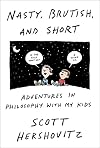
I finished this book a couple of weeks ago and have been mulling this review. I consider myself a philomath who gets jazzed by philomathy. Now, when it comes to philosophy, not so much. Not at least since I was an impressionable teen. But I wanted to learn what was in this book. The roots of the word philosophy mean lover of wisdom, and yet, so much philosophy is philosophical BS. Okay, that's an opinion. And philosophy boils down to opinion, right? Okay (again, sorry), philosophy boils down show more to thinking about things (with the necessary biases and perspectives of the thinker.)
In this collection of thoughts and observations. Hershovitz tries to Make Sense of Morality by looking at rights, revenge, punishment, authority and language, Make Sense of Ourselves by looking at sex, gender and sports, and race and responsibility, and finally Make Sense of the World by looking at knowledge, truth, mind, infinity, and (surprisingly) god, wrapping it up with his take on How to Raise a Philosopher. He says "This book is inspired by kids, but it’s not for them. In fact, kids are my Trojan horse. I’m not after young minds. I’m after yours." Nice. (But he is after his kids' minds.) Hershovitz is an attorney and I know of several attorneys whose undergraduate degree is in philosophy. I find that curious. Hershovitz pokes at himself, and I got a kick out the part where he talks of his father's skepticism over him majoring in philosophy "That's what you want to study?" Hershovitz says "After a few more minutes of muttering about brains and vats, I added, 'The department has lots of logic classes too.' 'Well,' [his father] said, 'I hope you take those.'"
I made a lot of notes, picking away - not entirely in opposition - and I disagreed a lot but I also agreed a lot. Hershovitz says "Sure, I’d like to persuade you to see things my way. But the truth is: I’m happy for you to think differently—as long as you’ve thought it through." I like that and that is generally how I approach things in my professional and private life. And when it comes to my kids, all adults now, I too am happy they think differently (except when it comes to animation... Bugs Bunny is, and anime isn't {wink}), so that is a good position. And when it comes to his kids... I did shake my head a few times with respect to the age of his kids in conversations he shared. But my incredulity doesn't matter.
So, do I recommend this? Maybe. There are always good things and not as good things to find in here.
One more thing: the notes section of this book are in the detestable form of sentence fragments after the main body with no links in the text. Superscripts - even hyperlinked asterisks - are small, unobtrusive, and do not interfere with the reading. It is maddeningly annoying to guess as to whether a passage has a note or not and to all publishers who inflict this on readers, you should be embarrassed at the laziness. And the presumption. Let me decide whether I want to check something and don’t make it a burden.
Selected outtakes:
[in response to an engineer's practical critique of the "trolley problem"] I love that letter, for two reasons. First, it’s a reminder that the real world is never so simple as a philosopher’s hypothetical.
{Herein lies the crux. Philosophy too often asks questions that don’t really matter in the real world. But... this one may have real world implications someday if we ever let AI do all the driving.}
[on one study of revenge] ... kids between four and eight were asked to play a computer game in which other participants (controlled by the researchers) would either steal their stickers or give them stickers as gifts. When the kids got the chance, they took revenge on the sticker stealers, stealing from them at much higher rates than they did from other participants. But they did not show the same reciprocity when it came to kindness. A kid who’d received a gift was no more likely to give one to the giver than to give one to anyone else. Getting even, it seems, comes more naturally than giving back.
{Why is this surprising. Primitive revenge is far older than empathy in human evolution because survival depends on strength, and shows of such. Far older even though empathy is not a human only quality, meaning it has roots farther up the genetic tree.}
[on words] I won’t teach my kids “Sticks and Stones,” because I want them to feel okay about the fact that words hurt.
{Words do matter. I agree with this.}
[on relationships] When we’re in a relationship with someone—as spouses, colleagues, friends, or even just as fellow human beings—we have expectations for how the other person ought to behave. {Some have more expectations } Most fundamentally, we expect people to treat us with goodwill.
{This is not a bad base position to hold. I'll respect you until you've wronged me.}
Hume has his fans, but I’m not one of them. I think that reason and desire operate independently.
{I heartily concur; I'm not one either. }
[on me nitpicking something] But once Hank was on the move, Rex started to run him down, mostly on accident.
{"On accident"?? Kids talk that way. Here's a link to a paper on that: What Speakers Don’t Notice: Language Changes Can Sneak In}
[on parenting, one aspect] Hank got the message “no Minecraft” sent. He knew he’d acted badly. But I didn’t want that to be the last message he heard. He’s one of us, and he always will be, no matter how badly he acts.
{Good }
[on Robert Paul Wolff's naive - my word - philosophy; Wolff being a philosophical anarchist, which is "skeptical about all claims to authority"]
Why? Wolff argues that our ability to reason makes us responsible for what we do. More than that, Wolff says, we’re obligated to take responsibility for what we do, by thinking it through. According to Wolff, a responsible person aims to act autonomously—according to decisions that she makes, as a result of her own deliberations. She won’t think herself free to do whatever she wants; she’ll recognize that she has responsibilities to others.
{This is the failed with a couple of years of data political position about people being responsible to others with respect to the C-virus.}
[on Hershovitz becoming a student of Joseph Raz, who was a major critic of Wolff's position, and Hershovitz setting "out to show that his work on authority was wrong."] Raz didn't mind. Or if he did, he didn't tell me. But I doubt that he did. Because that’s how philosophy works. You say something, and the world sets out to show that you’re wrong.
[more on words] When you use a slur like kike, you don’t just call those ideas to mind. You also imply that it’s okay to use the word—to operate within the ideology. You invite others to see the world in an anti-Semitic way. And that way of seeing the world is harmful.
{Again, Words matter. I do not like hurtful words even from loved ones who don't see them as hurtful. }
Some people use sex and gender as synonyms, but they’re not really. Because gender is about social roles, not biology.
[on dispelling a convention] The connection between gender roles and our bodies is just not that tight. And the connection between gender roles and our brains doesn’t seem so strong either. The link between girls and pink, for instance, is completely cultural. Just ask a 1918 article in the classic rag Earnshaw’s Infants’ Department: The generally accepted rule is pink for the boys, and blue for the girls. The reason is that pink, being a more decided and stronger color, is more suitable for the boy, while blue, which is more delicate and dainty, is prettier for the girl.
{Cool}
[on dispelling misunderstandings about transgender athletes and the role of testosterone in performance] [scientist Joanna] Harper can speak to the question from personal experience, since she’s a trans athlete. For more than three decades, she ran men’s marathons. Then she transitioned, started hormone therapy, and began competing as a woman. Harper reports that the drugs reduced her speed by 12 percent. But her new competition was slower too, so Harper stayed at roughly the same spot in the pack.
[on Whiteness] We are a long way off, but we should welcome the day when White is not a meaningful part of anyone’s identity.
{I am tired of the HR questions that I can voluntarily decline but wonder as to the screening if I do.}
[on taking responsibility when you are responsible, and also when you aren't] ... sometimes you should. Or so says David Enoch. He’s another philosopher of law. He teaches at Hebrew University, so he doesn’t live on our street. But I wish he did, because he’s one of my favorite people to argue with. We disagree about almost everything, and often he leaves me worried that I’m wrong. That’s the best you can ask in an intellectual opponent.
{I like this }
[on the book When Jackie Met Hank] Rex [Hershovitz's son] loved that story. We read it over and over. And he asked me to read it to his pre-K class. But he struggled to make sense of it. As did all the other kids at the JCC preschool. They were full of questions.
{Jeez. Pre-K??? Of course they struggled }
[on a persistent philosophical problem] For all you can tell, the external world is an elaborate illusion. Things would appear just the same to you whether it actually exists or not.
{And if it is, it matters none.. with no discernible difference, go with what you know.. that’s a problem with philosophy.}
[on echo chambers to avoid] There are echo chambers on the left too (though none with near the reach that Limbaugh had). In her book Nice Racism: How Progressive White People Perpetuate Racial Harm, Robin DiAngelo offers up a list of actions and attitudes that are racist. Some of the items on the list are clear-cut cases—wearing blackface, for instance, or refusing to learn the proper pronunciation of people’s names. Others aren’t as obvious. There’s room for doubt, for instance, that it’s racist to include neurodiversity in your organization’s “diversity work.” (It’s not a zero-sum game, after all; you can root out racism and make a workplace hospitable to people wired up in different ways.) But DiAngelo doesn’t want to hear any doubts about the entries on her list. Indeed, she says it’s racist to have them. The last item on her list is: “not understanding why something on this list is problematic.” In saying that, DiAngelo is attempting to insulate her views from criticism—to discredit any dissent in advance, regardless of the reason for it. That’s a good way to get an echo chamber going.
{This is a problem, and one the wrong wing will jump on while blindly ignoring their hypocrisy.}
[on a point by his teacher and mentor, Jules Coleman]
"in my view..." I started.
He cut me off.
“You’re too young to have views,” he said. “You can have questions, curiosities, ideas . . . even inclinations. But not views. You’re not ready for views.”
He was making two points. First, it’s dangerous to have views, because often you dig in to defend them. And that makes it hard to hear what other people have to say. One of Coleman’s signal virtues as a philosopher is his willingness to change his views. That’s because he’s more committed to questions than answers. He wants to understand, and he’s willing to go wherever his understanding takes him, even if it requires him to backtrack from where he’s been before.
Second, you have to earn your views. You shouldn’t have a view unless you can defend it, make an argument for it, and explain where the arguments against it go wrong
{a bit patronizing, but not wrong.}
[on some weird need for a perceived balance] A popular version of utilitarianism tells us that we ought to try to maximize the balance of pleasure over pain in the universe. It’s an appealing idea. Our actions have consequences.
{The entire universe? Right. }
[on pretending religion] I don’t believe, and I never did, not from the first time I heard the stories. But here’s the thing: I pretend. And I don’t plan to stop. Because pretending makes the world a better place.
[...]
There are ways to make these [major life] events meaningful without God. But many nonbelievers miss out because they fail to fashion alternative traditions. The solution is not to believe. It is to pretend.
{No. I can't emphasize that enough. No.}
[Pascal's Wager] “If you gain, you gain all; if you lose, you lose nothing. Wager, then, without hesitation that He is.” That argument is called Pascal’s Wager
{He doesn’t talk about the flaws in the wager }
[on understanding, and not understanding the world] And, more fundamentally, we do not know why the world exists, why the laws of physics are what they are, or even why there are laws of physics in the first place.
{Why the world exists? Wrong question. How is good. Why is useless and meaningless when it comes to the world. Why the laws of physics are what they are does have value because it lends insight into their relationship to reality and a possible window onto other laws. As to why there are laws, that's just silly. }
Jumping off points:
Emma Byrne’s Swearing Is Good for You: The Amazing Science of Bad Language {queued}
Harry Frankfurt’s book On Bullshit "was an unlikely bestseller" {Found and read }
Aaron James’s Assholes: A Theory. "It’s just what it sounds like—an attempt to explain what assholes are and why we find them so bothersome. It is, I think, essential reading for our age." {already queued, along with the version about The Former Guy}
Isabel Wilkerson 's Caste: The Origins of Our Discontents {Also already queued, along with The Warmth of Other Suns} show less
In this collection of thoughts and observations. Hershovitz tries to Make Sense of Morality by looking at rights, revenge, punishment, authority and language, Make Sense of Ourselves by looking at sex, gender and sports, and race and responsibility, and finally Make Sense of the World by looking at knowledge, truth, mind, infinity, and (surprisingly) god, wrapping it up with his take on How to Raise a Philosopher. He says "This book is inspired by kids, but it’s not for them. In fact, kids are my Trojan horse. I’m not after young minds. I’m after yours." Nice. (But he is after his kids' minds.) Hershovitz is an attorney and I know of several attorneys whose undergraduate degree is in philosophy. I find that curious. Hershovitz pokes at himself, and I got a kick out the part where he talks of his father's skepticism over him majoring in philosophy "That's what you want to study?" Hershovitz says "After a few more minutes of muttering about brains and vats, I added, 'The department has lots of logic classes too.' 'Well,' [his father] said, 'I hope you take those.'"
I made a lot of notes, picking away - not entirely in opposition - and I disagreed a lot but I also agreed a lot. Hershovitz says "Sure, I’d like to persuade you to see things my way. But the truth is: I’m happy for you to think differently—as long as you’ve thought it through." I like that and that is generally how I approach things in my professional and private life. And when it comes to my kids, all adults now, I too am happy they think differently (except when it comes to animation... Bugs Bunny is, and anime isn't {wink}), so that is a good position. And when it comes to his kids... I did shake my head a few times with respect to the age of his kids in conversations he shared. But my incredulity doesn't matter.
So, do I recommend this? Maybe. There are always good things and not as good things to find in here.
One more thing: the notes section of this book are in the detestable form of sentence fragments after the main body with no links in the text. Superscripts - even hyperlinked asterisks - are small, unobtrusive, and do not interfere with the reading. It is maddeningly annoying to guess as to whether a passage has a note or not and to all publishers who inflict this on readers, you should be embarrassed at the laziness. And the presumption. Let me decide whether I want to check something and don’t make it a burden.
Selected outtakes:
[in response to an engineer's practical critique of the "trolley problem"] I love that letter, for two reasons. First, it’s a reminder that the real world is never so simple as a philosopher’s hypothetical.
{Herein lies the crux. Philosophy too often asks questions that don’t really matter in the real world. But... this one may have real world implications someday if we ever let AI do all the driving.}
[on one study of revenge] ... kids between four and eight were asked to play a computer game in which other participants (controlled by the researchers) would either steal their stickers or give them stickers as gifts. When the kids got the chance, they took revenge on the sticker stealers, stealing from them at much higher rates than they did from other participants. But they did not show the same reciprocity when it came to kindness. A kid who’d received a gift was no more likely to give one to the giver than to give one to anyone else. Getting even, it seems, comes more naturally than giving back.
{Why is this surprising. Primitive revenge is far older than empathy in human evolution because survival depends on strength, and shows of such. Far older even though empathy is not a human only quality, meaning it has roots farther up the genetic tree.}
[on words] I won’t teach my kids “Sticks and Stones,” because I want them to feel okay about the fact that words hurt.
{Words do matter. I agree with this.}
[on relationships] When we’re in a relationship with someone—as spouses, colleagues, friends, or even just as fellow human beings—we have expectations for how the other person ought to behave. {Some have more expectations } Most fundamentally, we expect people to treat us with goodwill.
{This is not a bad base position to hold. I'll respect you until you've wronged me.}
Hume has his fans, but I’m not one of them. I think that reason and desire operate independently.
{I heartily concur; I'm not one either. }
[on me nitpicking something] But once Hank was on the move, Rex started to run him down, mostly on accident.
{"On accident"?? Kids talk that way. Here's a link to a paper on that: What Speakers Don’t Notice: Language Changes Can Sneak In}
[on parenting, one aspect] Hank got the message “no Minecraft” sent. He knew he’d acted badly. But I didn’t want that to be the last message he heard. He’s one of us, and he always will be, no matter how badly he acts.
{Good }
[on Robert Paul Wolff's naive - my word - philosophy; Wolff being a philosophical anarchist, which is "skeptical about all claims to authority"]
Why? Wolff argues that our ability to reason makes us responsible for what we do. More than that, Wolff says, we’re obligated to take responsibility for what we do, by thinking it through. According to Wolff, a responsible person aims to act autonomously—according to decisions that she makes, as a result of her own deliberations. She won’t think herself free to do whatever she wants; she’ll recognize that she has responsibilities to others.
{This is the failed with a couple of years of data political position about people being responsible to others with respect to the C-virus.}
[on Hershovitz becoming a student of Joseph Raz, who was a major critic of Wolff's position, and Hershovitz setting "out to show that his work on authority was wrong."] Raz didn't mind. Or if he did, he didn't tell me. But I doubt that he did. Because that’s how philosophy works. You say something, and the world sets out to show that you’re wrong.
[more on words] When you use a slur like kike, you don’t just call those ideas to mind. You also imply that it’s okay to use the word—to operate within the ideology. You invite others to see the world in an anti-Semitic way. And that way of seeing the world is harmful.
{Again, Words matter. I do not like hurtful words even from loved ones who don't see them as hurtful. }
Some people use sex and gender as synonyms, but they’re not really. Because gender is about social roles, not biology.
[on dispelling a convention] The connection between gender roles and our bodies is just not that tight. And the connection between gender roles and our brains doesn’t seem so strong either. The link between girls and pink, for instance, is completely cultural. Just ask a 1918 article in the classic rag Earnshaw’s Infants’ Department: The generally accepted rule is pink for the boys, and blue for the girls. The reason is that pink, being a more decided and stronger color, is more suitable for the boy, while blue, which is more delicate and dainty, is prettier for the girl.
{Cool}
[on dispelling misunderstandings about transgender athletes and the role of testosterone in performance] [scientist Joanna] Harper can speak to the question from personal experience, since she’s a trans athlete. For more than three decades, she ran men’s marathons. Then she transitioned, started hormone therapy, and began competing as a woman. Harper reports that the drugs reduced her speed by 12 percent. But her new competition was slower too, so Harper stayed at roughly the same spot in the pack.
[on Whiteness] We are a long way off, but we should welcome the day when White is not a meaningful part of anyone’s identity.
{I am tired of the HR questions that I can voluntarily decline but wonder as to the screening if I do.}
[on taking responsibility when you are responsible, and also when you aren't] ... sometimes you should. Or so says David Enoch. He’s another philosopher of law. He teaches at Hebrew University, so he doesn’t live on our street. But I wish he did, because he’s one of my favorite people to argue with. We disagree about almost everything, and often he leaves me worried that I’m wrong. That’s the best you can ask in an intellectual opponent.
{I like this }
[on the book When Jackie Met Hank] Rex [Hershovitz's son] loved that story. We read it over and over. And he asked me to read it to his pre-K class. But he struggled to make sense of it. As did all the other kids at the JCC preschool. They were full of questions.
{Jeez. Pre-K??? Of course they struggled }
[on a persistent philosophical problem] For all you can tell, the external world is an elaborate illusion. Things would appear just the same to you whether it actually exists or not.
{And if it is, it matters none.. with no discernible difference, go with what you know.. that’s a problem with philosophy.}
[on echo chambers to avoid] There are echo chambers on the left too (though none with near the reach that Limbaugh had). In her book Nice Racism: How Progressive White People Perpetuate Racial Harm, Robin DiAngelo offers up a list of actions and attitudes that are racist. Some of the items on the list are clear-cut cases—wearing blackface, for instance, or refusing to learn the proper pronunciation of people’s names. Others aren’t as obvious. There’s room for doubt, for instance, that it’s racist to include neurodiversity in your organization’s “diversity work.” (It’s not a zero-sum game, after all; you can root out racism and make a workplace hospitable to people wired up in different ways.) But DiAngelo doesn’t want to hear any doubts about the entries on her list. Indeed, she says it’s racist to have them. The last item on her list is: “not understanding why something on this list is problematic.” In saying that, DiAngelo is attempting to insulate her views from criticism—to discredit any dissent in advance, regardless of the reason for it. That’s a good way to get an echo chamber going.
{This is a problem, and one the wrong wing will jump on while blindly ignoring their hypocrisy.}
[on a point by his teacher and mentor, Jules Coleman]
"in my view..." I started.
He cut me off.
“You’re too young to have views,” he said. “You can have questions, curiosities, ideas . . . even inclinations. But not views. You’re not ready for views.”
He was making two points. First, it’s dangerous to have views, because often you dig in to defend them. And that makes it hard to hear what other people have to say. One of Coleman’s signal virtues as a philosopher is his willingness to change his views. That’s because he’s more committed to questions than answers. He wants to understand, and he’s willing to go wherever his understanding takes him, even if it requires him to backtrack from where he’s been before.
Second, you have to earn your views. You shouldn’t have a view unless you can defend it, make an argument for it, and explain where the arguments against it go wrong
{a bit patronizing, but not wrong.}
[on some weird need for a perceived balance] A popular version of utilitarianism tells us that we ought to try to maximize the balance of pleasure over pain in the universe. It’s an appealing idea. Our actions have consequences.
{The entire universe? Right. }
[on pretending religion] I don’t believe, and I never did, not from the first time I heard the stories. But here’s the thing: I pretend. And I don’t plan to stop. Because pretending makes the world a better place.
[...]
There are ways to make these [major life] events meaningful without God. But many nonbelievers miss out because they fail to fashion alternative traditions. The solution is not to believe. It is to pretend.
{No. I can't emphasize that enough. No.}
[Pascal's Wager] “If you gain, you gain all; if you lose, you lose nothing. Wager, then, without hesitation that He is.” That argument is called Pascal’s Wager
{He doesn’t talk about the flaws in the wager }
[on understanding, and not understanding the world] And, more fundamentally, we do not know why the world exists, why the laws of physics are what they are, or even why there are laws of physics in the first place.
{Why the world exists? Wrong question. How is good. Why is useless and meaningless when it comes to the world. Why the laws of physics are what they are does have value because it lends insight into their relationship to reality and a possible window onto other laws. As to why there are laws, that's just silly. }
Jumping off points:
Emma Byrne’s Swearing Is Good for You: The Amazing Science of Bad Language {queued}
Harry Frankfurt’s book On Bullshit "was an unlikely bestseller" {Found and read }
Aaron James’s Assholes: A Theory. "It’s just what it sounds like—an attempt to explain what assholes are and why we find them so bothersome. It is, I think, essential reading for our age." {already queued, along with the version about The Former Guy}
Isabel Wilkerson 's Caste: The Origins of Our Discontents {Also already queued, along with The Warmth of Other Suns} show less
This originally appeared at The Irresponsible Reader.
---
WHAT'S NASTY, BRUTISH, AND SHORT ABOUT?
The official description is:
Some of the best philosophers in the world gather in surprising places—preschools and playgrounds. They debate questions about metaphysics and morality, even though they’ve never heard the words and perhaps can’t even tie their shoes. They’re kids. And as Scott Hershovitz shows in this delightful debut, they’re astoundingly good philosophers.
Hershovitz has show more two young sons, Rex and Hank. From the time they could talk, he noticed that they raised philosophical questions and were determined to answer them. They re-created ancient arguments. And they advanced entirely new ones. That’s not unusual, Hershovitz says. Every kid is a philosopher.
Following an agenda set by Rex and Hank, Hershovitz takes us on a fun romp through classic and contemporary philosophy, powered by questions like, Does Hank have the right to drink soda? When is it okay to swear? and, Does the number six exist? Hershovitz and his boys take on more weighty issues too. They explore punishment, authority, sex, gender, race, the nature of truth and knowledge, and the existence of God. Along the way, they get help from professional philosophers, famous and obscure. And they show that all of us have a lot to learn from listening to kids—and thinking with them.
Hershovitz calls on us to support kids in their philosophical adventures. But more than that, he challenges us to join them so that we can become better, more discerning thinkers and recapture some of the wonder kids have at the world.
The book is broken down into three sections: "Making Sense of Morality" (covering ideas like Rights, Revenge, Punishment, Authority, and Language); "Making Sense of Ourselves" (surely non-controversial chapters covering "Sex, Gender, and Sports"; and "Race and Responsibility"); and "Making Sense of the World" (Knowledge, Truth, Mind, Infinity, and God—the easy bits of philosophy). While discussing these, Hershovitz will describe the idea(s) he's focusing on—or the aspects of them, to be more specific; he'll then illustrate them with questions from or discussions with his sons; give us a brief history of philosophy on the topic; and then his personal take on them. Usually with more input from his sons along the way.
HOW WAS THE NARRATION?
Hershovitz was fantastic. If he gets tired of the whole professor/philosopher gig, he could have a new career in audiobook narration. I can only imagine that his classes are great to sit through.
He delivered the material that in the wrong hands could've come across as super-dry, or really jokey and kept it engaging, entertaining, and informative—with a little bit of the persuasiveness needed to keep someone listening to a book about philosophy.
I was quite impressed.
SO, WHAT DID I THINK ABOUT NASTY, BRUTISH, AND SHORT?
Oh, I have some serious issues with some of the philosophy here. The chapter on "God" (to the surprise of few who read this blog regularly) really bothered me—but it did underline the importance of Special Revelation to go with General Revelation.
The Conclusion, "How to Raise a Philosopher," was fantastic. Truly some of the best parenting advice I've heard/read in ages (and I don't even need that any more and I still found myself taking notes). For raising more than just philosophers.
Sure, I disagreed with some of his conclusions—but I loved hearing the way Hershovitz thought through the ideas he was proposing and/or discussing, the way he dealt with his kids and their questions, I appreciated the way he explained concepts both basic and complex in a way that non-philosophers could understand, and he managed to be entertaining all along. Some of his witticisms did cause me to react audibly. There's a good deal of so-called common sense mixed in with the profound as well—always nice to see for a layman like myself.
This book is a strange alchemy of parenting advice (even if largely given by example rather than by precept), Philosophy 101, and humor. It works so well that it's hard to explain. I can only hope there's a sequel or three as Hank and Rex age.
All in all, I heartily recommend this for parents, people who want to get a start in philosophy but aren't sure where (and don't want to admit that to anyone), and others. The print version might be nice for easy reference, but the audiobook format is a real winner. show less
---
WHAT'S NASTY, BRUTISH, AND SHORT ABOUT?
The official description is:
Some of the best philosophers in the world gather in surprising places—preschools and playgrounds. They debate questions about metaphysics and morality, even though they’ve never heard the words and perhaps can’t even tie their shoes. They’re kids. And as Scott Hershovitz shows in this delightful debut, they’re astoundingly good philosophers.
Hershovitz has show more two young sons, Rex and Hank. From the time they could talk, he noticed that they raised philosophical questions and were determined to answer them. They re-created ancient arguments. And they advanced entirely new ones. That’s not unusual, Hershovitz says. Every kid is a philosopher.
Following an agenda set by Rex and Hank, Hershovitz takes us on a fun romp through classic and contemporary philosophy, powered by questions like, Does Hank have the right to drink soda? When is it okay to swear? and, Does the number six exist? Hershovitz and his boys take on more weighty issues too. They explore punishment, authority, sex, gender, race, the nature of truth and knowledge, and the existence of God. Along the way, they get help from professional philosophers, famous and obscure. And they show that all of us have a lot to learn from listening to kids—and thinking with them.
Hershovitz calls on us to support kids in their philosophical adventures. But more than that, he challenges us to join them so that we can become better, more discerning thinkers and recapture some of the wonder kids have at the world.
The book is broken down into three sections: "Making Sense of Morality" (covering ideas like Rights, Revenge, Punishment, Authority, and Language); "Making Sense of Ourselves" (surely non-controversial chapters covering "Sex, Gender, and Sports"; and "Race and Responsibility"); and "Making Sense of the World" (Knowledge, Truth, Mind, Infinity, and God—the easy bits of philosophy). While discussing these, Hershovitz will describe the idea(s) he's focusing on—or the aspects of them, to be more specific; he'll then illustrate them with questions from or discussions with his sons; give us a brief history of philosophy on the topic; and then his personal take on them. Usually with more input from his sons along the way.
HOW WAS THE NARRATION?
Hershovitz was fantastic. If he gets tired of the whole professor/philosopher gig, he could have a new career in audiobook narration. I can only imagine that his classes are great to sit through.
He delivered the material that in the wrong hands could've come across as super-dry, or really jokey and kept it engaging, entertaining, and informative—with a little bit of the persuasiveness needed to keep someone listening to a book about philosophy.
I was quite impressed.
SO, WHAT DID I THINK ABOUT NASTY, BRUTISH, AND SHORT?
Oh, I have some serious issues with some of the philosophy here. The chapter on "God" (to the surprise of few who read this blog regularly) really bothered me—but it did underline the importance of Special Revelation to go with General Revelation.
The Conclusion, "How to Raise a Philosopher," was fantastic. Truly some of the best parenting advice I've heard/read in ages (and I don't even need that any more and I still found myself taking notes). For raising more than just philosophers.
Sure, I disagreed with some of his conclusions—but I loved hearing the way Hershovitz thought through the ideas he was proposing and/or discussing, the way he dealt with his kids and their questions, I appreciated the way he explained concepts both basic and complex in a way that non-philosophers could understand, and he managed to be entertaining all along. Some of his witticisms did cause me to react audibly. There's a good deal of so-called common sense mixed in with the profound as well—always nice to see for a layman like myself.
This book is a strange alchemy of parenting advice (even if largely given by example rather than by precept), Philosophy 101, and humor. It works so well that it's hard to explain. I can only hope there's a sequel or three as Hank and Rex age.
All in all, I heartily recommend this for parents, people who want to get a start in philosophy but aren't sure where (and don't want to admit that to anyone), and others. The print version might be nice for easy reference, but the audiobook format is a real winner. show less
Children, Hershovitz tells us, are natural philosophers. They're curious about the big questions to which philosophers devote careers, and capable of exploring those questions with surprisingly deep levels of insight.
Hershovitz uses conversations with his sons Rex and Hank to introduce his discussions of philosophical issues. What are rights? When is revenge justified? What do we mean when we say that we know something? Are we responsible for the racist behavior of our ancestors? Is there a show more god?
Those are hefty issues for boys who were anywhere from three to pre-teen when those conversations took place, but Hershovitz is right that Hank and Rex are capable of more thoughtful responses than I'd have expected. It helps, of course, that they've grown up with a father who takes them seriously when those converations happen, who knows how to discuss difficult ideas at an age-appropriate level, and who has the skill of finding opportunities to talk about such things without making them feel like work.
And the boys' contributions are generally only the introduction to the topics, which Hershovitz goes on to discuss for his adult readers. These are introductory-level discussions; if you took an Intro to Philosophy class in college, there's not much here that will be new. But if the field is new to you, this is an entertaining introduction to some of its basic ideas and challenges, and approaching each topic from a kid's-eye point of view allows Hershovitz to ease his readers into the ideas without condescending to them.
If you're wondering about the title, the 17th-century philosopher Thomas Hobbes once argued that without political community to regulate our behavior, our lives would be "nasty, brutish, and short;" Hershovitz jokingly uses the phrase to describe his kids. show less
Hershovitz uses conversations with his sons Rex and Hank to introduce his discussions of philosophical issues. What are rights? When is revenge justified? What do we mean when we say that we know something? Are we responsible for the racist behavior of our ancestors? Is there a show more god?
Those are hefty issues for boys who were anywhere from three to pre-teen when those conversations took place, but Hershovitz is right that Hank and Rex are capable of more thoughtful responses than I'd have expected. It helps, of course, that they've grown up with a father who takes them seriously when those converations happen, who knows how to discuss difficult ideas at an age-appropriate level, and who has the skill of finding opportunities to talk about such things without making them feel like work.
And the boys' contributions are generally only the introduction to the topics, which Hershovitz goes on to discuss for his adult readers. These are introductory-level discussions; if you took an Intro to Philosophy class in college, there's not much here that will be new. But if the field is new to you, this is an entertaining introduction to some of its basic ideas and challenges, and approaching each topic from a kid's-eye point of view allows Hershovitz to ease his readers into the ideas without condescending to them.
If you're wondering about the title, the 17th-century philosopher Thomas Hobbes once argued that without political community to regulate our behavior, our lives would be "nasty, brutish, and short;" Hershovitz jokingly uses the phrase to describe his kids. show less
Philosophy is notoriously difficult to define. Ask 100 people for a definition, and you’ll get 100 different answers. But I think a good basic definition is one offered in the book: philosophy is the art of thinking. Really, it is the art of asking basic questions and not being satisfied with simple answers.
And who likes to ask basic questions that appear simple but are hard and sometimes impossible to answer? Kids. As philosopher Gareth Matthews—specialist in the philosophy of childhood show more and philosophy for children—said, “The adult must cultivate the naivete that is required for doing philosophy, but to the child such naivete is entirely natural.”
Frankly, as adults, most of us outgrow our curiosity and focus exclusively on “practical concerns,” forgetting how fascinating and complex the world really is and how little we actually understand about it. Children do not have this handicap, and, as such, represent a good lens through which to explore the questions of philosophy.
Of course, children are better at asking the questions than answering them. As Stanford professor David Mills put it, philosophy is the “ungainly attempt to tackle questions that come naturally to children, using the methods that come naturally to lawyers.” If this book were strictly about how children answer their own questions, it wouldn’t be worth very much. So while adult philosophers never lose their childlike curiosity, they do develop more rigorous logical methods for answering them.
This mix of innocent questioning from children and complex reasoning towards an answer from philosophers makes it unique among philosophy books. While the stories about the author’s kids can get tiresome and annoying very quickly (like the parent that we all want to scream “shut up about your kids!” to), they often introduce a good starting point for more substantial philosophical discussion.
The book is distinctive in this way: it is part philosophy book, part parenting manual, part philosophy of childhood. But it’s not for kids; it’s for adults who want to reconnect with the part of their brain that still wonders whether other people see the color red in the same way they do, or if the universe had a beginning or has always existed. It’s also an instruction manual for getting your kids to be more reflective and creative thinkers, all while exploring some of the most fascinating puzzles in philosophy—including the infamous Trolley Problem.
In exploring these issues, the author gives us one piece of excellent, timeless advice. He tells us, just as he tells his philosophy students, that if you find yourself objecting to the views of a philosopher, assume that the philosopher has already considered your objections and nevertheless felt no need to even point them out. Then determine the reasons why.
Upon further reflection, you may discover the philosopher was right after all, and if not, then at least you’ve covered your bases and thought more deeply about the topic. Philosophers, keep in mind, have spent years, decades, and in some cases their entire lives developing their theories, so the student that spends ten minutes considering and rejecting their views should seriously consider the possibility that they themselves are mistaken or confused. Philosophers can, of course, spend their entire lives being wrong, but you should at least give them the benefit of the doubt, at least initially.
Also, as the author points out, most philosophical problems elude easy answers. But the point of philosophy is not to definitively solve the mysteries of the universe; it’s to hone your reasoning and argumentation skills—making you a more rational, tolerant, and open-minded thinker. The author conveys this attitude towards the subject in a time where we perhaps need it most, with parenting advice that holds out hope for a generation of deeper thinkers.
The author does a reasonably good job of presenting various philosophical issues, ranging from moral philosophy and the philosophy of race and gender to the theory of knowledge, metaphysics, consciousness, and the existence of god, reminiscing about past conversations with his two kids and juxtaposing those discussions with the works and ideas of various philosophers, both prominent and obscure.
A highlight of the book for me was the chapter titled “Language,” where the author explains to us why and how he encourages his young children to swear.
Should we teach our kids to swear? Fuck yes we should. As he notes, it’s not a bad idea to prepare your kids to be successful in all social situations, and swearing certainly has its place. Your kids will be exposed to swearing anyway; you might as well teach them when and where it’s acceptable and when and where it’s not, early on.
One criticism of the book may be that—much like the chapter on swearing—at times you get the impression that this book is written more like an opinion piece rather than an objective introduction to philosophical topics, as the author sometimes seems more concerned to defend his own views than to outline competing arguments.
He also sends contradictory messages in some instances. In the chapter on race, for example, the author (correctly) points out that race, as a biological concept, is an intellectually bankrupt idea. The superficial differences in physical appearance between groups of people tell you absolutely nothing about the character or intelligence of any single individual, particularly when the variation in traits is so wide within each group. In addition, the way we categorize race is completely arbitrary. There is no “white” race that is biologically meaningful; it groups together, quite arbitrarily, people from all across Europe in a completely socially constructed way. We are all humans, biologically.
And yet, later in the chapter, the author tells us that “white people” living today may want to assume responsibility for the sins their “white” ancestors committed against black people in the past. But if there is no such thing as “being white,” then how can a white person assume responsibility for the actions of a group that doesn’t exist?
You could say that white people exist as a social construction, but social constructions can be rejected. That’s what people mean when they say that “they don’t see color.” This phrase is often derided as a naive thing to say, but it’s not. When people say that “they don’t see color,” they don’t mean that they literally don’t notice the color of someone’s skin; they mean that they don’t consider the color of their skin a sign of character or intelligence any more than the length or color of a person’s hair. Or their height, or weight, or eye color, or any other superficial physical attribute.
We should, of course, do our part to fight against discrimination, personal and systemic, and ensure that everyone gets equal opportunity. And I realize that this is easier said than done, and that there are still racist people out there. We need to do our best to expose them and prevent unequal treatment and pay. But there is no need to deride ourselves for the sins of others or to think that we are all racist or sexist deep down. Remember that no academic has the right to tell you that you are racist or sexist without even knowing you, and this is an ideology the author seems to endorse, or at least one he doesn’t push back on.
Research on implicit bias has been debunked, and it bears repeating: no one has the right to tell someone they’ve never met what they think or feel. (For more information on the questionable research on implicit bias, read Jesse Singal’s important book “The Quick Fix: Why Fad Psychology Can’t Cure Our Social Ills.”)
In other parts of the book, the author provides great lessons in intellectual humility. In an age where everyone thinks they’re an expert on everything, the author resists speaking on topics he knows he has little experience with. On the topic of consciousness, for example, the author writes, “What’s my view on all this? I don’t have one.”
Despite being a philosopher, he admits that he hasn’t spent enough time on the subject to have earned the right to a view on consciousness. He has his inclinations, which he shares, but is aware of the complexity of the topic and his relatively limited amount of time he’s spent on it. (Although, it should be said, that no matter how little time you spend on the topic, you ARE probably warranted in thinking Daniel Dennett’s view that “consciousness is an illusion” is, as the philosopher Galen Strawson put it, “the silliest claim ever made.” I don’t generally like speaking in absolutes, but Strawson is absolutely correct here.)
Imagine if everyone were so honest about what they knew, what they didn’t, and the degree to which they felt confidence in their views. Those are the types of people you should want your kids to become.
Which is all the more surprising that the author sends his kids to religious school. The way he writes, it would appear that he leans towards atheism. But after telling us that he has never believed the stories in the Bible, he writes:
“But here’s the thing: I pretend. And I don’t plan to stop. Because pretending makes the world a better place.”
We’ll ignore the question as to whether that statement is true, and just note how intellectually dishonest this statement is for a philosopher that had just said the point of his profession is the pursuit of truth. This was a very disappointing section of the book for me.
And it’s not because I hold people’s religious beliefs against them personally. There are many good people that are religious (although I don’t think it’s religion that makes them good). There are also people who use religion to inflict harm on others. As with race, someone’s religion does little to tell me about their character, and I try not to judge them too harshly before getting to know them.
But for a philosopher to say that they don’t believe in the stories of religion, but then to say that they pretend they do, is to display a complete lack of intellectual integrity, which is inconsistent with the stated purpose of the entire book and with his earlier admonition to always have reasons for the things you believe. And there’s more.
The author stated earlier in the book his disdain for relativism. Well, pretending to believe something you know isn’t true sounds an awful lot like relativism, especially since it grants others the reciprocal right to do the same, in the name of a different religion or ideology (each person gets his own truth). This, of course, is the danger of “faith,” and, despite the author’s insistence to the contrary, is antithetical to the manner in which philosophy and science should be conducted.
And this is why I’m not quite sure how to rate this book. I enjoyed a lot of it, yet felt that he contradicted himself at times, possibly because he seemed to be working so hard to not offend anyone. He does, overall, send a good message, and offers useful parenting advice. For this reason, I decided to go with four stars, and would generally recommend the book, with the caveat that the reader watch out for the more questionable parts highlighted above. show less
And who likes to ask basic questions that appear simple but are hard and sometimes impossible to answer? Kids. As philosopher Gareth Matthews—specialist in the philosophy of childhood show more and philosophy for children—said, “The adult must cultivate the naivete that is required for doing philosophy, but to the child such naivete is entirely natural.”
Frankly, as adults, most of us outgrow our curiosity and focus exclusively on “practical concerns,” forgetting how fascinating and complex the world really is and how little we actually understand about it. Children do not have this handicap, and, as such, represent a good lens through which to explore the questions of philosophy.
Of course, children are better at asking the questions than answering them. As Stanford professor David Mills put it, philosophy is the “ungainly attempt to tackle questions that come naturally to children, using the methods that come naturally to lawyers.” If this book were strictly about how children answer their own questions, it wouldn’t be worth very much. So while adult philosophers never lose their childlike curiosity, they do develop more rigorous logical methods for answering them.
This mix of innocent questioning from children and complex reasoning towards an answer from philosophers makes it unique among philosophy books. While the stories about the author’s kids can get tiresome and annoying very quickly (like the parent that we all want to scream “shut up about your kids!” to), they often introduce a good starting point for more substantial philosophical discussion.
The book is distinctive in this way: it is part philosophy book, part parenting manual, part philosophy of childhood. But it’s not for kids; it’s for adults who want to reconnect with the part of their brain that still wonders whether other people see the color red in the same way they do, or if the universe had a beginning or has always existed. It’s also an instruction manual for getting your kids to be more reflective and creative thinkers, all while exploring some of the most fascinating puzzles in philosophy—including the infamous Trolley Problem.
In exploring these issues, the author gives us one piece of excellent, timeless advice. He tells us, just as he tells his philosophy students, that if you find yourself objecting to the views of a philosopher, assume that the philosopher has already considered your objections and nevertheless felt no need to even point them out. Then determine the reasons why.
Upon further reflection, you may discover the philosopher was right after all, and if not, then at least you’ve covered your bases and thought more deeply about the topic. Philosophers, keep in mind, have spent years, decades, and in some cases their entire lives developing their theories, so the student that spends ten minutes considering and rejecting their views should seriously consider the possibility that they themselves are mistaken or confused. Philosophers can, of course, spend their entire lives being wrong, but you should at least give them the benefit of the doubt, at least initially.
Also, as the author points out, most philosophical problems elude easy answers. But the point of philosophy is not to definitively solve the mysteries of the universe; it’s to hone your reasoning and argumentation skills—making you a more rational, tolerant, and open-minded thinker. The author conveys this attitude towards the subject in a time where we perhaps need it most, with parenting advice that holds out hope for a generation of deeper thinkers.
The author does a reasonably good job of presenting various philosophical issues, ranging from moral philosophy and the philosophy of race and gender to the theory of knowledge, metaphysics, consciousness, and the existence of god, reminiscing about past conversations with his two kids and juxtaposing those discussions with the works and ideas of various philosophers, both prominent and obscure.
A highlight of the book for me was the chapter titled “Language,” where the author explains to us why and how he encourages his young children to swear.
Should we teach our kids to swear? Fuck yes we should. As he notes, it’s not a bad idea to prepare your kids to be successful in all social situations, and swearing certainly has its place. Your kids will be exposed to swearing anyway; you might as well teach them when and where it’s acceptable and when and where it’s not, early on.
One criticism of the book may be that—much like the chapter on swearing—at times you get the impression that this book is written more like an opinion piece rather than an objective introduction to philosophical topics, as the author sometimes seems more concerned to defend his own views than to outline competing arguments.
He also sends contradictory messages in some instances. In the chapter on race, for example, the author (correctly) points out that race, as a biological concept, is an intellectually bankrupt idea. The superficial differences in physical appearance between groups of people tell you absolutely nothing about the character or intelligence of any single individual, particularly when the variation in traits is so wide within each group. In addition, the way we categorize race is completely arbitrary. There is no “white” race that is biologically meaningful; it groups together, quite arbitrarily, people from all across Europe in a completely socially constructed way. We are all humans, biologically.
And yet, later in the chapter, the author tells us that “white people” living today may want to assume responsibility for the sins their “white” ancestors committed against black people in the past. But if there is no such thing as “being white,” then how can a white person assume responsibility for the actions of a group that doesn’t exist?
You could say that white people exist as a social construction, but social constructions can be rejected. That’s what people mean when they say that “they don’t see color.” This phrase is often derided as a naive thing to say, but it’s not. When people say that “they don’t see color,” they don’t mean that they literally don’t notice the color of someone’s skin; they mean that they don’t consider the color of their skin a sign of character or intelligence any more than the length or color of a person’s hair. Or their height, or weight, or eye color, or any other superficial physical attribute.
We should, of course, do our part to fight against discrimination, personal and systemic, and ensure that everyone gets equal opportunity. And I realize that this is easier said than done, and that there are still racist people out there. We need to do our best to expose them and prevent unequal treatment and pay. But there is no need to deride ourselves for the sins of others or to think that we are all racist or sexist deep down. Remember that no academic has the right to tell you that you are racist or sexist without even knowing you, and this is an ideology the author seems to endorse, or at least one he doesn’t push back on.
Research on implicit bias has been debunked, and it bears repeating: no one has the right to tell someone they’ve never met what they think or feel. (For more information on the questionable research on implicit bias, read Jesse Singal’s important book “The Quick Fix: Why Fad Psychology Can’t Cure Our Social Ills.”)
In other parts of the book, the author provides great lessons in intellectual humility. In an age where everyone thinks they’re an expert on everything, the author resists speaking on topics he knows he has little experience with. On the topic of consciousness, for example, the author writes, “What’s my view on all this? I don’t have one.”
Despite being a philosopher, he admits that he hasn’t spent enough time on the subject to have earned the right to a view on consciousness. He has his inclinations, which he shares, but is aware of the complexity of the topic and his relatively limited amount of time he’s spent on it. (Although, it should be said, that no matter how little time you spend on the topic, you ARE probably warranted in thinking Daniel Dennett’s view that “consciousness is an illusion” is, as the philosopher Galen Strawson put it, “the silliest claim ever made.” I don’t generally like speaking in absolutes, but Strawson is absolutely correct here.)
Imagine if everyone were so honest about what they knew, what they didn’t, and the degree to which they felt confidence in their views. Those are the types of people you should want your kids to become.
Which is all the more surprising that the author sends his kids to religious school. The way he writes, it would appear that he leans towards atheism. But after telling us that he has never believed the stories in the Bible, he writes:
“But here’s the thing: I pretend. And I don’t plan to stop. Because pretending makes the world a better place.”
We’ll ignore the question as to whether that statement is true, and just note how intellectually dishonest this statement is for a philosopher that had just said the point of his profession is the pursuit of truth. This was a very disappointing section of the book for me.
And it’s not because I hold people’s religious beliefs against them personally. There are many good people that are religious (although I don’t think it’s religion that makes them good). There are also people who use religion to inflict harm on others. As with race, someone’s religion does little to tell me about their character, and I try not to judge them too harshly before getting to know them.
But for a philosopher to say that they don’t believe in the stories of religion, but then to say that they pretend they do, is to display a complete lack of intellectual integrity, which is inconsistent with the stated purpose of the entire book and with his earlier admonition to always have reasons for the things you believe. And there’s more.
The author stated earlier in the book his disdain for relativism. Well, pretending to believe something you know isn’t true sounds an awful lot like relativism, especially since it grants others the reciprocal right to do the same, in the name of a different religion or ideology (each person gets his own truth). This, of course, is the danger of “faith,” and, despite the author’s insistence to the contrary, is antithetical to the manner in which philosophy and science should be conducted.
And this is why I’m not quite sure how to rate this book. I enjoyed a lot of it, yet felt that he contradicted himself at times, possibly because he seemed to be working so hard to not offend anyone. He does, overall, send a good message, and offers useful parenting advice. For this reason, I decided to go with four stars, and would generally recommend the book, with the caveat that the reader watch out for the more questionable parts highlighted above. show less
Lists
Wishlist (1)
Awards

Statistics
- Works
- 4
- Members
- 195
- Popularity
- #112,376
- Rating
- 4.1
- Reviews
- 7
- ISBNs
- 16
- Languages
- 1