
Seyward Darby
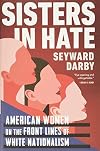
Author of Sisters in hate: American women on the front lines of white nationalism
About the Author
Seyward Darby is the editor in chief of the Atavist Magazine. She previously served as the deputy editor of Foreign Policy and the online editor and assistant managing editor of the New Republic. Her writing has appeared in the New York Times, The Attantic, the Washington Post, and The Guardian, show more among other publications. show less
Works by Seyward Darby
Sisters in hate: American women on the front lines of white nationalism (2020) 192 copies, 11 reviews
Tagged
Common Knowledge
Members
Reviews
Disclaimer: The publisher sent me a copy of the book in exchange for a fair and unbiased review.
Seyward Darby’s Sisters in Hate profiles three women who were/are part of the White Supremacy Klan. (I am sorry, I will not use the word movement for it, and yes, the K is intentional). If you read this past week’s New York Times, you were able to read much of the profile of Corinna, so you should check out that essay first before reading the book if you are in doubt.
Darby’s book is at show more once necessary and terrifying.
On one had the profiles are terrifying because the women are so, well, every day. Darby is correct to point at that we tend put mothers, in particular WHITE mothers, on a pedestal of “thou are great and most be protected” and this is tied to the idea of nice and meek that all women are encouraged to present and that women of color in particular get attacked for not being when they say something like, “I don’t want to do that”. I am speaking generalities here, and I know that that race and age also are factors. But regardless of her privilege as a white woman, Dr Blasely-Ford would have been presented radically differently by many outlets and people if she had let her anger show. But a certain Supreme Court justice can come storming in, throwing a temper tantrum, insult a sitting senator, and still get approved.
Darby breaks down the language that such women use to deflect or disarm the charge of racism when they speak as well as the image of the “perfect white wife and mother” can be used to challenge the charge of racism as well as justify breaking with the model by speaking in public. While she can’t give an exact reason why all three women joined hate groups ( in at least one case it seems to be a desire to belong), she can and does point to what harm such people can do even when they are not disrupting a neighborhood with marches. If anything, the end of the book is a call to pay attention and not seek meekly by.
Darby’s writing is engaging, and she neither demonizes nor sanctifies her subjects. She presents the story as fully as she can, noting when she could not speak to the subjects. Perhaps it is this use of neutral language that make the book so scary. They could literally be your next-door neighborhood. Anyone could become them.
And that is the reason why this book should be read. If books about racisms are most reads because they educate about behavior and interaction, books about racists are just as important, not because they normalize behavior, but because they showcase what normalizing or disregarding such behavior does and how it affects society in ways that we can’t quite see. show less
Seyward Darby’s Sisters in Hate profiles three women who were/are part of the White Supremacy Klan. (I am sorry, I will not use the word movement for it, and yes, the K is intentional). If you read this past week’s New York Times, you were able to read much of the profile of Corinna, so you should check out that essay first before reading the book if you are in doubt.
Darby’s book is at show more once necessary and terrifying.
On one had the profiles are terrifying because the women are so, well, every day. Darby is correct to point at that we tend put mothers, in particular WHITE mothers, on a pedestal of “thou are great and most be protected” and this is tied to the idea of nice and meek that all women are encouraged to present and that women of color in particular get attacked for not being when they say something like, “I don’t want to do that”. I am speaking generalities here, and I know that that race and age also are factors. But regardless of her privilege as a white woman, Dr Blasely-Ford would have been presented radically differently by many outlets and people if she had let her anger show. But a certain Supreme Court justice can come storming in, throwing a temper tantrum, insult a sitting senator, and still get approved.
Darby breaks down the language that such women use to deflect or disarm the charge of racism when they speak as well as the image of the “perfect white wife and mother” can be used to challenge the charge of racism as well as justify breaking with the model by speaking in public. While she can’t give an exact reason why all three women joined hate groups ( in at least one case it seems to be a desire to belong), she can and does point to what harm such people can do even when they are not disrupting a neighborhood with marches. If anything, the end of the book is a call to pay attention and not seek meekly by.
Darby’s writing is engaging, and she neither demonizes nor sanctifies her subjects. She presents the story as fully as she can, noting when she could not speak to the subjects. Perhaps it is this use of neutral language that make the book so scary. They could literally be your next-door neighborhood. Anyone could become them.
And that is the reason why this book should be read. If books about racisms are most reads because they educate about behavior and interaction, books about racists are just as important, not because they normalize behavior, but because they showcase what normalizing or disregarding such behavior does and how it affects society in ways that we can’t quite see. show less

Sisters in Hate: American Women on the Front Lines of White Nationalism by Seyward Darby exceeded any expectations I had for the book. This is eye-opening and, to the extent possible, empathetic toward the women profiled without condoning or supporting their hatred.
In many books that use profiles as a major part of presenting a thesis there is a bit of a disconnect between any broader information that serves to contextualize and explain and the personal accounts of the individuals presented. show more Darby avoids that problem here by interspersing any sociological, psychological, or political information with the ongoing narrative of the woman being profiled. This serves, I think, several purposes. First, it presents the ideas when they are most applicable to the woman's story so we can better understand her as well as extrapolate out to other women. It also, by not having all of the broad ideas, theories, and statistics in their own chapters, makes the book flow much better. Finally, and this will be especially important for readers like myself who grow frustrated and/or angry while reading what these women believe and support, it acts like a governor on those emotions so we never get so frustrated or angry that we forget the main point of reading the book. And that point is to better understand both the hate movement(s) and the individuals in those movements.
I was particularly impressed with the way Darby managed to present these women as whole human beings and not simply caricatures set up for our derision. I was surprised the extent to which I could feel some degree of empathy for aspects of what brought them to where they are. I personally couldn't make it all the way to feeling that for the person but it did keep me from feeling the degree of dislike I would normally feel.
While there is a bit of a conclusion that offers some sense of hope it stops well short of being prescriptive. In large part, I would guess, because there is no single cure-all for hate movement(s). It does, however, suggest that offering a hand out of hatred can work for some (most?) of those in the movement.
I would recommend this to anyone wanting to better understand an underexposed aspect of the white nationalist (read white supremacist, or even simply racist) movement that has been empowered by our clown-in-chief. As for people who give one star reviews but no constructive or worthwhile critique whatsoever, just ignore them, they look for books that they disagree with and, without reading them, give one star ratings. Likely upset because she wasn't included in the book when she is clearly just as ill-informed and bigoted as those included. Oh well, if you actually want to understand women in the racist, oops, white nationalist, movement I highly recommend this book.
Reviewed from a copy made available by the publisher via NetGalley. show less
In many books that use profiles as a major part of presenting a thesis there is a bit of a disconnect between any broader information that serves to contextualize and explain and the personal accounts of the individuals presented. show more Darby avoids that problem here by interspersing any sociological, psychological, or political information with the ongoing narrative of the woman being profiled. This serves, I think, several purposes. First, it presents the ideas when they are most applicable to the woman's story so we can better understand her as well as extrapolate out to other women. It also, by not having all of the broad ideas, theories, and statistics in their own chapters, makes the book flow much better. Finally, and this will be especially important for readers like myself who grow frustrated and/or angry while reading what these women believe and support, it acts like a governor on those emotions so we never get so frustrated or angry that we forget the main point of reading the book. And that point is to better understand both the hate movement(s) and the individuals in those movements.
I was particularly impressed with the way Darby managed to present these women as whole human beings and not simply caricatures set up for our derision. I was surprised the extent to which I could feel some degree of empathy for aspects of what brought them to where they are. I personally couldn't make it all the way to feeling that for the person but it did keep me from feeling the degree of dislike I would normally feel.
While there is a bit of a conclusion that offers some sense of hope it stops well short of being prescriptive. In large part, I would guess, because there is no single cure-all for hate movement(s). It does, however, suggest that offering a hand out of hatred can work for some (most?) of those in the movement.
I would recommend this to anyone wanting to better understand an underexposed aspect of the white nationalist (read white supremacist, or even simply racist) movement that has been empowered by our clown-in-chief. As for people who give one star reviews but no constructive or worthwhile critique whatsoever, just ignore them, they look for books that they disagree with and, without reading them, give one star ratings. Likely upset because she wasn't included in the book when she is clearly just as ill-informed and bigoted as those included. Oh well, if you actually want to understand women in the racist, oops, white nationalist, movement I highly recommend this book.
Reviewed from a copy made available by the publisher via NetGalley. show less
absolutely CRUCIAL in understanding women's role in white nationalist spaces and the different avenues in which the recruitment process takes place, especially in our current social media climate!!!beyond the obvious alt-right paths via youtube and message boards, there's really important moments in here that showcase how certain circles (tradwives, paganism, new age wellness) can be exposure to white nationalist talking points and pull women in with promise of empowerment & community- and show more these circles/subcultures are all having their moment on tiktok and instagram right now. power truly lies in understanding that you're not always going to encounter hate groups that are violent and easy to spot; you're just as likely to find them in women like the ones featured here who are polite and 'normal' and 'just asking questions' show less
Sheesh. I'm not sure I'm comfortable with "I liked it," as a 4-star rating summation, because I didn't like the subject matter. I felt it was necessary to read, in the way that I feel it is necessary to read discussions of chilling truths. In light of this past (fingers crossed) Administration, I'm attempting to ameliorate (or at least mitigate) my naivete.
Darby opened my eyes -- not to the rightness of the alt-right movement, but to the fact that it exists, robustly so, in America right show more now. And its adherents are passionate, and many thousands are younger than I am. That last bit is particularly interesting and reveals so much about the state of fear, politics, and something I'll call "Millennial outrage." show less
Darby opened my eyes -- not to the rightness of the alt-right movement, but to the fact that it exists, robustly so, in America right show more now. And its adherents are passionate, and many thousands are younger than I am. That last bit is particularly interesting and reveals so much about the state of fear, politics, and something I'll call "Millennial outrage." show less
Awards


Statistics
- Works
- 1
- Members
- 192
- Popularity
- #113,796
- Rating
- 4.2
- Reviews
- 11
- ISBNs
- 11