
Natalie Pope Boyce
Author of Dark Day in the Deep Sea
About the Author
Image credit: Natalie Pope Boyce
Works by Natalie Pope Boyce
Ancient Greece and the Olympics: A Nonfiction Companion to Hour of the Olympics (2004) 1,824 copies, 6 reviews
American Revolution: A Nonfiction Companion to Revolutionary War on Wednesday (2004) 1,673 copies, 10 reviews
Sabertooths and the Ice Age: A Nonfiction Companion to Sunset of the Sabertooth (2005) 1,141 copies, 4 reviews
Ancient Rome and Pompeii: A Nonfiction Companion to Vacation Under the Volcano (2006) — Author — 1,082 copies, 4 reviews
Tsunamis and Other Natural Disasters: A Nonfiction Companion to High Tide in Hawaii (2007) 1,041 copies, 4 reviews
Polar Bears and the Arctic: A Nonfiction Companion to Polar Bears Past Bedtime (2007) — Author — 917 copies, 3 reviews
Sea Monsters: A Nonfiction Companion to Dark Day in the Deep Sea (2008) — Author — 898 copies, 1 review
Penguins and Antarctica: A Nonfiction Companion to Eve of the Emperor Penguin (2008) 866 copies, 3 reviews
Leprechauns and Irish Folklore: A Nonfiction Companion to Leprechaun in Late Winter (2010) 747 copies, 2 reviews
Pandas and Other Endangered Species: A Nonfiction Companion to A Perfect Time for Pandas (2012) 495 copies, 7 reviews
Snakes and Other Reptiles: A Nonfiction Companion to A Crazy Day With Cobras (2011) 424 copies, 2 reviews
Rags and Riches: Kids in the Time of Charles Dickens: A Nonfiction Companion to A Ghost Tale for Christmas Time (2010) 354 copies, 2 reviews
China: Land of the Emperor's Great Wall: A Nonfiction Companion to Day of the Dragon King (2014) 184 copies, 1 review
Associated Works
Vacation Under the Volcano / Magic Tree House Research Guide Ancient Rome and Pompeii (2007) — Author — 12 copies, 2 reviews
Tagged
Common Knowledge
- Gender
- female
- Occupations
- children's librarian
teacher of English as a Second Language
author - Relationships
- Osborne, Mary Pope (sister)
Members
Reviews
Magic Tree House Fact Tracker #26: Pandas and Other Endangered Species: A Nonfiction Companion to Magic Tree House #48: A Perfect Time for Pandas by Mary Pope Osborne
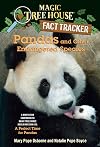
I liked reading this book. The main message is to teach children information about pandas and some other endangered species, and how children can help try to save them. One thing I liked about this book is the style of the text. On the pages, there is the regular text in the chapter, but then on some pages there are sidebars or a conversation between the characters. For example, when the book talks about bamboo, the boy character says to the girl "if you tried to eat bamboo, I bet it would show more scratch your throat" to which she responded "I know! But pandas have very tough throats so the bamboo doesn't hurt them". I think this gives children a break from the text that is in the standard format and they get to read short sentences that give information related to the chapter. Another thing I liked about this book was the last section on how children can help. Often times, books will just bring up problems in the world and not offer any kind of advice for the kids. This book names ways that children can change small things that can make a big difference. It also gives many more research tools in case the children want to expand their knowledge even further. Some examples they listed include pick up litter, build bird feeders, or saving energy. show less
Magic Tree House Research Guide #22: Rags and Riches: Kids in the Time of Charles Dickens: A Nonfiction Companion to Magic Tree House #44: A Ghost Tale for Christmas Time (A Stepping Stone Book(TM)) by Mary Pope Osborne
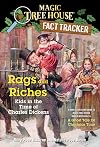
This is the companion book to A Ghost Tale for Christmas Time, a historical fantasy romp through Dickens' A Christmas Carol,which is why it has the subtitle, Kids in the Time of Charles Dickens, when "Kids in the Victorian Era" might seem more logical.
Charles Dickens lived from 1812 - 1870, largely in the Victoria Era. Queen Victoria reigned from 1837- 1901. Rich or poor, life was difficult for Britain's children in those days. Rich children suffered from serious diseases and were raised show more largely apart from their parents. Boys were sent away to strict schools while girls studied at home with a governess those subjects which were thought most likely to win them a suitable husband - French, dancing, drawing, music. Of course, they were still much better off than the poor children and street children who filled the streets of London. They slept outside in rags or lived in debtors' prisons or squalid housing. They often worked in dangerous factories for long hours with little or no pay - beginning as young as five years old! Cholera and typhoid were epidemic. Life for a poor child in the time of Charles Dickens was wretched. Rags to Riches explains all these facets of Victorian Era life and more, with liberal use of sketches and period photographs.
It is doubtful that any child can read the accounts in the chapter, "Jobs for Poor Kids," and not be affected. Imagine life as a climbing boy, often only five or six years old,
"Since they were small, they could squeeze through narrow parts of the chimney.
Climbing boys climbed to the top of the chimney and swept the coal dust out on their way back down. They got cuts and bruises from the jagged bricks. To toughen up their skin, salt water was rubbed into it.
If the boys got scared and stopped climbing, the chimney sweeps jabbed their feet with pins or lit fires to keep them moving. At times climbing boys got burned or stuck in the chimneys and suffocated.'
Quite a different reality from the friendly, Bert, of Mary Poppins fame!
A children's highlight from the Victoria Era? The birth of the modern children's picture book - Beatrix Potter's illustrated Tales of Peter Rabbit. Of course, without money, poor children likely only glimpsed the tiny little books through shop windows.
This is not an easy topic for which to create a research guide. A chronological approach does not work well, and the many aspects of a child's life are almost too large in scope for a book of this small scale. Still, Pope has created a semblance of order, dividing the topic into six chapters: 'Hard Times for Kids," "What Charles Dickens Saw," "The London of Dickens," "Jobs for Poor Kids," Rich Kids," and "How Things Changed."
Avenues for further research and an index complete this guide book.
http://www.shelf-employed.blogspot.com show less
Charles Dickens lived from 1812 - 1870, largely in the Victoria Era. Queen Victoria reigned from 1837- 1901. Rich or poor, life was difficult for Britain's children in those days. Rich children suffered from serious diseases and were raised show more largely apart from their parents. Boys were sent away to strict schools while girls studied at home with a governess those subjects which were thought most likely to win them a suitable husband - French, dancing, drawing, music. Of course, they were still much better off than the poor children and street children who filled the streets of London. They slept outside in rags or lived in debtors' prisons or squalid housing. They often worked in dangerous factories for long hours with little or no pay - beginning as young as five years old! Cholera and typhoid were epidemic. Life for a poor child in the time of Charles Dickens was wretched. Rags to Riches explains all these facets of Victorian Era life and more, with liberal use of sketches and period photographs.
It is doubtful that any child can read the accounts in the chapter, "Jobs for Poor Kids," and not be affected. Imagine life as a climbing boy, often only five or six years old,
"Since they were small, they could squeeze through narrow parts of the chimney.
Climbing boys climbed to the top of the chimney and swept the coal dust out on their way back down. They got cuts and bruises from the jagged bricks. To toughen up their skin, salt water was rubbed into it.
If the boys got scared and stopped climbing, the chimney sweeps jabbed their feet with pins or lit fires to keep them moving. At times climbing boys got burned or stuck in the chimneys and suffocated.'
Quite a different reality from the friendly, Bert, of Mary Poppins fame!
A children's highlight from the Victoria Era? The birth of the modern children's picture book - Beatrix Potter's illustrated Tales of Peter Rabbit. Of course, without money, poor children likely only glimpsed the tiny little books through shop windows.
This is not an easy topic for which to create a research guide. A chronological approach does not work well, and the many aspects of a child's life are almost too large in scope for a book of this small scale. Still, Pope has created a semblance of order, dividing the topic into six chapters: 'Hard Times for Kids," "What Charles Dickens Saw," "The London of Dickens," "Jobs for Poor Kids," Rich Kids," and "How Things Changed."
Avenues for further research and an index complete this guide book.
http://www.shelf-employed.blogspot.com show less
Magic Tree House Fact Tracker #26: Pandas and Other Endangered Species: A Nonfiction Companion to Magic Tree House #48: A Perfect Time for Pandas (A Stepping Stone Book(TM)) by Mary Pope Osborne
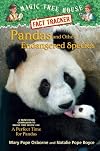
This is a nonfiction companion for the Magic Tree House book A Perfect Time for Pandas. It's full of fascinating facts about pandas ("A newborn panda is about as long as a pencil and as light as a stick of butter!") and other endangered species. I love the idea of pairing fiction and nonfiction to fill in the gaps with facts. Someone was thinking! There's also an excellent section at the end called "Doing More Research" that includes books, museums, zoos, DVDs, and websites.
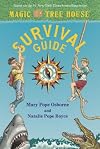
I enjoyed this book because I like to think of it as a how to book. the first thing I liked was it was broken into sections then each section was broken up into smaller sections. So the first one was wilderness skills then that was broken into seven more sub headings that show you exactly what to do when in the wilderness. the next thing that i liked was within each subsection there was a step by step numbered on what to do if you were in that situation. the illustrations that went with each show more group was also very detailed that helped out, such as what to do if there is a twister it shows that kids running away. I think the over all message of this book is about things will happen and there is always a way to survive the situation. show less
Lists
Awards

You May Also Like
Associated Authors
Statistics
- Works
- 25
- Also by
- 4
- Members
- 20,040
- Popularity
- #1,081
- Rating
- 3.9
- Reviews
- 82
- ISBNs
- 306
- Languages
- 9