
Caleb Gayle
Author of We Refuse to Forget: A True Story of Black Creeks, American Identity, and Power
Works by Caleb Gayle
We Refuse to Forget: A True Story of Black Creeks, American Identity, and Power (2022) 92 copies, 3 reviews
Tagged
Common Knowledge
There is no Common Knowledge data for this author yet. You can help.
Members
Reviews
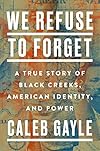
This book investigates a singular, marginal identity—people who, along with their ancestors, are “fully Black and fully Creek.” And in doing so, it exposes & interrogates some crucial aspects of race and power in American history.
For a fairly dense nonfiction book, the tone is both measured and curious. The personal narrative threads do feel a little muddled at times, but even at that, there are flashes of real poignancy and insight. They serve as a recurring clarification that this show more isn’t abstract history; it’s bound up with current lives, and living inheritances.
For me, what landed most was the depiction of how systematically the U.S. government dismantled the communal structures of the Creek people. The goal wasn’t only—maybe not even primarily—to seize land, but to break down collective identity. White colonizers, embodied in the US government, “knew that communalism among the Creeks provided strength, but you can divide and conquer a nation more easily with private property if you pit family estate against family estate.” The 1887 Dawes Act was formulated to do exactly that, to “divide Indigenous, communally held lands. . . . [forcing] these Nations, according to historian Kent Blansett, to ‘assume a capitalist and proprietary relationship with property.’ ” And, sadder still, with each other. Gayle elucidates how political and economic power work to convince people to see themselves apart from the communities that once sustained them. This was a widespread process, affecting the history of many Indian nations, and it’s well demonstrated in the specifics Gayle provides.
There is a powerful combination of intellect and anger throughout the book, and it’s infectious. It’s not a polemic, but you won’t come away from it without some outrage. The book is reflective, and at the same time deeply unsettling in its exploration of just how thoroughly the forces of racial hierarchy have been woven into law, policy and practice—both in the US as a whole, and even within the Creek nation itself. show less
For a fairly dense nonfiction book, the tone is both measured and curious. The personal narrative threads do feel a little muddled at times, but even at that, there are flashes of real poignancy and insight. They serve as a recurring clarification that this show more isn’t abstract history; it’s bound up with current lives, and living inheritances.
For me, what landed most was the depiction of how systematically the U.S. government dismantled the communal structures of the Creek people. The goal wasn’t only—maybe not even primarily—to seize land, but to break down collective identity. White colonizers, embodied in the US government, “knew that communalism among the Creeks provided strength, but you can divide and conquer a nation more easily with private property if you pit family estate against family estate.” The 1887 Dawes Act was formulated to do exactly that, to “divide Indigenous, communally held lands. . . . [forcing] these Nations, according to historian Kent Blansett, to ‘assume a capitalist and proprietary relationship with property.’ ” And, sadder still, with each other. Gayle elucidates how political and economic power work to convince people to see themselves apart from the communities that once sustained them. This was a widespread process, affecting the history of many Indian nations, and it’s well demonstrated in the specifics Gayle provides.
There is a powerful combination of intellect and anger throughout the book, and it’s infectious. It’s not a polemic, but you won’t come away from it without some outrage. The book is reflective, and at the same time deeply unsettling in its exploration of just how thoroughly the forces of racial hierarchy have been woven into law, policy and practice—both in the US as a whole, and even within the Creek nation itself. show less
When blacks would go into Indian Territory (Oklahoma) and live with the Creeks, they had the opportunity to marry into the tribe. When they did, they became a member of the tribe. This is the story of the Simmons family. It tells the history of their family from Cow Tom, the first member of the family to be a Black Creek who was a chief of the tribe, through his present-day descendants who had their citizenship in the Creek Nation taken from them in 1979 when the Creeks wrote a new show more constitution that fell in line with what the U.S. Government wanted for them to have more autonomy over their tribal culture, lives, and government. The family and other Black Creek families are trying to get the Black Creek citizenship returned to them and have shown through their genealogies that they are blood Creeks.
I found this book fascinating on so many levels. Obviously, I enjoyed the Simmons Family history. I liked reading of their successes and prosperity as they were treated like people in the Creek Nation. I liked seeing the opportunities for them before the white settlers came into Indian Territory after the Civil War. The U.S. government broke treaties with the tribes and forced their bigoted roles onto the tribes, especially Black members of those tribes.
Reading the history and culture of the Creeks was interesting. I learned so much that I was never taught in school. I also liked learning some of the history of Oklahoma. I knew little of it and have only recently learned of the Tulsa Race Massacre in 1921. I appreciated knowing it still affects the race relations between Tulsa residents.
I liked that Mr. Gayle puts his experiences into the book since his family only moved to Oklahoma when he was eight. I liked how he takes the history of the Black Creeks and thinks about its effect on him today. It makes me think also of how much I need to learn of the Black experience and the negative impact that still abounds within the Black community from slavery, Jim Crow laws, police brutality, and white privledge and apathy.
This is a book all people need to read. It opened my eyes to how much we are not taught and how much is whitewashed or ignored. Very well written and worth your time though it is a hard book to read. show less
I found this book fascinating on so many levels. Obviously, I enjoyed the Simmons Family history. I liked reading of their successes and prosperity as they were treated like people in the Creek Nation. I liked seeing the opportunities for them before the white settlers came into Indian Territory after the Civil War. The U.S. government broke treaties with the tribes and forced their bigoted roles onto the tribes, especially Black members of those tribes.
Reading the history and culture of the Creeks was interesting. I learned so much that I was never taught in school. I also liked learning some of the history of Oklahoma. I knew little of it and have only recently learned of the Tulsa Race Massacre in 1921. I appreciated knowing it still affects the race relations between Tulsa residents.
I liked that Mr. Gayle puts his experiences into the book since his family only moved to Oklahoma when he was eight. I liked how he takes the history of the Black Creeks and thinks about its effect on him today. It makes me think also of how much I need to learn of the Black experience and the negative impact that still abounds within the Black community from slavery, Jim Crow laws, police brutality, and white privledge and apathy.
This is a book all people need to read. It opened my eyes to how much we are not taught and how much is whitewashed or ignored. Very well written and worth your time though it is a hard book to read. show less

nonfiction, Black and Indigenous American history, (systemically racist) historical policy effects on the ability to recognize complex identities, among other rights.
interesting and well worth learning about, though the way all the information is spliced together sometimes makes the narrative arc harder to follow. But there's value in telling each person's stories, and for showing how complex the issues are. Recommended.
interesting and well worth learning about, though the way all the information is spliced together sometimes makes the narrative arc harder to follow. But there's value in telling each person's stories, and for showing how complex the issues are. Recommended.
Lists
Awards


You May Also Like
Associated Authors
Statistics
- Works
- 3
- Members
- 178
- Popularity
- #120,888
- Rating
- 3.9
- Reviews
- 3
- ISBNs
- 15