
Ann Haywood Leal
Author of Also Known As Harper
About the Author
Works by Ann Haywood Leal
Also Know As Harper 1 copy
Associated Works
My Bookstore: Writers Celebrate Their Favorite Places to Browse, Read, and Shop (2012) — Contributor — 616 copies, 16 reviews
Tagged
Common Knowledge
There is no Common Knowledge data for this author yet. You can help.
Members
Reviews

Those who might think that YA is all fluff, please take some time to read this book.
Dealing with the difficult, tragic subject of homelessness, the author shows keen insight into this travesty.
Told through the eyes of fifth grade Harper, we witness the plight of her mother and her family.
Her father's absence leaves Harper with conflicted emotions, Harper remembers her father before the alcohol became #1 priority in his life, before he grew more and more dependent upon the liquor, before his show more children had to witness abuse and verbal arrows that stung.
Harper is glad her father left, but now watches as day by day her mother cannot pay the bills and increasingly month by month is late with the rent.
When they are evicted, they have no safety net. As Harper and her family scrabble to salvage some of their possessions from the front yard where they were thrown by the land lady, Harper is faced with the reality that while their items are second hand, they are important to the family, and now, there is no where to place them.
Living in a run down motel provides temporary shelter. When Harper's mother losses one of her two cleaning jobs, they cannot afford the motel.
Harper's mother is strong. Harper's mother is hard working. Harper's mother is not at fault for the homelessness of her family. Harper's mother is not, what some cold, uninformed people would deem "a welfare queen!" -- God, I hate that phrase!!!
Depressing story? Yes. But, truly, such is life for those living on the edge of society.
I know because I volunteered in our local homeless shelter and served on the board of directors for a number of years.
Conservative statistics note 1.6 million children are homeless in the United States. While we watch tv programs asking us to give up our cup of coffee and send the money to India or Africa, please, let us take heed that people in our own back yard need shelter and food.
Politicians on the right and left would like us to believe we are in the "land of plenty." Not true! Not true!!!!
http://www.care2.com/causes/over-one-million-u-s-kids-are-homeless.html
http://www.ucdenver.edu/academics/colleges/ArchitecturePlanning/discover/centers....
-------------
Harper has talent; she can write poetry. Harper has dreams; she wants to win the poetry contest at her school.
Harper cannot go to school because she must watch Hemingway, her little brother who obsessively keeps watch for the return of his father, as every night he stands guard waiting for a vehicle to return with the father that he remembers as kind and supportive.
There are wonderful characters in this book. Harper finds and befriends another homeless family.
While her spirit is bruised, it is not crushed and Harper and her family try to make the best of a very difficult situation.
Five Stars. Highly recommended! show less
Dealing with the difficult, tragic subject of homelessness, the author shows keen insight into this travesty.
Told through the eyes of fifth grade Harper, we witness the plight of her mother and her family.
Her father's absence leaves Harper with conflicted emotions, Harper remembers her father before the alcohol became #1 priority in his life, before he grew more and more dependent upon the liquor, before his show more children had to witness abuse and verbal arrows that stung.
Harper is glad her father left, but now watches as day by day her mother cannot pay the bills and increasingly month by month is late with the rent.
When they are evicted, they have no safety net. As Harper and her family scrabble to salvage some of their possessions from the front yard where they were thrown by the land lady, Harper is faced with the reality that while their items are second hand, they are important to the family, and now, there is no where to place them.
Living in a run down motel provides temporary shelter. When Harper's mother losses one of her two cleaning jobs, they cannot afford the motel.
Harper's mother is strong. Harper's mother is hard working. Harper's mother is not at fault for the homelessness of her family. Harper's mother is not, what some cold, uninformed people would deem "a welfare queen!" -- God, I hate that phrase!!!
Depressing story? Yes. But, truly, such is life for those living on the edge of society.
I know because I volunteered in our local homeless shelter and served on the board of directors for a number of years.
Conservative statistics note 1.6 million children are homeless in the United States. While we watch tv programs asking us to give up our cup of coffee and send the money to India or Africa, please, let us take heed that people in our own back yard need shelter and food.
Politicians on the right and left would like us to believe we are in the "land of plenty." Not true! Not true!!!!
http://www.care2.com/causes/over-one-million-u-s-kids-are-homeless.html
http://www.ucdenver.edu/academics/colleges/ArchitecturePlanning/discover/centers....
-------------
Harper has talent; she can write poetry. Harper has dreams; she wants to win the poetry contest at her school.
Harper cannot go to school because she must watch Hemingway, her little brother who obsessively keeps watch for the return of his father, as every night he stands guard waiting for a vehicle to return with the father that he remembers as kind and supportive.
There are wonderful characters in this book. Harper finds and befriends another homeless family.
While her spirit is bruised, it is not crushed and Harper and her family try to make the best of a very difficult situation.
Five Stars. Highly recommended! show less
Mock Newbery 2010
There were a lot of things I disliked about this, but let's start with the positives: it portrays homelessness in an interesting way, from the family being evicted, to living in a motel, to pitching a tent in the woods, all the while making the best of it and trying to stay together and support each other. It also features one my my favorite books, To Kill a Mockingbird, heavily.
But To Kill a Mockingbird it is not. I thought Harper Lee's voice as a narrator was too flowery. show more It just didn't sound real. Harper Lee is a poet, and her poems are featured in the book, but honestly there isn't much difference between the language of her poetry and the way she tells the story. Both are full of Southern folksiness that sounds forced; it's like I can see the author trying to be artful, which really bugs me. I also had this problem with [b:Crows and Cards|4818478|Crows and Cards|Joseph Helgerson|http://ecx.images-amazon.com/images/I/516ukAsLFNL._SL75_.jpg|4883620] and [b:Return to Sender|3236586|Return to Sender|Julia Alvarez|http://photo.goodreads.com/books/1234063391s/3236586.jpg|3271108]. I think I'm being extra hard on them because they're Mock Newbery books and I expect better writing.
I imagine this book is so well-received because there are so many serious issues in it: the death of a baby (no, two babies), a girl so traumatized she doesn't speak, an alcoholic father who abandons his already poverty-stricken family, the aforementioned homelessness, an old lady who's been driven a little crazy by grief, kids who can't go to school because they're poor, mothers who labor day after day but can't afford to take care of their kids, families hiding from Child Protective Services to stay together, a stinky bully of a girl named Winnie Rae. I mean, this book has more than its share of injustice in it, but it was not inspirational or fun to read. The ending was unbelievably convenient and depressing at the same time
So, yeah, not a fan. show less
There were a lot of things I disliked about this, but let's start with the positives: it portrays homelessness in an interesting way, from the family being evicted, to living in a motel, to pitching a tent in the woods, all the while making the best of it and trying to stay together and support each other. It also features one my my favorite books, To Kill a Mockingbird, heavily.
But To Kill a Mockingbird it is not. I thought Harper Lee's voice as a narrator was too flowery. show more It just didn't sound real. Harper Lee is a poet, and her poems are featured in the book, but honestly there isn't much difference between the language of her poetry and the way she tells the story. Both are full of Southern folksiness that sounds forced; it's like I can see the author trying to be artful, which really bugs me. I also had this problem with [b:Crows and Cards|4818478|Crows and Cards|Joseph Helgerson|http://ecx.images-amazon.com/images/I/516ukAsLFNL._SL75_.jpg|4883620] and [b:Return to Sender|3236586|Return to Sender|Julia Alvarez|http://photo.goodreads.com/books/1234063391s/3236586.jpg|3271108]. I think I'm being extra hard on them because they're Mock Newbery books and I expect better writing.
I imagine this book is so well-received because there are so many serious issues in it: the death of a baby (no, two babies), a girl so traumatized she doesn't speak, an alcoholic father who abandons his already poverty-stricken family, the aforementioned homelessness, an old lady who's been driven a little crazy by grief, kids who can't go to school because they're poor, mothers who labor day after day but can't afford to take care of their kids, families hiding from Child Protective Services to stay together, a stinky bully of a girl named Winnie Rae. I mean, this book has more than its share of injustice in it, but it was not inspirational or fun to read. The ending was unbelievably convenient and depressing at the same time
So, yeah, not a fan. show less
I honestly couldn't put this one down. I took it to work with me one day and decided to read for just one minute while I was turning on my computer.... and about fifteen minutes later realized it was time to hit crl+alt+delete.
It's a coming-of-age novel set in the south that sort of reminds me of a cross between Dorothy Allison and Fannie Flagg. It's got that colorful southern setting and has those great original characters with real life problems, but it's not as tragic as Allison's novels show more nor is it as funny as Flagg's. It strikes this great middle of the road chord - and I DO NOT mean that in a negative way. I love that no one in the story is either totally good or totally bad - I just hate it when stories are written that way... it's (usually) so unrealistic. And yes, I get that sometimes it's a metaphor, but I don't like being hit over the head with metaphors and I don't think kids do either. Ok, off my soapbox - sorry. I also loved the poetry scattered throughout the book - it's a good way to introduce it. I like that although it was a good ending it wasn't a "too perfect" ending.
Anyway, this novel was great and I'm recommending it all middle school girls that I know - and I think it could even still be good for high school girls looking for an easy read.
Big Thumbs Up! show less
It's a coming-of-age novel set in the south that sort of reminds me of a cross between Dorothy Allison and Fannie Flagg. It's got that colorful southern setting and has those great original characters with real life problems, but it's not as tragic as Allison's novels show more nor is it as funny as Flagg's. It strikes this great middle of the road chord - and I DO NOT mean that in a negative way. I love that no one in the story is either totally good or totally bad - I just hate it when stories are written that way... it's (usually) so unrealistic. And yes, I get that sometimes it's a metaphor, but I don't like being hit over the head with metaphors and I don't think kids do either. Ok, off my soapbox - sorry. I also loved the poetry scattered throughout the book - it's a good way to introduce it. I like that although it was a good ending it wasn't a "too perfect" ending.
Anyway, this novel was great and I'm recommending it all middle school girls that I know - and I think it could even still be good for high school girls looking for an easy read.
Big Thumbs Up! show less
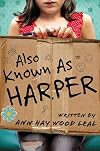
Fifth grader Harper Lee Morgan is named after her mother’s favorite author, and Harper knows that the poems that she writes are good. However, circumstances beyond her control must take precedence. When they suddenly lose their home, it is up to Harper to watch her younger brother, Hemingway, while their mother tries to find extra jobs to make some money and be able to find a real home. Harper is devastated that her family situation will prevent her from being able to read her poems at her show more school’s poetry competition, but with help from unexpected places—new friends and old enemies—Harper realizes that poetry can be performed in any environment.
ALSO KNOWN AS HARPER is an easy and gentle read that introduces young readers to the delicate issue of homelessness through the eyes of a thoroughly appealing protagonist.
The occasionally whimsical and melodramatic plot is anchored by Harper Lee, whose passions, vulnerabilities, and narration contain ageless appeal. She is a very well realized character, and approaches the events in her life with objectivity and fluidity: she is healthily skeptical of some scenarios, but is willing to admit that she was wrong and has a lot to learn. Her interactions with her younger brother are adorable; in fact, the sense of familial strength in ALSO KNOWN AS HARPER will make you want to give your siblings, parents, or children a big hug for just existing.
Some of the supporting characters, however, are not believable as Harper Lee, and their characterization can seem repetitive and excessive, such as the wheelchair lady’s oft-noted ability to understand Harper better than she understands herself. The resolution is hasty and therefore not as satisfying as it could be, and as I noted earlier, there is a strain of fantastical unbelievability that runs throughout the story. A lot of the situations that Harper, her brother, and her friends stumble upon feel contrived, which is unfortunate, as it detracts from the poignancy of Harper and her family’s predicament.
ALSO KNOWN AS HARPER has its amateuristic flaws, but its intentions are clear and good: it illustrates the power of essential relationships to sustain one through the worst situations. As a result, it may be a good book for adults and children to read separately and discuss together. show less
ALSO KNOWN AS HARPER is an easy and gentle read that introduces young readers to the delicate issue of homelessness through the eyes of a thoroughly appealing protagonist.
The occasionally whimsical and melodramatic plot is anchored by Harper Lee, whose passions, vulnerabilities, and narration contain ageless appeal. She is a very well realized character, and approaches the events in her life with objectivity and fluidity: she is healthily skeptical of some scenarios, but is willing to admit that she was wrong and has a lot to learn. Her interactions with her younger brother are adorable; in fact, the sense of familial strength in ALSO KNOWN AS HARPER will make you want to give your siblings, parents, or children a big hug for just existing.
Some of the supporting characters, however, are not believable as Harper Lee, and their characterization can seem repetitive and excessive, such as the wheelchair lady’s oft-noted ability to understand Harper better than she understands herself. The resolution is hasty and therefore not as satisfying as it could be, and as I noted earlier, there is a strain of fantastical unbelievability that runs throughout the story. A lot of the situations that Harper, her brother, and her friends stumble upon feel contrived, which is unfortunate, as it detracts from the poignancy of Harper and her family’s predicament.
ALSO KNOWN AS HARPER has its amateuristic flaws, but its intentions are clear and good: it illustrates the power of essential relationships to sustain one through the worst situations. As a result, it may be a good book for adults and children to read separately and discuss together. show less
Awards


You May Also Like


Associated Authors
Statistics
- Works
- 3
- Also by
- 1
- Members
- 477
- Popularity
- #51,682
- Rating
- 3.7
- Reviews
- 22
- ISBNs
- 7