
Miles Hyman
Author of Shirley Jackson's "The Lottery": The Authorized Graphic Adaptation
About the Author
Miles Hyman has illustrated books for adults and children, and his work has been exhibited at the Eiffel Tower. He lives in Los Angeles. (Bowker Author Biography)
Works by Miles Hyman
The Black Dahlia (1) — Illustrator — 16 copies
Deux aventures de Félouda 1 copy
Een Engelse romance 1 copy
Associated Works
Mount Vernon Love Story: A Novel of George and Martha Washington (1969) — Cover artist, some editions — 1,191 copies, 19 reviews
Tagged
Common Knowledge
Members
Reviews

Chilling; Hyman masterfully channels the spirit of the original.
(Full disclosure: I received a free copy of this book for review from the publisher, Hill and Wang.)
No point in changing things now, is there?
First published in the June 26, 1948, issue of The New Yorker, Shirley Jackson's short story "The Lottery" has held up remarkably well over time; it's still as chilling and relevant today as it was seven decades ago.
Set in Any Town, USA, the story opens on a sunny June day, as the show more bustling townspeople prepare for the annual lottery. The very word evokes feelings of hope and luck, piles of money and all the good things the winner might do with her prize. Yet this lottery is much darker and more sinister than all that; entrants don't sacrifice a dollar to the kitty, but rather their very lives. And, until a revolution overthrows the barbaric, antiquated system, everyone is forced to participate - whether they want to or not.
I didn't realize it at first, but this graphic novel adaptation was written by one of Shirley Jackson's descendants - her grandson, Miles Hyman, who has previously written and illustrated several French-language graphic novels. The result is both skillful and strangely touching; I say "strangely" because, well, it's a bleak and brutal story.
Yet Hyman masterfully channels the spirit of the original story. The artwork is lovely, yet almost doggedly plain and drab - much like the town, which sees fit to murder one of its own in hopes of a bountiful harvest. There's a real Leave it to Beaver quality to the story, but with a dash of noir to spice things up. As with the original, the plainness of the setting only heightens the horror that's to come.
The story is faithful to the original, though Hyman does add some new scenes to flesh out the history of the Lottery and its mythic box, supposedly built from remains of the very first one. Much of the dialogue is lifted right from the source material, word for word.
But this isn't to suggest that Shirley Jackson's 'The Lottery' is unnecessary or a rip-off; quite the opposite. It introduces the story to a whole new audience, while adding to the mythos of the original.
If nothing else, Jackson fans should read it for the preface, in which Hyman shares a family ritual involving an ornate Victorian music box, and a childhood spent among artistic luminaries. These memories, told with obvious care and love, made me see the story in a new (dare I say gentler? nostalgic, even?) light.
http://www.easyvegan.info/2016/10/31/shirley-jacksons-the-lottery-the-authorized... show less

Hyman introduces two prominent changes with his adaptation of Jackson's iconic short story:
● Scene 1 - Two officials preparing the ballots before dawn
● Scene 2 - Tessie alone in the house before Lottery begins
(There is another scene in a diner which transposes into dialogue some of Jackson's descriptive prose. It also may be new, I do not examine that scene in detail.)
Hyman's adaptation does not include Jackson's complete text, though without tracking word-for-word, my impression is show more that most if not all included text is verbatim. Most text here is dialogue, with occasional comic-style captions; most excluded text appears to be description, for which Hyman substitutes images.
The illustrations remind me of William Joyce's affected 1930s graphic design, similarly stylised though in Hyman's case not art deco. (If there's a term for this style of illustration, I don't know it.) The illustrations are I think well suited to the story, a frisson between nostalgic sentiment and the brutality of the crowd which works in tandem with the plot.
Arguably one could read Hyman's adaptation without his additions. Indeed, Hyman inserts both scenes before Jackson's opening lines and then proceeds faithfully through the rest of the story. It is a simple matter to skip his additions, commencing instead with the helpful caption containing Jackson's famous first lines ("The morning of June 27th was clear and sunny, with the fresh warmth of a full-summer day; the flowers were blossoming profusely and the grass was richly green."). So why add these scenes, then -- what does their inclusion contribute to the story?
One possible answer is they assist in the visual telling of the story -- both new sections are practically wordless. This explanation appears especially relevant to the first new scene, with the careful preparation of a ballot box, suggesting an important vote of some kind will occur, and these images replace scattered phrases in Jackson's story which more or less impart the same information. Another possible explanation is Hyman has added new information, as though providing backstory of his own invention or restoring passages Jackson may have excised.
Scene 2 is different from Scene 1. Scene 2 depicts Tessie alone in her house and is completely new and not alluded to in Jackson's story. The scene is somewhat in tension with Tessie's later sheepish admission to a neighbour that she forgot the date, not because they contradict this chain of events but because --when viewed after finishing the story-- her actions seem contemplative and even a kind of preparation for leave-taking. Admittedly, at the end of Scene 2, Tessie appears to become aware of her surroundings, as though recalling what day it is, just as she confesses later. The tension may be wholly supplied by the reader, then. As a visual substitute for these lines, however, the scene both fails and is superfluous. Superfluous because Hyman includes the text verbatim later on; and a failure because Tessie's seeming realisation at the end of the scene is visually subtle, discernible only at the suggestion of her own statement. Without that confession, there is nothing definitive visually except that she finishes bathing.
What then, do the scenes do? Effectively they prolong the text by slowing down the reader and the moment, thereby postponing the climax. Jackson's original text slows the reader's progress with a languid, almost tranquil description of people gathering, but even when depicted individually (Hyman devotes several pages of multiple panels to these scenes), the eyes still propel the plot along, especially as there is very little text to read. Hyman's additional scenes restore the languid pace, and the resulting delayed gratification not only is congruous with Jackson's original text, it is for me a crucial element of pacing for both the final reveal, and the sense of the story overall.
I note here that Hyman's adaptation is authorized by Jackson's estate, and that he is Jackson's grandson, a fact he readily discloses in his preface. My reading already lead me to conclude Hyman does not add new information in the sense of backstory or cutting-room floor edits. Though the Jackson estate imprimatur is of course not the same as Jackson's personal approval, it goes some way in corroborating my own conclusion.
//
An observation not specific to this adaptation but inclusive of Jackson's original story: "The Lottery" resonates with the American tradition of public lynchings, during which a community gathers with a mixture of celebration and somber observation, and murders a member or members of the community. To be clear: the white members murder a black member of the community. The selection of murder victim is random at both the micro and macro levels: most immediately, because the black person was a convenient scapegoat or was the enemy of a white person for reasons unrelated to the "reason" given for their lynching; and generally, because it is entirely accidental (in the Aristotelian sense) that the black person was born with physical traits considered by their community as deserving execution.
Whether intentional or consciously a part of Jackson's writing, the resonance between the story and so important an aspect of American history is striking. In his preface to The Magic of Shirley Jackson, her husband remarked that Jackson “was always proud that the Union of South Africa banned 'The Lottery,' and she felt that they at least understood the story.” Suggests to me the parallel was part of Jackson's thinking, though it's curious she doesn't raise this point in her "Biography of a Story" or various other places in which she discusses the story or its reception. show less
● Scene 1 - Two officials preparing the ballots before dawn
● Scene 2 - Tessie alone in the house before Lottery begins
(There is another scene in a diner which transposes into dialogue some of Jackson's descriptive prose. It also may be new, I do not examine that scene in detail.)
Hyman's adaptation does not include Jackson's complete text, though without tracking word-for-word, my impression is show more that most if not all included text is verbatim. Most text here is dialogue, with occasional comic-style captions; most excluded text appears to be description, for which Hyman substitutes images.
The illustrations remind me of William Joyce's affected 1930s graphic design, similarly stylised though in Hyman's case not art deco. (If there's a term for this style of illustration, I don't know it.) The illustrations are I think well suited to the story, a frisson between nostalgic sentiment and the brutality of the crowd which works in tandem with the plot.
Arguably one could read Hyman's adaptation without his additions. Indeed, Hyman inserts both scenes before Jackson's opening lines and then proceeds faithfully through the rest of the story. It is a simple matter to skip his additions, commencing instead with the helpful caption containing Jackson's famous first lines ("The morning of June 27th was clear and sunny, with the fresh warmth of a full-summer day; the flowers were blossoming profusely and the grass was richly green."). So why add these scenes, then -- what does their inclusion contribute to the story?
One possible answer is they assist in the visual telling of the story -- both new sections are practically wordless. This explanation appears especially relevant to the first new scene, with the careful preparation of a ballot box, suggesting an important vote of some kind will occur, and these images replace scattered phrases in Jackson's story which more or less impart the same information. Another possible explanation is Hyman has added new information, as though providing backstory of his own invention or restoring passages Jackson may have excised.
Scene 2 is different from Scene 1. Scene 2 depicts Tessie alone in her house and is completely new and not alluded to in Jackson's story. The scene is somewhat in tension with Tessie's later sheepish admission to a neighbour that she forgot the date, not because they contradict this chain of events but because --when viewed after finishing the story-- her actions seem contemplative and even a kind of preparation for leave-taking. Admittedly, at the end of Scene 2, Tessie appears to become aware of her surroundings, as though recalling what day it is, just as she confesses later. The tension may be wholly supplied by the reader, then. As a visual substitute for these lines, however, the scene both fails and is superfluous. Superfluous because Hyman includes the text verbatim later on; and a failure because Tessie's seeming realisation at the end of the scene is visually subtle, discernible only at the suggestion of her own statement. Without that confession, there is nothing definitive visually except that she finishes bathing.
What then, do the scenes do? Effectively they prolong the text by slowing down the reader and the moment, thereby postponing the climax. Jackson's original text slows the reader's progress with a languid, almost tranquil description of people gathering, but even when depicted individually (Hyman devotes several pages of multiple panels to these scenes), the eyes still propel the plot along, especially as there is very little text to read. Hyman's additional scenes restore the languid pace, and the resulting delayed gratification not only is congruous with Jackson's original text, it is for me a crucial element of pacing for both the final reveal, and the sense of the story overall.
I note here that Hyman's adaptation is authorized by Jackson's estate, and that he is Jackson's grandson, a fact he readily discloses in his preface. My reading already lead me to conclude Hyman does not add new information in the sense of backstory or cutting-room floor edits. Though the Jackson estate imprimatur is of course not the same as Jackson's personal approval, it goes some way in corroborating my own conclusion.
//
An observation not specific to this adaptation but inclusive of Jackson's original story: "The Lottery" resonates with the American tradition of public lynchings, during which a community gathers with a mixture of celebration and somber observation, and murders a member or members of the community. To be clear: the white members murder a black member of the community. The selection of murder victim is random at both the micro and macro levels: most immediately, because the black person was a convenient scapegoat or was the enemy of a white person for reasons unrelated to the "reason" given for their lynching; and generally, because it is entirely accidental (in the Aristotelian sense) that the black person was born with physical traits considered by their community as deserving execution.
Whether intentional or consciously a part of Jackson's writing, the resonance between the story and so important an aspect of American history is striking. In his preface to The Magic of Shirley Jackson, her husband remarked that Jackson “was always proud that the Union of South Africa banned 'The Lottery,' and she felt that they at least understood the story.” Suggests to me the parallel was part of Jackson's thinking, though it's curious she doesn't raise this point in her "Biography of a Story" or various other places in which she discusses the story or its reception. show less
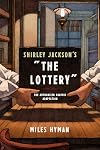
I picked this up off a display at the peacock library and then it got lost in my giant stack of library books. I rediscovered it today while looking through the stack for returns. "The Lottery" has stuck with me for decades—it is so dark and eerie, and it feels like something that people really would go along with for decades. While the illustrations in this graphic adaptation are beautiful (completed by Jackson's grandson), I think this story works better as just text. It packs a much show more bigger gut punch. That realization of...wait, they're about to do WHAT? show less
I'm obsessed with this graphic novel adaptation of Shirley Jackson's haunting short story, "The Lottery." The story begins with everyone in the village gathering for the annual Lottery. As the they run through a roll call of village families to ensure everyone has been able to attend, the villagers make small talk with their neighbors, the sounds of friendly chat filling the air. But the day is soon about to turn, and not everyone is happy once the Lottery begins.
This graphic novel is so show more powerful because of the amount of text it utilizes throughout. The story begins slowly with dozens of pages containing barely a few words of text as everyone prepares for the even. As they begin to gather, though, the dialogue increases, filling the pages with pleasant conversation and atmosphere. This pleasant facade continues through the story's dark end, juxtaposing the danger of tradition that the story tells with the bliss of ignorance that the pictures portray. This is an excellent read for anyone middle school or older! show less
This graphic novel is so show more powerful because of the amount of text it utilizes throughout. The story begins slowly with dozens of pages containing barely a few words of text as everyone prepares for the even. As they begin to gather, though, the dialogue increases, filling the pages with pleasant conversation and atmosphere. This pleasant facade continues through the story's dark end, juxtaposing the danger of tradition that the story tells with the bliss of ignorance that the pictures portray. This is an excellent read for anyone middle school or older! show less
Lists
Awards


You May Also Like


Associated Authors
Statistics
- Works
- 12
- Also by
- 8
- Members
- 425
- Popularity
- #57,428
- Rating
- 3.8
- Reviews
- 30
- ISBNs
- 32
- Languages
- 8