
A.J. Butcher
Author of Mission One: The Frankenstein Factory
About the Author
Series
Works by A.J. Butcher
Spy High: Mission One 1 copy
Tagged
Common Knowledge
- Canonical name
- A.J. Butcher
- Legal name
- Andrew James Butcher
- Gender
- male
- Occupations
- English Teacher
- Organizations
- Talbot Heath School
- Nationality
- England (birth)
- Places of residence
- Bournemouth, Dorset, England, UK
- Map Location
- UK
Members
Reviews

Butcher's attempt at terrorist plots and secret spy activities falls extremely short of the mark. Even with the misty future of 2066 to work with, Butcher's characters inhabit a world that defies governmental logic entirely. Extremely unlikely scenarios in which teenage spies are placed in positions of power are made even more unlikely when people who should be the most paranoid people on the planet--spies, government agents, and terrorists--accept everything at face value and put their show more trust in whoever comes along. The action scenes were frustrating to anyone that's had a hint of self-defense or martial arts training, with people throwing themselves at one another like football players or zapping each other with guns that somehow send shocks through huge spaces of empty air. An extremely tenuous explanation of antimatter supposedly starts the end of the world in a particle accelerator as people wander around inside it, agents fall huge distances with only a few bruises, and computers can't seem to decide whether they're going to act human or not. What began as a question of ethics versus terrorism ended up as a test of logic and patience. show less
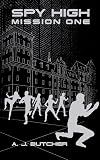
In the world of teenage spying, Jake, Ben, Eddie, Jennifer, Cally, and Lori make up Deveraux Academy’s Bond Team. Being one of the six members of this team takes much more than everyday focus and is without a doubt a full-time job. Being on the team would be probably the single, greatest experience of one’s entire life.
Since the book takes place around 2060, the characters come from backgrounds that in the present day could rarely be imagined. Ben for instance is what is called a show more “domer” basically the air quality got so bad in the United States; all of our agriculture was almost completely destroyed. So, for the farms to exist in 2060, the farms were put in domes. Ben is the son of a farmer of one of these domes in Oklahoma.
The main characters in the book started off not really liking each other. Like today, the team really judged each other on looks and social backgrounds. So the class system didn’t really change in the sixty year period between us and them. The only things that did change changed dramatically.
Technology for instance: the development of holograms was so far along they were able to create a fully functioning school using them. They were also able to accommodate virtual reality into the curriculum at “Spy High.” This is technology that is just starting to be implemented today.
By the end of the book, most of the characters have learned to co-exist with one another, but still have problems that still need some serious work. This book is the precursor to a series that was definitely meant to be strictly for character development and was done extremely well.
Having read the Alex Rider series by Anthony Horowitz, Spy High is more than comparable in technology, action, and character development. The book itself has the detail of Tom Clancy, along with the action of Ian Fleming. This book is just as fun for the reader as it was for the author to write it. show less
Since the book takes place around 2060, the characters come from backgrounds that in the present day could rarely be imagined. Ben for instance is what is called a show more “domer” basically the air quality got so bad in the United States; all of our agriculture was almost completely destroyed. So, for the farms to exist in 2060, the farms were put in domes. Ben is the son of a farmer of one of these domes in Oklahoma.
The main characters in the book started off not really liking each other. Like today, the team really judged each other on looks and social backgrounds. So the class system didn’t really change in the sixty year period between us and them. The only things that did change changed dramatically.
Technology for instance: the development of holograms was so far along they were able to create a fully functioning school using them. They were also able to accommodate virtual reality into the curriculum at “Spy High.” This is technology that is just starting to be implemented today.
By the end of the book, most of the characters have learned to co-exist with one another, but still have problems that still need some serious work. This book is the precursor to a series that was definitely meant to be strictly for character development and was done extremely well.
Having read the Alex Rider series by Anthony Horowitz, Spy High is more than comparable in technology, action, and character development. The book itself has the detail of Tom Clancy, along with the action of Ian Fleming. This book is just as fun for the reader as it was for the author to write it. show less
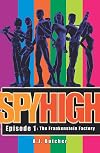
Late last year I found a series of books called CHERUB. These were fantastic British books, full of good characterisation and interesting plot lines.
When I first picked up The Frankenstein Factory, I was hoping it would be similar - an American version, if you like. Unfortunately it was not to be. The storylines are set in the future, and the enemy seems flat and unthreatening - unlike the very real threats in CHERUB. Also the characters seem more set to stereotypes - Ben the rich show more boy-leader, Eddie the goof, Jake the troubled bad-boy, Lori the beauty, Callie the uber-smart street kid, and Jennifer the cold martial arts expert. Finally, no real justification is given to why these spies are chosen as teenagers.
The book probably suffered because I was comparing it to the CHERUB series - on it's own, it would probably stand up better. It did become more interesting as you got into it, although it felt a little predictable from place to place. show less
When I first picked up The Frankenstein Factory, I was hoping it would be similar - an American version, if you like. Unfortunately it was not to be. The storylines are set in the future, and the enemy seems flat and unthreatening - unlike the very real threats in CHERUB. Also the characters seem more set to stereotypes - Ben the rich show more boy-leader, Eddie the goof, Jake the troubled bad-boy, Lori the beauty, Callie the uber-smart street kid, and Jennifer the cold martial arts expert. Finally, no real justification is given to why these spies are chosen as teenagers.
The book probably suffered because I was comparing it to the CHERUB series - on it's own, it would probably stand up better. It did become more interesting as you got into it, although it felt a little predictable from place to place. show less
The book was all over the place and had me very confused. There are mission briefings that have nothing to do with the book at the beginning of each chapter. It jumps from character to character with out fully describng who they are. After things finally start to make since half through the book it ends up being interesting. If you can be patient and wait for the good parts to come, I recommend this book.
You May Also Like


Statistics
- Works
- 18
- Members
- 1,063
- Popularity
- #24,216
- Rating
- 3.3
- Reviews
- 10
- ISBNs
- 91
- Languages
- 5
- Favorited
- 1