
Allan Ahlberg (1938–2025)
Author of Each Peach Pear Plum
About the Author
Allan Ahlberg was born in 1938 in South London, and grew up in the Black Country. He worked as a teacher, postman, grave digger, soldier and plumber's mate before he became a full-time writer. He met his wife and creative partner, Janet at teacher training college. It was because Janet wanted to show more illustrate a book that Allan wrote his first book, the Brick Street boys. After that, together they wrote 37 books. Janet died in 1994 and Ahlberg discontinued his writing career for a few years before picking it up again. (Bowker Author Biography) show less
Series
Works by Allan Ahlberg
The Pet Shop 8 copies
Skeleton Crew (Funnybones) 7 copies
Each Peach Pear Plum (Video) — Author — 2 copies
Funnybones: Skeleton Crew 2 copies
MAMA QUE GANO MUCHOS PREMIOS, LA 2 copies
Funnybones: The Collection 2 copies
BANGDITI! 1 copy
The Jolly Postman 1 copy
Daesplendor 1 copy
Arf! 1 copy
Funny Bones 8 Books Collection Set ( Bumps in the Night, Dinosaur Dreams, Give the Dog a Bone, Mystery Tour, Skeleton Crew, The Black Cat,The Pet Shop) (2016) 1 copy, 1 review
So Can I 1 copy
The Pencil 1 copy
Gjengen holder sammen 1 copy
Skeleton Crew (Funnybones) 1 copy
Red nose readers 1 copy
"OSSASPASSO" 1 copy
Funnybones: The Pet Shop 1 copy
La Famille Butinet 1 copy
Goldilocks: The Play 1 copy
Associated Works
Cricket Magazine, Vol. 5, No. 10, June 1978 — Contributor — 3 copies
Tagged
Common Knowledge
- Legal name
- Ahlberg, George Allan
- Birthdate
- 1938-06-05
- Date of death
- 2025-07-29
- Gender
- male
- Education
- Oldbury Grammar School
Sunderland Technical College - Occupations
- postal carrier
primary school teacher
children's book author
poet - Awards and honors
- British Book Award (Children's Author of the Year, 1995)
- Relationships
- Ahlberg, Janet (former spouse|her death, 1994)
Ahlberg, Jessica (daughter)
Clarke, Vanessa (spouse) - Short biography
- Allan Ahlberg is one of the UK's most acclaimed and successful authors of children's books - including the best-selling Jolly Postman series. Born in Croydon in 1938, he was educated at Sunderland Technical College. Although he dreamed of becoming a writer since the age of twelve, his route to that goal was somewhat circuitous. Other jobs along the way included postman (not an especially jolly one, he recalls), gravedigger, plumber, and teacher.
Ahlberg wrote his first book when he was thirty-seven, after a decade of teaching - a profession that he maintains is "much harder" than being a writer. He says that if he hadn't become a writer, he would have loved to be a soccer player. He was married for many years to fellow children's author Janet Ahlberg, with whom he often worked. Their daughter, Jessica Ahlberg, is also a children's author. - Nationality
- UK
- Birthplace
- Croydon, Surrey, England, UK
- Places of residence
- Oldbury, West Midlands, England, UK
Bath, Somerset, England, UK
Lewes, Sussex, England, UK - Map Location
- England, UK
Members
Reviews

"If you meet a witch, / Don't scream and run; / Whatever she does / It's only in fun..." So begins the rhyming text of this miniature fold-out paper-chain picture-book about witches. The poem—one verse per fold-out panel—advises the young reader not to panic at a witch's various shenanigans, unless of course, she speaks of being hungry. The fold-outs themselves are all witch-shaped, and depict various magical practitioners in a number of different actions, each corresponding to the verse show more with which they are paired.
That prolific and beloved British author/illustrator team, Janet and Allan Ahlberg, who were also a married couple, and who produced many popular picture-books over the course of their partnership, from their Jolly Postman series to their Kate Greenaway Medal-winning Each Peach Pear Plum, created the Daisychains series of fold-out paper-chain picture-books between 1983 and 1985. Which Witch?, published in 1983, is one of around nine titles in the series (all now quite difficult to find), and came to my attention during one of my periodic searches for new (or new to me) witchy picture-books—a particular pet project of mine. I am very glad to have tracked it down, as it is a fun little novelty item, with an entertaining poem that would make for a good read-aloud, and appealing artwork on the witch-shaped pages. I would love to see this one either reprinted or remade as a full-sized picture-book, although the latter seems unlikely to happen, given Janet Ahlberg's death in 1994. In any case, this is one I would recommend (if one can obtain it) to fans of the Ahlbergs, and to young people who enjoy witchy fare and/or unusual picture-book formats. show less
That prolific and beloved British author/illustrator team, Janet and Allan Ahlberg, who were also a married couple, and who produced many popular picture-books over the course of their partnership, from their Jolly Postman series to their Kate Greenaway Medal-winning Each Peach Pear Plum, created the Daisychains series of fold-out paper-chain picture-books between 1983 and 1985. Which Witch?, published in 1983, is one of around nine titles in the series (all now quite difficult to find), and came to my attention during one of my periodic searches for new (or new to me) witchy picture-books—a particular pet project of mine. I am very glad to have tracked it down, as it is a fun little novelty item, with an entertaining poem that would make for a good read-aloud, and appealing artwork on the witch-shaped pages. I would love to see this one either reprinted or remade as a full-sized picture-book, although the latter seems unlikely to happen, given Janet Ahlberg's death in 1994. In any case, this is one I would recommend (if one can obtain it) to fans of the Ahlbergs, and to young people who enjoy witchy fare and/or unusual picture-book formats. show less

The eponymous Burglar Bill lives a solitary life of crime in this picture-book from Janet and Allan Ahlberg, robbing homes at night and returning to his own domicile - entirely kitted out with ill-gotten goods - to sleep during the day. Then one night he discovers a cardboard box at one of the homes he is burgling, and thinking it might come in handy, brings it home with him. Imagine his surprise when it contains a baby! Now Burglar Bill has an entirely new occupation: child minder. Soon he show more also has a lady love, in the form of Burglar Betty, leading to some surprising changes in all of their lives...
Originally published in 1977, and recommended to me by an online friend, Burglar Bill is only the second picture-book I have read from Janet and Allan Ahlberg, following upon their classic Each Peach Pear Plum. I found it quite amusing, with its blithe acceptance of Burglar Bill's crime sprees, and its tale of lifestyle reformation. The artwork was likewise appealing, with plenty of fun little details to examine. It's interesting to note that a number of online reviews criticize the fact that Bill and Betty were never punished for their transgressions, leading me to wonder whether this issue has ever caused the book to be challenged, when it comes to inclusion in school and public library collections. I note that many American libraries in WorldCat have it in their collection, so perhaps the eventual reformation of the characters was enough for it to pass muster. I also wonder whether the satirical poem Burglar Bill, included in F. Anstey's 1888 Burglar Bill, and Other Pieces for the Use of the Young Reciter, might have been an inspiration for the Ahlbergs. After all, that poem - perhaps meant to mock sentimental stories like Frances Hodgson's Burnett's Editha's Burglar - also dealt with a burglar and his transformative encounter with an innocent child.
Whatever the case might be, this is one I enjoyed, and that I would recommend to picture-book readers who enjoy humorous and somewhat quirky stories. show less
Originally published in 1977, and recommended to me by an online friend, Burglar Bill is only the second picture-book I have read from Janet and Allan Ahlberg, following upon their classic Each Peach Pear Plum. I found it quite amusing, with its blithe acceptance of Burglar Bill's crime sprees, and its tale of lifestyle reformation. The artwork was likewise appealing, with plenty of fun little details to examine. It's interesting to note that a number of online reviews criticize the fact that Bill and Betty were never punished for their transgressions, leading me to wonder whether this issue has ever caused the book to be challenged, when it comes to inclusion in school and public library collections. I note that many American libraries in WorldCat have it in their collection, so perhaps the eventual reformation of the characters was enough for it to pass muster. I also wonder whether the satirical poem Burglar Bill, included in F. Anstey's 1888 Burglar Bill, and Other Pieces for the Use of the Young Reciter, might have been an inspiration for the Ahlbergs. After all, that poem - perhaps meant to mock sentimental stories like Frances Hodgson's Burnett's Editha's Burglar - also dealt with a burglar and his transformative encounter with an innocent child.
Whatever the case might be, this is one I enjoyed, and that I would recommend to picture-book readers who enjoy humorous and somewhat quirky stories. show less
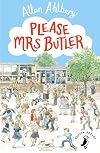
According to a list I saw the other day, Please Mrs Butler is one of the top ten favourite children's poems in the UK. It is the first poem in this collection and we used to have it read to us in infant school every day so it felt. Due to oversaturation, it is not my favourite of the collection, but I do think this whole book is filled with very clever observations of the absurdities of both children and teachers and creates a lot of nostalgia. They are a little old-fashioned. Even when I show more was in school, teachers didn't smoke in the staffroom and headteachers couldn't punish children with slippers, and that was over thirty years ago, so I've no idea how accurate it is to MODERN primary school life, but it certainly feels accurate to what I remember. I always think this would make an excellent school play.
Side note: Listening to Please Mrs Butler in infant school was one of the first ways I learned that I was different to most other children - when the child complains that Derek Drew keeps taking their rubber, the teacher suggests 'Keep it in your hand, dear. Hide it up your vest. Swallow it if you like, my love.' And without fail all the other kids would fall about laughing because the word 'vest' had been mentioned because it was a bit of UNDERWEAR! It really bugged me because clearly swallowing it is the escalation line and no one paid any attention to that because for the next five minutes they were just shouting 'vest' and giggling. Hiding in in your clothes is not that unusual but swallowing it could actually kill you, so why are we not reacting to a teacher suggesting THAT? That was what all of infant school was like for me. show less
Side note: Listening to Please Mrs Butler in infant school was one of the first ways I learned that I was different to most other children - when the child complains that Derek Drew keeps taking their rubber, the teacher suggests 'Keep it in your hand, dear. Hide it up your vest. Swallow it if you like, my love.' And without fail all the other kids would fall about laughing because the word 'vest' had been mentioned because it was a bit of UNDERWEAR! It really bugged me because clearly swallowing it is the escalation line and no one paid any attention to that because for the next five minutes they were just shouting 'vest' and giggling. Hiding in in your clothes is not that unusual but swallowing it could actually kill you, so why are we not reacting to a teacher suggesting THAT? That was what all of infant school was like for me. show less
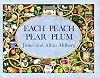
Love of language and literature works best as a daisy chain, down the generations. Some of the best picture books have a similar structure, with repetition, rhyme, and rhythm as cues. This is such a book.
First, I read this to my child, pausing before pointing out the next character, who would be hiding in the picture somewhere.
Then I would read, but stop before saying the last words on each page, allowing my child to jump in with the next name.
"Each Peach Pear Plum, I spy Tom Thumb"
"Tom show more Thumb in the cupboard, I spy Mother Hubbard
Mother Hubbard..., I spy..."
My child learned to read the book: pretend reading (memory), then properly.
The whole book is a daisy chain of names familiar from fairy tales and nursery rhymes, creating a story that includes Robin Hood, Baby Bunting, the Three Bears, a Wicked Witch, and Cinderella.
This remains one of a few special books we both know off by heart, more than twenty years later.
Pass it on
Another daisy chain: it’s a book I’ve given to many friends. They usually say how much they and their child enjoy it. I hope that one day, they and their children will pass it on.
Last week, a friend I gave it to more than ten years ago, and who now lives in Australia, sent me a picture of her younger child with the book, saying her kids still love it. A simple gesture that filled me with joy, and flooded a difficult week with happy memories.
Thanksgiving life lessons
An aunty figure in my youth, had two favourite axioms:
“Send postcards to people when they are alive, not flowers when they are dead.”
and
“Great oaks from little acorns grow.”
My friend sent a virtual postcard.
And a love of reading nurtures our acorns into saplings and on to mighty oaks.
Tomorrow is Thanksgiving in the US. I am thankful for those who nurtured me, and for the privilege of nurturing others. show less
First, I read this to my child, pausing before pointing out the next character, who would be hiding in the picture somewhere.
Then I would read, but stop before saying the last words on each page, allowing my child to jump in with the next name.
"Each Peach Pear Plum, I spy Tom Thumb"
"Tom show more Thumb in the cupboard, I spy Mother Hubbard
Mother Hubbard..., I spy..."
My child learned to read the book: pretend reading (memory), then properly.
The whole book is a daisy chain of names familiar from fairy tales and nursery rhymes, creating a story that includes Robin Hood, Baby Bunting, the Three Bears, a Wicked Witch, and Cinderella.
This remains one of a few special books we both know off by heart, more than twenty years later.
Pass it on
Another daisy chain: it’s a book I’ve given to many friends. They usually say how much they and their child enjoy it. I hope that one day, they and their children will pass it on.
Last week, a friend I gave it to more than ten years ago, and who now lives in Australia, sent me a picture of her younger child with the book, saying her kids still love it. A simple gesture that filled me with joy, and flooded a difficult week with happy memories.
Thanksgiving life lessons
An aunty figure in my youth, had two favourite axioms:
“Send postcards to people when they are alive, not flowers when they are dead.”
and
“Great oaks from little acorns grow.”
My friend sent a virtual postcard.
And a love of reading nurtures our acorns into saplings and on to mighty oaks.
Tomorrow is Thanksgiving in the US. I am thankful for those who nurtured me, and for the privilege of nurturing others. show less
Lists
Awards


You May Also Like


Associated Authors
Statistics
- Works
- 246
- Also by
- 4
- Members
- 20,726
- Popularity
- #1,041
- Rating
- 4.0
- Reviews
- 367
- ISBNs
- 973
- Languages
- 19
- Favorited
- 7