
Sally J. Cole
Author of Legacy on Stone: Rock Art of the Colorado Plateau and Four Corners Region
Works by Sally J. Cole
Legacy on Stone: Rock Art of the Colorado Plateau and Four Corners Region (1990) 65 copies, 2 reviews
An analysis of the prehistoric and historic rock art of west-central Colorado (Cultural resource series) (1987) 3 copies
Katsina Iconography in Homol'ovi Rock Art : Central Little Colorado River Valley, Arizona (1992) (1992) 2 copies
Associated Works
New Dimensions In Rock Art Studies OP #9 (Volume 9) (Occasional Papers) (2004) — Contributor — 6 copies
Tagged
Common Knowledge
- Gender
- female
Members
Reviews
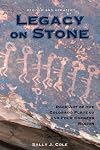
A technical treatise on Native American “rock art” from the Colorado Plateau region. “Rock art” is quoted because author Sally J. Cole notes that some extant Native American groups object to the term, contending that these things are not “art” in the European sense, but ancestral markings indicating stewardship of the land, and that calling them “art” is a subtle form of cultural appropriation; however, despite various other suggestions, “rock art” is still the term used. show more I suspect there are cultural problems with translating the concept. Cole also notes that “rock painting” is preferred to the term “pictograph”, even though pictograph has been used for years to describe images made by painting on rock (as opposed to “petroglyphs”, which are made by carving, pecking, or otherwise affecting the rock surface). Cole consistently uses “painting” or “rock painting” rather than “pictograph”.
Cole organizes her discussion by age and region; chapters discuss “hunter and gatherer” art; Ancestral Puebloan art; Fremont art; and prehistoric Eastern Shoshone art. This arrangement was difficult for me to follow; I have only a casual layperson’s interest in Southwestern archaeology and would have to be a lot more knowledgeable to keep track of the technical terms.
Some of the art Cole illustrates has been vandalized; there’s an interesting theme here. In a few cases the vandalism was ancient; when a Native American group moved into an area occupied by another group, they apparently sometimes made a claim of “ownership” by vandalizing or modifying the earlier group’s rock art; this fits in with Coles earlier mention that extant native groups (she cites the Hopi) as seeing the rock markings as indicating “ownership”, or at least “stewardship”. In some cases, the ancient vandalism involved stabbing or shooting arrows or other projectiles at the art. Cole shows some art vandalized with bullet scars; although the surficial explanation is gun-toting yahoos, there’s the deeper, atavistic idea of claiming ownership. (This should not be construed that I am condoning vandalism of Native American sites).
Related to the above, this is not a guidebook; Cole does not give directions to any of the sites she illustrates, except in the most general terms (“Chaco Canyon”, for example). However, she does give site numbers from original publications (“Site 42SA3711, Cedar Mesa, Utah”). Thus, a scholar could track down the references and investigate the site, while a casual vandal would not be that motivated; this is probably a reasonable compromise between the need to identify sites for further scientific research and the need to protect them from vandalism.
Cole mentions some astronomical significance at some of the sites – features that are illuminated or shadowed at the summer solstice, for example. However, one of the most famous purported rock art depictions of an astronomical event – the Chaco Canyon painting that is theorized to represent the 1054 AD supernova that created the Crab Nebula in Taurus – gets an illustration, but is only cited as “… a crescent moon and other imagery…”.
Profusely illustrated in color, and extensively referenced; alas, I would need to have much more background in Southwestern archaeology in order to fully appreciate this book. show less
Cole organizes her discussion by age and region; chapters discuss “hunter and gatherer” art; Ancestral Puebloan art; Fremont art; and prehistoric Eastern Shoshone art. This arrangement was difficult for me to follow; I have only a casual layperson’s interest in Southwestern archaeology and would have to be a lot more knowledgeable to keep track of the technical terms.
Some of the art Cole illustrates has been vandalized; there’s an interesting theme here. In a few cases the vandalism was ancient; when a Native American group moved into an area occupied by another group, they apparently sometimes made a claim of “ownership” by vandalizing or modifying the earlier group’s rock art; this fits in with Coles earlier mention that extant native groups (she cites the Hopi) as seeing the rock markings as indicating “ownership”, or at least “stewardship”. In some cases, the ancient vandalism involved stabbing or shooting arrows or other projectiles at the art. Cole shows some art vandalized with bullet scars; although the surficial explanation is gun-toting yahoos, there’s the deeper, atavistic idea of claiming ownership. (This should not be construed that I am condoning vandalism of Native American sites).
Related to the above, this is not a guidebook; Cole does not give directions to any of the sites she illustrates, except in the most general terms (“Chaco Canyon”, for example). However, she does give site numbers from original publications (“Site 42SA3711, Cedar Mesa, Utah”). Thus, a scholar could track down the references and investigate the site, while a casual vandal would not be that motivated; this is probably a reasonable compromise between the need to identify sites for further scientific research and the need to protect them from vandalism.
Cole mentions some astronomical significance at some of the sites – features that are illuminated or shadowed at the summer solstice, for example. However, one of the most famous purported rock art depictions of an astronomical event – the Chaco Canyon painting that is theorized to represent the 1054 AD supernova that created the Crab Nebula in Taurus – gets an illustration, but is only cited as “… a crescent moon and other imagery…”.
Profusely illustrated in color, and extensively referenced; alas, I would need to have much more background in Southwestern archaeology in order to fully appreciate this book. show less
Even if you aren't an archeologist, this book is worth reading for the wonderful color photos of petroglyphs from throughout the Colorado Plateau. The text is purely descriptive, with little to no speculation about the meanings of purpose of the rock art. There is an extensive bibliography which will be quite useful for the academic reader.
Worth reading once, worth owning for the archeologist.
Worth reading once, worth owning for the archeologist.
You May Also Like
Associated Authors
Statistics
- Works
- 8
- Also by
- 1
- Members
- 75
- Popularity
- #235,803
- Rating
- 3.5
- Reviews
- 2
- ISBNs
- 4