
David J. Brewer (1837–1910)
Author of The world's best orations: from the earliest period to the present time
About the Author
Image credit: Credit: Frances Benjamin Johnston, circa 1906
(Frances Benjamin Johnston Collection,
LoC Prints and Photographs Division,
LC-USZ62-83098)
(Frances Benjamin Johnston Collection,
LoC Prints and Photographs Division,
LC-USZ62-83098)
Series
Works by David J. Brewer
World's Best Orations V10 5 copies
World's Best Orations form the Earliest Period to the Present Time, Volume 8: Lys-Pym; (2012) 4 copies
The Crowned Masterpieces of Literature That Have Advanced Civilization: The World's Best Essays, Vol. V, Epi-Hal (1908) 2 copies, 1 review
The Crowned Masterpieces of Literature That Have Advanced Civilization: The World's Best Essays, Vol. III, Car-Dan (1902) 2 copies
Associated Works
The Supreme Court and the Constitution: Readings in American Constitutional History (1969) — Contributor, some editions — 68 copies
Tagged
Common Knowledge
- Legal name
- Brewer, David Josiah
- Birthdate
- 1837-06-20
- Date of death
- 1910-03-28
- Gender
- male
- Education
- Yale University (AB|1856)
- Occupations
- Associate Justice of the Supreme Court (1890-1910)
lawyer
jurist - Organizations
- Supreme Court of the United States (Associate Justice ∙ 1890-1910)
- Awards and honors
- Phi Beta Kappa
- Relationships
- Field, Stephen Johnson (uncle)
- Nationality
- USA
- Birthplace
- Izmir, Turkey
- Burial location
- Mt. Muncie Cemetery, Leavenworth, Kansas, USA
- Associated Place (for map)
- USA
Members
Reviews

The short book is a printed version of a single speech. People enjoyed it so much in 1897 that it was printed and reprinted by popular demand. It is just as delightful today as in was then.
Brewer was a justice on the U.S. Supreme Court, who had gained some reputation from his opinion (and court majority ruling) in 1892, which had clearly stated that “America is a Christian nation”. He was invited to speak to the faculty and students at the Harvard Divinity School. While the resulting show more address gave some valuable insight and advice to the audience, it also contained humor and gave some look into the mind of Brewer.
This humor is best expressed in his early words, where he noted that for 50 years he had sat before pulpits without the ability to reply. He had even accepted words like "woe unto you lawyers", even though he felt like shouting "woe unto you ministers"; but that "Now all is reversed. I have the pulpit before me. I am to talk and you must listen."
After his opening, Brewer noted the seeming decline of the ministry. In colonial days the minister might be the only college educated man in town, and was looked to for leadership in many areas. Modern society seemed to diminish this role. Division of labor, expanded education and specialization gave to many others a share of that leadership. But by embracing the American goals of individualism an individual in the ministry could be very successful. He just couldn’t expect it as a result of his position. The minister is judged based on his effect of his congregants, and has no ‘free ticket’ based on divinity school education.
The positive side of this is that the minister also becomes a worker, worthy of his pay. Neither he nor his congregation should treat his pay as charity, to forward the selfless work of a man of God. This actually frees them to concentrate on their primary task: to bring the message of redemption to people. He also points out that they should strive to end the image of themselves as mendicants, the seeking of discounts, and the reputation of preachers as slow to pay. As they narrow their focus, they can improve their performance. As they are judged as individuals they can seek, earn, and receive individual reputation and reward.
In our current struggle with anti-religion in society, the message is as clearly important now as over a century ago, and I think anyone who takes the side of religion will enjoy this short book. show less
Brewer was a justice on the U.S. Supreme Court, who had gained some reputation from his opinion (and court majority ruling) in 1892, which had clearly stated that “America is a Christian nation”. He was invited to speak to the faculty and students at the Harvard Divinity School. While the resulting show more address gave some valuable insight and advice to the audience, it also contained humor and gave some look into the mind of Brewer.
This humor is best expressed in his early words, where he noted that for 50 years he had sat before pulpits without the ability to reply. He had even accepted words like "woe unto you lawyers", even though he felt like shouting "woe unto you ministers"; but that "Now all is reversed. I have the pulpit before me. I am to talk and you must listen."
After his opening, Brewer noted the seeming decline of the ministry. In colonial days the minister might be the only college educated man in town, and was looked to for leadership in many areas. Modern society seemed to diminish this role. Division of labor, expanded education and specialization gave to many others a share of that leadership. But by embracing the American goals of individualism an individual in the ministry could be very successful. He just couldn’t expect it as a result of his position. The minister is judged based on his effect of his congregants, and has no ‘free ticket’ based on divinity school education.
The positive side of this is that the minister also becomes a worker, worthy of his pay. Neither he nor his congregation should treat his pay as charity, to forward the selfless work of a man of God. This actually frees them to concentrate on their primary task: to bring the message of redemption to people. He also points out that they should strive to end the image of themselves as mendicants, the seeking of discounts, and the reputation of preachers as slow to pay. As they narrow their focus, they can improve their performance. As they are judged as individuals they can seek, earn, and receive individual reputation and reward.
In our current struggle with anti-religion in society, the message is as clearly important now as over a century ago, and I think anyone who takes the side of religion will enjoy this short book. show less
Crowned masterpieces of literature that have advanced civilization (v.05): as preserved and presented by the world's best essays, from the earliest period to the present time by David J. Brewer
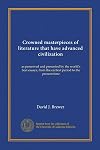
An extremely mixed bag including ancient writers --Epictetus, Epicurus, Aulus Gellius,; early modern writers --Erasmus, Fenelon, and nineteenth century writers--Horace Greeley etc. Apparently the collection as a whole is arranged sheerly alphabetically and this volume is late E, all of F and G, and the first essay of H (Sir Matthew Hale). Individual essays are useful as sources though the collection is very scattered.
You May Also Like
Associated Authors
Statistics
- Works
- 45
- Also by
- 2
- Members
- 98
- Popularity
- #193,037
- Rating
- 3.9
- Reviews
- 2
- ISBNs
- 18
