
Ara 13 (1)
Author of Drawers & Booths
For other authors named Ara 13, see the disambiguation page.
Works by Ara 13
Tagged
Common Knowledge
There is no Common Knowledge data for this author yet. You can help.
Members
Reviews

I'm at somewhat of a loss as how to adequately discuss "Drawers & Booths" without cracking up in both a laughter and asylum sense during the process, and that's undoubtedly a compliment to its eccentric author, Ara 13, so bear with me while I lay out some facts first to get myself acclimated. Ara 13 is not a pseudonym as far as I know; Ara legally changed his last name from Hirsch to 13 in 1998, "mainly because it's funny," his press release states. Funny -- and goofy -- indeed. "Drawers & show more Booths," Ara 13s debut novel, won an "Outstanding Book of the Year" award from the 2008 Independent Publisher Book Awards (an IPPY prize, arguably the indie publishing equivalent of a Pulitzer or Man Booker), and also won a bronze medal for "Storyteller of the Year."
So does "Drawers & Booths" truly merit these awards and accolades? Hell yes! I've had the misfortune of reading (with always the good intentions of positively reviewing) far too many indies and self-published books which lack the backing of big-time publishers with marketing budgets to burn for a very simple reason: they SUCK. They're embarassingly godawful. Not so "Drawers & Booths".
Remember John Fowles' metafictional masterpiece, "The French Lieutenant's Woman?" Remember how Fowles lost control of his two leading characters and so inserted himself as a character into his own book in order to take back the authorial reigns? "Drawers & Booths" is kind of like that -- hard (as in the author's in the book and out of the book and all over the place) metafiction.
Ayn Rand asked: Who is John Galt. Ara 13 asks: Who is Hattie Shore? Figure out who Hattie Shore is in the novel and you've figured out the philosophy and thematic concepts "Drawers & Booths" repeatedly pivots around, for despite the seemingly arbitrary transitions from third to first person or from past to present tense, or the humorous insertion of its author into the text and ensuing narrative anarchy in which minor characters, heretofore indistinct, begin describing their physical appearance to the reader, blurting out, "Remember what I look like! Remember me! Remember me!" Ara 13 is relaying a compelling even though its long been patented, existential question: Where do I (the reader) begin, and you (the author) end (or vice versa)?
For the first thirty pages or so the reader's just a reader, reading generally about a military base on the fictional isle of Cortinia and its third-world inhabitants, and particularly about a man known only as the Corporal, a media correspondent for the Marines (and I'll bet Ara's alter ego what with Ara's real life years of service as a combat correspondent for the Marine Corps). But then all narrative hell breaks loose....
"Kick approached the church and stepped over the entryway frame. It was dark to his immediate sides, and the sunlit sanctuary made it harder for Kick's eyes to adjust to the recesses of shadows in his periphery.
'Father Atkinson?' he called.
'No,' I reply, emerging from the dark.
Kick turns to his right. 'Who the hell are you?'
'Nobody,' I measure him up, wondering how he will react.
'You don't belong here,' he senses. 'What the hell are you doing? You are going to fuck everything up.'
'How do you know I'm not with the Red Cross?'
'Don't fuck with me. We are well into the story, and here you are speaking first-person and ... and present tense! The readers are gonna immediately realize something is wrong!'
'Well, they will now,' I quip.
'Get the fuck out of here!'
'In due time.'
'What do we do?' Kick panics.
'Relax, no one is reading this. Do you know how hard it is for a first-time author to get published?'
And back and forth we go in and out of Cortinia; from Cortinia to being put on hold for two hysterical blank pages while the author answers his cell phone; to a detective hunt for the mysterious Hattie Shore; to a military grunt declaring "we're in present tense! we're in present tense!" as if present tense were synonymous with "incoming, incoming!"; to a courtroom drama where (gasp!) God is put on trial; and finally back to the Corporal, to a "normal" narrative, and the Corporal's unlikely heroics.
No offense to Ara 13s present publisher, Covington Moore Publishing House -- thank God (or thank fate for you atheists) that great independent presses exist and offer up-and-comers like Ara 13 a chance they might not otherwise get -- but were I a corporate head honcho at, say, FSG, Random House, Putnam, Viking, Scribners, etc. et al., one of the Big Boys on the hunt for the Next Big Thing, I'd be saying hup-2 pronto, Ara 13, sign right here on the dotted line. show less
So does "Drawers & Booths" truly merit these awards and accolades? Hell yes! I've had the misfortune of reading (with always the good intentions of positively reviewing) far too many indies and self-published books which lack the backing of big-time publishers with marketing budgets to burn for a very simple reason: they SUCK. They're embarassingly godawful. Not so "Drawers & Booths".
Remember John Fowles' metafictional masterpiece, "The French Lieutenant's Woman?" Remember how Fowles lost control of his two leading characters and so inserted himself as a character into his own book in order to take back the authorial reigns? "Drawers & Booths" is kind of like that -- hard (as in the author's in the book and out of the book and all over the place) metafiction.
Ayn Rand asked: Who is John Galt. Ara 13 asks: Who is Hattie Shore? Figure out who Hattie Shore is in the novel and you've figured out the philosophy and thematic concepts "Drawers & Booths" repeatedly pivots around, for despite the seemingly arbitrary transitions from third to first person or from past to present tense, or the humorous insertion of its author into the text and ensuing narrative anarchy in which minor characters, heretofore indistinct, begin describing their physical appearance to the reader, blurting out, "Remember what I look like! Remember me! Remember me!" Ara 13 is relaying a compelling even though its long been patented, existential question: Where do I (the reader) begin, and you (the author) end (or vice versa)?
For the first thirty pages or so the reader's just a reader, reading generally about a military base on the fictional isle of Cortinia and its third-world inhabitants, and particularly about a man known only as the Corporal, a media correspondent for the Marines (and I'll bet Ara's alter ego what with Ara's real life years of service as a combat correspondent for the Marine Corps). But then all narrative hell breaks loose....
"Kick approached the church and stepped over the entryway frame. It was dark to his immediate sides, and the sunlit sanctuary made it harder for Kick's eyes to adjust to the recesses of shadows in his periphery.
'Father Atkinson?' he called.
'No,' I reply, emerging from the dark.
Kick turns to his right. 'Who the hell are you?'
'Nobody,' I measure him up, wondering how he will react.
'You don't belong here,' he senses. 'What the hell are you doing? You are going to fuck everything up.'
'How do you know I'm not with the Red Cross?'
'Don't fuck with me. We are well into the story, and here you are speaking first-person and ... and present tense! The readers are gonna immediately realize something is wrong!'
'Well, they will now,' I quip.
'Get the fuck out of here!'
'In due time.'
'What do we do?' Kick panics.
'Relax, no one is reading this. Do you know how hard it is for a first-time author to get published?'
And back and forth we go in and out of Cortinia; from Cortinia to being put on hold for two hysterical blank pages while the author answers his cell phone; to a detective hunt for the mysterious Hattie Shore; to a military grunt declaring "we're in present tense! we're in present tense!" as if present tense were synonymous with "incoming, incoming!"; to a courtroom drama where (gasp!) God is put on trial; and finally back to the Corporal, to a "normal" narrative, and the Corporal's unlikely heroics.
No offense to Ara 13s present publisher, Covington Moore Publishing House -- thank God (or thank fate for you atheists) that great independent presses exist and offer up-and-comers like Ara 13 a chance they might not otherwise get -- but were I a corporate head honcho at, say, FSG, Random House, Putnam, Viking, Scribners, etc. et al., one of the Big Boys on the hunt for the Next Big Thing, I'd be saying hup-2 pronto, Ara 13, sign right here on the dotted line. show less
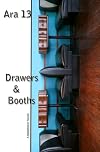
Ara 13's novel Drawers & Booths is a nifty work of metafiction that has just about everything I look for in a novel – humor, interesting characters, entertaining storylines, some real food for thought, and lots of surprises. In fact, the humor, characters, and storylines are all surprises. It's a book that's very hard to review without giving away too much of the plot (make that plots, plural). A bare bones description runs something like this: The book begins with a Marine Corps corporal show more (referred to only as "the Corporal") on a special assignment as liaison between the U.S. Army and the island nation of Cortinia. But by page 35, it's obvious something is up. There's a shift of focus and a shadowy figure disrupts the military tale and detours us into a new story, with a hard-boiled detective looking for a possible serial killer. Now don't get too comfortable, because within a few pages, everything shifts again and stories keep piling on top of other stories, doubling back and turning and twisting right up to the final page. Characters become aware of their roles in the narrative, question plot developments, quarrel amongst themselves, and even begin to rebel against the author who eventually makes an appearance in his own book.
Of course, the idea of unruly and unmanageable characters in fiction certainly isn't a new one; and other authors have slipped themselves into their own works. And I imagine most young writers have, at one time or another, played with the idea of putting God on trial in one of their stories – although not often so literally or with such hilarious consequences. I notice that I marked "LOL" in the margin of a page in Chapter Ten – because I was actually laughing out loud (it's when God says he's a little teacup – read the book, you'll understand). I love it when that happens!
Drawers & Booths was recognized as an "Outstanding Book of the Year" in the 2008 Independent Publisher Book Awards, and its author (who legally changed his last name from Hirsch to 13 in 1998) received a bronze medal as a "Storyteller of the Year." Well deserved; although, admittedly, the book isn't going to be everybody's cuppa – some of the language, and the discussion about religion will disturb some readers. And the constant shifting back and forth, and shuffling of storylines can be confusing, and even a little annoying at times – I had absolutely fallen in love with The Corporal just before his story reared up, shook itself and turned into something completely different!
I also suspect it's not going to be an easy book to find (the publisher, CovingtonMoore is based in Austin TX). But if you want a good, fast, irreverent, thought-provoking, and just downright funny read – Drawers & Booths is definitely worth tracking down. And Ara 13 is someone to watch. show less
Of course, the idea of unruly and unmanageable characters in fiction certainly isn't a new one; and other authors have slipped themselves into their own works. And I imagine most young writers have, at one time or another, played with the idea of putting God on trial in one of their stories – although not often so literally or with such hilarious consequences. I notice that I marked "LOL" in the margin of a page in Chapter Ten – because I was actually laughing out loud (it's when God says he's a little teacup – read the book, you'll understand). I love it when that happens!
Drawers & Booths was recognized as an "Outstanding Book of the Year" in the 2008 Independent Publisher Book Awards, and its author (who legally changed his last name from Hirsch to 13 in 1998) received a bronze medal as a "Storyteller of the Year." Well deserved; although, admittedly, the book isn't going to be everybody's cuppa – some of the language, and the discussion about religion will disturb some readers. And the constant shifting back and forth, and shuffling of storylines can be confusing, and even a little annoying at times – I had absolutely fallen in love with The Corporal just before his story reared up, shook itself and turned into something completely different!
I also suspect it's not going to be an easy book to find (the publisher, CovingtonMoore is based in Austin TX). But if you want a good, fast, irreverent, thought-provoking, and just downright funny read – Drawers & Booths is definitely worth tracking down. And Ara 13 is someone to watch. show less
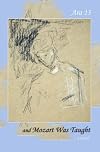
At the risk of sounding clichéd, where do I start?
To begin with, AND MOZART WAS TAUGHT is in no way an average novel. It's well above average both in reading level and the ideas expressed. It is, in fact, metafiction -- a post-modern form of writing that most authors would probably find difficult to pull off without slipping into totally self-conscious lecturing mode.
I'm happy to say that wasn't the case with this book (or, at least, it's kept to a minimum). The book has a central story show more about a girl named Emily who's bullied mercilessly (and for seemingly no particular reason) by her peers. She also happens to be brilliant -- her nose always in a book, which can't help matters. Jean, a math teacher, seeks to intervene on Emily's behalf after an incident culminates in violence (arguably, self-defense). Her concern for Emily grows stronger as she observes the laissez-faire attitudes of Emily's, um, father, Joe, and the school principal. All attempts on Jean's part to protect the girl simply seem to aggravate the situation, by setting her even farther apart from the other kids. Jean feels her hands are tied.
And even though Jean thinks Joe lacks intelligence and compassion, he has both in abundance. Joe is a frustrated newspaperman who encourages Emily to develop her intellect, but recognizes that he can't protect her from everything. In fact, Joe's so busy grappling with his own misplaced guilt and unrealized potential it's a miracle Emily registers on his radar at all.
During one visit to the principal's office, Jean vents her frustration after a particularly unfruitful exchange by exclaiming, "Isn't she the reason we become teachers?"
Hold that thought. Because it seems to be the essential point of the story. How much of who we are is shaped by genetics versus nurturing? How much can be taught as opposed to being intuited? And how much protection do we offer our children before it becomes overprotection? These questions are raised in myriad ways throughout the book. (And as for random chance and fate, let's not even go there ...)
Read the entire review at http://thebookgrrl.blogspot.com/2010/11/and-mozart-was-taught-nuture-nature-or.h... show less
To begin with, AND MOZART WAS TAUGHT is in no way an average novel. It's well above average both in reading level and the ideas expressed. It is, in fact, metafiction -- a post-modern form of writing that most authors would probably find difficult to pull off without slipping into totally self-conscious lecturing mode.
I'm happy to say that wasn't the case with this book (or, at least, it's kept to a minimum). The book has a central story show more about a girl named Emily who's bullied mercilessly (and for seemingly no particular reason) by her peers. She also happens to be brilliant -- her nose always in a book, which can't help matters. Jean, a math teacher, seeks to intervene on Emily's behalf after an incident culminates in violence (arguably, self-defense). Her concern for Emily grows stronger as she observes the laissez-faire attitudes of Emily's, um, father, Joe, and the school principal. All attempts on Jean's part to protect the girl simply seem to aggravate the situation, by setting her even farther apart from the other kids. Jean feels her hands are tied.
And even though Jean thinks Joe lacks intelligence and compassion, he has both in abundance. Joe is a frustrated newspaperman who encourages Emily to develop her intellect, but recognizes that he can't protect her from everything. In fact, Joe's so busy grappling with his own misplaced guilt and unrealized potential it's a miracle Emily registers on his radar at all.
During one visit to the principal's office, Jean vents her frustration after a particularly unfruitful exchange by exclaiming, "Isn't she the reason we become teachers?"
Hold that thought. Because it seems to be the essential point of the story. How much of who we are is shaped by genetics versus nurturing? How much can be taught as opposed to being intuited? And how much protection do we offer our children before it becomes overprotection? These questions are raised in myriad ways throughout the book. (And as for random chance and fate, let's not even go there ...)
Read the entire review at http://thebookgrrl.blogspot.com/2010/11/and-mozart-was-taught-nuture-nature-or.h... show less
This book definitely falls into the "metafiction" category, for what it's worth, and I don't know how to describe it without giving away things that should be left for the reader to discover. Let's just say that the story starts at an army MASH unit in a politically unstable country, is hijacked by a character from a different story who's hunting down the ultimate criminal, and culminates in the most important trial in the history of mankind (or does it?!?!? dun dun dunnnn). It's crazy and show more funny and thought-provoking and I loved it.
Excerpt!!!
"I suppose others thought I was trying to make a hodgepodge of things so the book would never see light of publication."
Marcus continued the reasoning. "The less sense the story made, the less likely an agent or publisher would find it credible?"
"That's the logic."
"In fact, you renamed the book from Displaced People to Drawers & Booths, a nonsense title, merely because the author has trouble pronouncing those words, making it even harder for him to promote."
"I like the new title. It's catchy."
PS--My used copy is signed by the author "Ara XIII, To McBrazil Nut, Thank You!" show less
Excerpt!!!
"I suppose others thought I was trying to make a hodgepodge of things so the book would never see light of publication."
Marcus continued the reasoning. "The less sense the story made, the less likely an agent or publisher would find it credible?"
"That's the logic."
"In fact, you renamed the book from Displaced People to Drawers & Booths, a nonsense title, merely because the author has trouble pronouncing those words, making it even harder for him to promote."
"I like the new title. It's catchy."
PS--My used copy is signed by the author "Ara XIII, To McBrazil Nut, Thank You!" show less
Lists
Metafiction (1)
Awards

Statistics
- Works
- 2
- Members
- 26
- Popularity
- #495,360
- Rating
- 4.0
- Reviews
- 7
- ISBNs
- 2
