
Peter Enns (1)
Author of Exodus (The NIV Application Commentary)
For other authors named Peter Enns, see the disambiguation page.
Series
Works by Peter Enns
Inspiration and Incarnation: Evangelicals and the Problem of the Old Testament (2005) 676 copies, 5 reviews
The Bible Tells Me So: Why Defending Scripture Has Made Us Unable to Read It (2014) 445 copies, 15 reviews
The Evolution of Adam: What the Bible Does and Doesn't Say about Human Origins (2012) 342 copies, 3 reviews
The Sin of Certainty: Why God Desires Our Trust More Than Our "Correct" Beliefs (2016) 311 copies, 5 reviews
How the Bible Actually Works: In Which I Explain How An Ancient, Ambiguous, and Diverse Book Leads Us to Wisdom Rather Than Answers―and Why That's Great News (2019) 309 copies, 5 reviews
Genesis for Normal People: A Guide to the Most Controversial, Misunderstood, and Abused Book of the Bible (Second Edition w/ Study Guide) (The Bible for Normal People) (2012) — Author — 101 copies, 1 review
The Bible and the Believer: How to Read the Bible Critically and Religiously (2012) — Author — 86 copies
Eyes to See, Ears to Hear: Essays in Memory of J. Alan Groves (2010) — Editor; Contributor — 62 copies
Curveball: When Your Faith Takes Turns You Never Saw Coming (or How I Stumbled and Tripped My Way to Finding a Bigger God) (2023) 44 copies, 1 review
Exodus for Normal People: A Guide to the Story—and History—of the Second Book of the Bible (The Bible for Normal People) (2021) 31 copies
Telling God's Story, Year One: Meeting Jesus: Student Guide & Activity Pages (Telling God's Story) (2011) 16 copies
Exodus Retold: Ancient Exegesis of the Departure from Egypt in Wis 15-21 and 19:1-9 (1997) 16 copies
Telling God's Story, Year Two: The Kingdom of Heaven: Instructor Text & Teaching Guide (2012) 12 copies
Invitation to Genesis: Planning Kit: A Short-Term DISCIPLE Bible Study (Disciple Bible Studies) (2006) 11 copies
Westminster Theological Journal 78.1 3 copies
Associated Works
Dictionary for Theological Interpretation of the Bible (2005) — Contributor, some editions — 598 copies, 5 reviews
Three Views on the New Testament Use of the Old Testament (2008) — Contributor — 409 copies, 2 reviews
The Idea of Biblical Interpretation: Essays in Honor of James L. Kugel (Supplements to the Journal for the Study of Judaism) (2004) — Contributor — 18 copies
Tagged
Common Knowledge
- Gender
- male
Members
Reviews
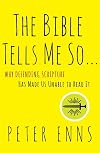
"The Bible Tells Me So" is an excellent and entertaining read that demonstrates, through scholarship and deep understanding, the Bible is not a literal, one-size fits all manual for how to live in the modern age. Enns's analysis of the Old Testament scriptures is particularly rigorous and he contextualizes much of these scriptures in light of their historical and cultural background. While Enns takes a sharp lens to the story of Israel I was a bit disappointed that the New Testament did not show more also get the same treatment. Enns asserts that Jesus changed the way the Jewish scriptures were meant to be read and understood, demonstrated in the writings of Paul, and this gives a cohesion to the Christian story in the Bible, but the NT are primarily discussed in light of the OT. More discussion, especially around the political intentions of the writers of the Gospel would have been welcome and warranted. Perhaps that is just the purview of another book. show less

Fear not.
Those two simple words comprise the most common command in the Bible. Ironically, though, many Christians live in—if not precisely fear—at least a certain uneasiness about scripture. Here are some of the big issues:
- How could God command the genocide of the Canaanites?
- How could God annihilate the entire human race in a flood?
- Why do different passages of scripture take opposing views?
- How can Genesis speak intelligently to the modern world?
- How did Jesus and Paul get away show more with interpreting scripture so ... creatively?
Many Christians repress or explain away these issues, but deep down, the tension remains.
Peter Enns confronts the questions head on. His solution is simple: the Bible isn't an instruction manual on God, it's the account of how flawed human beings experienced God.
Reading the Bible responsibly and respectfully today means learning what it meant for ancient Israelites to talk about God the way they did, and not pushing alien expectations onto texts written long ago and far away. (65)
If the Bible is analogous to incarnation (fully God and fully human), Enns swings the pendulum from our longstanding Evangelical Docetism (not fully human) towards the Ebionism (not fully divine) side of the spectrum.
Now, you may not agree with Enns. Many people don't. (There's a great joke in the Acknowledgements section about the "Evangelical Witness Protection Program.") You do have to respect a man who is so transparent with his views that he lost his teaching post at Westminster Theological Seminary. He also handles these issues with a genuine laugh-out-loud sense of humour.
Whether you agree or not, "fear not." God is more than big enough to handle our questions. show less
Those two simple words comprise the most common command in the Bible. Ironically, though, many Christians live in—if not precisely fear—at least a certain uneasiness about scripture. Here are some of the big issues:
- How could God command the genocide of the Canaanites?
- How could God annihilate the entire human race in a flood?
- Why do different passages of scripture take opposing views?
- How can Genesis speak intelligently to the modern world?
- How did Jesus and Paul get away show more with interpreting scripture so ... creatively?
Many Christians repress or explain away these issues, but deep down, the tension remains.
Peter Enns confronts the questions head on. His solution is simple: the Bible isn't an instruction manual on God, it's the account of how flawed human beings experienced God.
Reading the Bible responsibly and respectfully today means learning what it meant for ancient Israelites to talk about God the way they did, and not pushing alien expectations onto texts written long ago and far away. (65)
If the Bible is analogous to incarnation (fully God and fully human), Enns swings the pendulum from our longstanding Evangelical Docetism (not fully human) towards the Ebionism (not fully divine) side of the spectrum.
Now, you may not agree with Enns. Many people don't. (There's a great joke in the Acknowledgements section about the "Evangelical Witness Protection Program.") You do have to respect a man who is so transparent with his views that he lost his teaching post at Westminster Theological Seminary. He also handles these issues with a genuine laugh-out-loud sense of humour.
Whether you agree or not, "fear not." God is more than big enough to handle our questions. show less
I just read this, but I feel like I need to read it again for everything to sink in. As accessible as the book is, and it's often humorous as well, the ideas are challenging and will require further thought.
The author makes good points about keeping in mind time and culture when reading the Bible and not just seeing it as a rule book and trying to iron out/explain away inconsistencies.
He later says
Covering a variety of problem passages, he always comes back to his main point that "an owner's manual approach to the Bible doesn't work."
I picked this up because I'm re-reading the bible for the first time in years (I have one of those read-it-in-a-year versions—I'm increasingly skeptical of this approach, but I'll probably stick with it until I'm through), and there is quite a lot that bothers me, especially in the Old Testament. As a result, this book is my second foray this year into biblical scholarship, and I thought it made a lot of sense. That doesn't mean I'm on board with everything he says, but I will probably pick up more of his work, and that of others, as I look for answers. show less
The author makes good points about keeping in mind time and culture when reading the Bible and not just seeing it as a rule book and trying to iron out/explain away inconsistencies.
The Bible—from back to front—is the story of God told from the limited point of view of real peopleshow more
living at a certain place and time.
He later says
These ancient writers had an adequate understanding of God for them in their time, but not for all time—and if we take that to heart, we will actually be in a better position to respect these ancient voices and see what they have to say rather than whitewashing the details and making up "explanations" to ease our stress.
Covering a variety of problem passages, he always comes back to his main point that "an owner's manual approach to the Bible doesn't work."
I picked this up because I'm re-reading the bible for the first time in years (I have one of those read-it-in-a-year versions—I'm increasingly skeptical of this approach, but I'll probably stick with it until I'm through), and there is quite a lot that bothers me, especially in the Old Testament. As a result, this book is my second foray this year into biblical scholarship, and I thought it made a lot of sense. That doesn't mean I'm on board with everything he says, but I will probably pick up more of his work, and that of others, as I look for answers. show less
How the Bible Actually Works: In Which I Explain How An Ancient, Ambiguous, and Diverse Book Leads Us to Wisdom Rather Than Answers―and Why That's Great News by Peter Enns
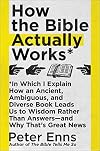
For most of my life, I have had an uncomfortable, conflicted relationship with the Bible. I love it and am constantly frustrated by it. Taught by "people of the book," from birth I was given all sorts of preconceived notions for what the Bible ought to be. This meant that as I've studied it more, I continually am having to deal with unmet expectations, which has felt like repeated faith crises.
Reading Enns' How the Bible Actually Works was a breath of fresh air, and truth be told, I had a show more hard time putting it down. He starts by sharing the questions he has heard on repeat from his students, namely: "What is the Bible, exactly? Who cares? What do I do with it?" And especially: "How does this ancient, distant, and odd book work for people who look to it today for spiritual guidance?" In his previous book - The Bible Tells me so - he argues that it's a mistake to see the Bible as an instruction manual, or a rulebook. In short, the "problems" of scripture that have to be explained are due to the baggage we bring to the text, expectations the Bible wasn't meant to meet.
His main point, the focus and oft-jokingly-repeated thesis is this: rather than seeing scripture as an instruction manual, or information to be downloaded, "the Bible holds out for us an invitation to join an ancient, well-traveled, and sacred quest to know God, the world we live in, and our place in it." The quest, in a single word, is wisdom. And he makes that point again and again and again looking at all the different parts of scripture to repeat it. As a friend put it, (and this phrase has stuck with me), his conclusion and thesis is "painfully obvious" and I so wish it had been drilled into my head as a youngster instead of all the religious baggage I carried for years. On all accounts, God is not a helicopter parent. As Rohr puts it, God is the "great-allower."
Of note, the book isn't written for conservative Christians. It's written for frustrated Christians - those "who have seen that the Bible doesn't meet the expectations they have been taught to cling to." It's for the barely Christian - hanging on to a thread of faith. And it may be for the formerly Christian - "who have had the courage to leave their faith behind when it ceased having any explanatory power for their reality because of what they were taught the Bible had to be."
If any of those identifiers resonate with you, I can't think of a better book for understanding the Bible. show less
Reading Enns' How the Bible Actually Works was a breath of fresh air, and truth be told, I had a show more hard time putting it down. He starts by sharing the questions he has heard on repeat from his students, namely: "What is the Bible, exactly? Who cares? What do I do with it?" And especially: "How does this ancient, distant, and odd book work for people who look to it today for spiritual guidance?" In his previous book - The Bible Tells me so - he argues that it's a mistake to see the Bible as an instruction manual, or a rulebook. In short, the "problems" of scripture that have to be explained are due to the baggage we bring to the text, expectations the Bible wasn't meant to meet.
His main point, the focus and oft-jokingly-repeated thesis is this: rather than seeing scripture as an instruction manual, or information to be downloaded, "the Bible holds out for us an invitation to join an ancient, well-traveled, and sacred quest to know God, the world we live in, and our place in it." The quest, in a single word, is wisdom. And he makes that point again and again and again looking at all the different parts of scripture to repeat it. As a friend put it, (and this phrase has stuck with me), his conclusion and thesis is "painfully obvious" and I so wish it had been drilled into my head as a youngster instead of all the religious baggage I carried for years. On all accounts, God is not a helicopter parent. As Rohr puts it, God is the "great-allower."
Of note, the book isn't written for conservative Christians. It's written for frustrated Christians - those "who have seen that the Bible doesn't meet the expectations they have been taught to cling to." It's for the barely Christian - hanging on to a thread of faith. And it may be for the formerly Christian - "who have had the courage to leave their faith behind when it ceased having any explanatory power for their reality because of what they were taught the Bible had to be."
If any of those identifiers resonate with you, I can't think of a better book for understanding the Bible. show less
Lists
You May Also Like
Associated Authors
Statistics
- Works
- 32
- Also by
- 8
- Members
- 3,583
- Popularity
- #7,074
- Rating
- 4.0
- Reviews
- 35
- ISBNs
- 86
- Languages
- 1
