
H. Leo Boles (1874–1946)
Author of Acts of the Apostles (Gospel Advocate New Testament Commentaries)
About the Author
Works by H. Leo Boles
Life and lessons of H. Leo Boles: Containing a biographical sketch of the author and seventy of his sermon outlines (1987) 4 copies
Holy Spirit 2 copies
Is Instrumental Music in Christian Worship Scriptural? — Author — 2 copies
1943 Annual lesson commentary on improved uniform series of international Bible lessons (1943) 2 copies
New Testament Teaching 1 copy
Associated Works
The Eldership: Elders, Deacons, Deaconesses, Evangelists or Preachers, Members (1950) — Author, some editions — 16 copies
Tagged
Common Knowledge
- Canonical name
- Boles, H. Leo
- Other names
- Boles, Henry Leo (birth name)
- Birthdate
- 1874-02-22
- Date of death
- 1946-02-07
- Gender
- male
- Occupations
- cleric
editor
teacher
college administrator - Organizations
- Churches of Christ
David Lipscomb College
Gospel Advocate - Relationships
- Boles, Henry Jefferson (father)
- Nationality
- USA
- Birthplace
- Gainesboro, Tennessee, USA
- Place of death
- Nashville, Tennessee, USA
- Burial location
- Woodlawn Memorial Park, Nashville, Tennessee, USA
- Associated Place (for map)
- Tennessee, USA
Members
Reviews
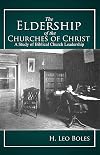
A short series of articles regarding the nature and service of, and other matters related to, the eldership.
The author addresses how local churches were established in the New Testament and how they were organized. He writes with a view of specific opponents who would suggest elderships were divinely inspired in the first century and were not to continue after the apostolic period as well as those who, for other reasons, favor monarchical or congregational leadership.
Most of what is written show more is good, healthy, and important for consideration. Yet the author, very focused on finding complete consistency throughout the New Testament (and with a view to his opponents), does go beyond what is written in at least two ways: his insistence on every church in the New Testament as having an eldership, and his related take, a church is only really a church when organized with elders.
Since there are qualifications for elders, as even the author concedes, there might well be situations in which a congregation does not have qualified men and thus would have no eldership. And while the author would expect a congregation to grow past that challenge quickly, such is not always feasible.
Many - perhaps even most - of the churches in the New Testament had elders (Jerusalem, Ephesus, Philippi for certain; the churches in Crete were to have elders appointed in them; etc.). But a close textual reading of 1 and 2 Corinthians demonstrates the church in Corinth, at least at the time of Paul's writings, did not have an eldership, and its organization and decisions were congregational in nature.
Thus it would have been better for bro. Boles to affirm the value and importance of elderships in local churches while recognizing there might be times churches are organized congregationally because of a lack of qualified men to serve as elders, and to not be as polemically bothered by this prospect.
A good resource for consideration. show less
The author addresses how local churches were established in the New Testament and how they were organized. He writes with a view of specific opponents who would suggest elderships were divinely inspired in the first century and were not to continue after the apostolic period as well as those who, for other reasons, favor monarchical or congregational leadership.
Most of what is written show more is good, healthy, and important for consideration. Yet the author, very focused on finding complete consistency throughout the New Testament (and with a view to his opponents), does go beyond what is written in at least two ways: his insistence on every church in the New Testament as having an eldership, and his related take, a church is only really a church when organized with elders.
Since there are qualifications for elders, as even the author concedes, there might well be situations in which a congregation does not have qualified men and thus would have no eldership. And while the author would expect a congregation to grow past that challenge quickly, such is not always feasible.
Many - perhaps even most - of the churches in the New Testament had elders (Jerusalem, Ephesus, Philippi for certain; the churches in Crete were to have elders appointed in them; etc.). But a close textual reading of 1 and 2 Corinthians demonstrates the church in Corinth, at least at the time of Paul's writings, did not have an eldership, and its organization and decisions were congregational in nature.
Thus it would have been better for bro. Boles to affirm the value and importance of elderships in local churches while recognizing there might be times churches are organized congregationally because of a lack of qualified men to serve as elders, and to not be as polemically bothered by this prospect.
A good resource for consideration. show less
You May Also Like


Associated Authors
Statistics
- Works
- 36
- Also by
- 1
- Members
- 791
- Popularity
- #32,199
- Rating
- 3.8
- Reviews
- 1
- ISBNs
- 15
- Languages
- 2


