
Oliver James (1) (1953–)
Author of Affluenza
For other authors named Oliver James, see the disambiguation page.
About the Author
Image credit: Courtesy of Allen and Unwin
Works by Oliver James
Office Politics: How to Thrive in a World of Lying, Backstabbing and Dirty Tricks (2013) 66 copies, 2 reviews
Upping Your Ziggy: How David Bowie Faced His Childhood Demons - and How You Can Face Yours (2016) 8 copies, 2 reviews
Tagged
Common Knowledge
- Birthdate
- 1953
- Gender
- male
- Occupations
- clinical psychologist
journalist
author
broadcaster - Nationality
- England
- Associated Place (for map)
- England
Members
Reviews

I can sum up my emotions about this book in one word. Bilge!
James promises to provide evidence for all he writes and yet mistakes anecdotes for proof, and correlation for causation. I already believe in what he set out to say but he somehow manages to make such a mess of it I wanted to throw the book across the room. His basic premise is that we need to get away from constantly desiring new things, ie greed Capitalism. This is great, I wholeheartedly agree with him on this. However, he show more underpins his evidence of this by claiming that rich people are unhappy, and poor people are happy. This is a ridiculous generalisation for anyone to make, let alone a clinical psychologist. His evidence is endless, repetitive, anecdotal interviews with people that are clearly chosen because they back his viewpoint. I'm sure, given a few hours I could find rich people who are happy and poor people who are unhappy, yet magically he couldn't find any.
At the end of the book there is a section titled 'The Unselfish Capitalist Manifesto' where the book really takes a turn for the bizarre. It ends up being a 37 page tirade against specific Labour MP's and the party as a whole. I'm no fan of politicians in general but none of this ire is aimed at a Conservative MP. He stops just shy of telling people to vote for the Conservatives at the next election but only by the thinnest of margins. It felt as though he decided to use the space at the end of the book as a political campaign, justifying it by the most tenuous links possible to the premise of the book. From time to time I like to seek out books that oppose my viewpoints and they generally provide a few thinking moments or alter my thoughts about something. I think this is a good thing to do. Mental or physical debate to challenge your beliefs is ever more important in an age where we can surround ourselves in an echo chamber. However, this book almost made me go against something I strongly believe in because I hated it so much, and that is a first. show less
James promises to provide evidence for all he writes and yet mistakes anecdotes for proof, and correlation for causation. I already believe in what he set out to say but he somehow manages to make such a mess of it I wanted to throw the book across the room. His basic premise is that we need to get away from constantly desiring new things, ie greed Capitalism. This is great, I wholeheartedly agree with him on this. However, he show more underpins his evidence of this by claiming that rich people are unhappy, and poor people are happy. This is a ridiculous generalisation for anyone to make, let alone a clinical psychologist. His evidence is endless, repetitive, anecdotal interviews with people that are clearly chosen because they back his viewpoint. I'm sure, given a few hours I could find rich people who are happy and poor people who are unhappy, yet magically he couldn't find any.
At the end of the book there is a section titled 'The Unselfish Capitalist Manifesto' where the book really takes a turn for the bizarre. It ends up being a 37 page tirade against specific Labour MP's and the party as a whole. I'm no fan of politicians in general but none of this ire is aimed at a Conservative MP. He stops just shy of telling people to vote for the Conservatives at the next election but only by the thinnest of margins. It felt as though he decided to use the space at the end of the book as a political campaign, justifying it by the most tenuous links possible to the premise of the book. From time to time I like to seek out books that oppose my viewpoints and they generally provide a few thinking moments or alter my thoughts about something. I think this is a good thing to do. Mental or physical debate to challenge your beliefs is ever more important in an age where we can surround ourselves in an echo chamber. However, this book almost made me go against something I strongly believe in because I hated it so much, and that is a first. show less
I've been meaning to read this for a while, and now that I have I'm really impressed. Perhaps the fact that I don't think I suffer too badly from Affluenza helps! Affluenza, James suggests, is an epidemic sweeping the English speaking world. It consists of an obsession with 'keeping-up-with-the-Joneses', excessive consumerism (buying stuff because you 'want' it instead of because you 'need' it), the need for increased wealth (beyond what you need), property fever - all leading to depression, show more anxiety and addictions.
Traveling the world's affluent cities (London, New York, Singapore etc) James interviews people who do and don't suffer from Affluenza, and tries to discover what makes some people more or less prone to the virus. He then goes on to suggest remedies, such as paying parents to look after their children (instead of forcing them back to work), teaching that it is not necessary to be rich and beautiful to be happy and how being playful, vivacious and authentic helps.
As someone he interview suggests, society is becoming populated by Tin Men from the Wizard of Oz - hollow inside.
I would have liked to have seen more interviews with normal citizens, instead of the stream of millionaires that he visited; and I'm not sure the very vicious attack on the Blairite government was completely necessary - I'd imagine that most governments (of all flavours and in all times) would have mucked it up just as they did (and do).
A fascinating read, certainly made me think about materiality, and asking myself do I 'need' or 'want' that? show less
Traveling the world's affluent cities (London, New York, Singapore etc) James interviews people who do and don't suffer from Affluenza, and tries to discover what makes some people more or less prone to the virus. He then goes on to suggest remedies, such as paying parents to look after their children (instead of forcing them back to work), teaching that it is not necessary to be rich and beautiful to be happy and how being playful, vivacious and authentic helps.
As someone he interview suggests, society is becoming populated by Tin Men from the Wizard of Oz - hollow inside.
I would have liked to have seen more interviews with normal citizens, instead of the stream of millionaires that he visited; and I'm not sure the very vicious attack on the Blairite government was completely necessary - I'd imagine that most governments (of all flavours and in all times) would have mucked it up just as they did (and do).
A fascinating read, certainly made me think about materiality, and asking myself do I 'need' or 'want' that? show less
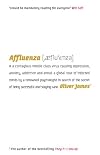
You could sum up most that is of any value in this book with that bon mot from Life's Little Instruction Book: "no-one said, on their deathbed, 'I wish I'd spent more time at the office'."
The first problem, of many, I have with Oliver James' Affluenza is that, for all the weight of scientific research he claims to have done, none of it is advanced in support of the existence of this thing called Affluenza in the first place. James states it as a bare fact - in fact, rather less than that: show more he includes a questionnaire designed to determine whether you have Affluenza, and then launches into an idiosyncratic monologue of anecdotes which he seems to regard as having the effect of revealing eternal verities.
The questionnaire doesn't give you much chance of not having the disease: answering in the affirmative to any one of the 16 statements he poses (grammarians and lawyers note: it's a disjunctive test) consigns you to infection. Given the statements include such outrages to public decency as "I would like to be admired by many people" and "my life would be better if I owned certain things I don't have now" it is difficult to see who, other than a misanthropic Trappist monk, wouldn't be "infected".
Other than Chet, a diabetic, malnourished, disenfranchised, frequently-mugged, misleadingly youthful-looking, church-going, taxi-driving New York immigrant, whom James has credulously (or, more likely, apocryphally) interviewed in the course of his travels.
Chet (who would never cheat on his wife, James confidently assures us) sounds almost too good to be true, as indeed do his "negative" New York examples, multi-millionaire broker Sam (who sounds like he stepped straight out of Wall Street) and Consuela, whom James admits reminds him of the "affluent young Manhattan women described in Jay McInerney's sharply observed novel "Story of My Life". You can't help the feeling James has been swept away by the literature a little.
Affluenza thereafter quickly settles down into a hair-shirt-adulating moan.
In part 3, after some 400 pages of injudiciously edited anecdotes, James takes the gloves off and, he warns the reader, gets "personal". It is quite tempting for a reviewer to do the same - this is, after all, a solution to the modern world's woes from the pen of an obviously angry, Eton-educated psychology graduate whose own aspirations for attention, fame and success seem transparent. In any case this is a book of politics and not pop psychology as it purports to be. James' target is "Selfish Capitalism" and prescriptions such as "reject much of the status quo" have more than a hint of the socialist workers' party leafleteer about them. What riles James, I suspect, is that, given a choice between "spiritually happy" impecunious violent disenfranchisement (the Chet model) and "spiritually barren" materialistic, godless life of sterile consumerism (Sam and Consuela), most people would squarely opt for the latter. And who could blame them: a small sprinkling of philosophical self-reflection leavens naked materialism in a way it tends not to compensate for the effects of violence and lack of access to health, education and justice. In fairness, James doesn't think so: he says, rather presumptuously drawing his readers' conclusions for them, "if you met them both I would be very surprised if you preferred to be Sam rather than Chet")
On the other hand, by the same assertion, James acknowledges that most people (being his readership) already do have this sense of self-reflection. If it is true that they would not like or relate to the cardboard figure of Sam precisely as James has cut him out (and as mentioned, I can't help thinking Sam's outline has been exaggerated) then Sam isn't a symptom of modern life, but an anomaly in it. As it happens, I've worked in the investment banking industry for a decade, and the only character I've come across who even vaguely resembles Sam is Gordon Gekko, and he was a figment of Oliver Stone's imagination.
When it comes down to it, what we have here is a fabulous hook: the name "Affluenza" is an inspired bit of marketing, and the initial premise - that over the last two or three decades our asset-rich/time-poor lives have got themselves out of perspective does resonate (I've hacked this review out on a blackberry on the tube on my way to work - you have to be very disciplined!). I dare say many of us would happily re-trade that equation if we could figure out how, but all the same, our lives are still richly fulfilled in other (non materialistic) perspectives. When you get down to the execution: James' love of anecdote, his badly disguised fifth-form socialist agenda and his laboured prose, the tendency to flip pages becomes hard to resist. show less
The first problem, of many, I have with Oliver James' Affluenza is that, for all the weight of scientific research he claims to have done, none of it is advanced in support of the existence of this thing called Affluenza in the first place. James states it as a bare fact - in fact, rather less than that: show more he includes a questionnaire designed to determine whether you have Affluenza, and then launches into an idiosyncratic monologue of anecdotes which he seems to regard as having the effect of revealing eternal verities.
The questionnaire doesn't give you much chance of not having the disease: answering in the affirmative to any one of the 16 statements he poses (grammarians and lawyers note: it's a disjunctive test) consigns you to infection. Given the statements include such outrages to public decency as "I would like to be admired by many people" and "my life would be better if I owned certain things I don't have now" it is difficult to see who, other than a misanthropic Trappist monk, wouldn't be "infected".
Other than Chet, a diabetic, malnourished, disenfranchised, frequently-mugged, misleadingly youthful-looking, church-going, taxi-driving New York immigrant, whom James has credulously (or, more likely, apocryphally) interviewed in the course of his travels.
Chet (who would never cheat on his wife, James confidently assures us) sounds almost too good to be true, as indeed do his "negative" New York examples, multi-millionaire broker Sam (who sounds like he stepped straight out of Wall Street) and Consuela, whom James admits reminds him of the "affluent young Manhattan women described in Jay McInerney's sharply observed novel "Story of My Life". You can't help the feeling James has been swept away by the literature a little.
Affluenza thereafter quickly settles down into a hair-shirt-adulating moan.
In part 3, after some 400 pages of injudiciously edited anecdotes, James takes the gloves off and, he warns the reader, gets "personal". It is quite tempting for a reviewer to do the same - this is, after all, a solution to the modern world's woes from the pen of an obviously angry, Eton-educated psychology graduate whose own aspirations for attention, fame and success seem transparent. In any case this is a book of politics and not pop psychology as it purports to be. James' target is "Selfish Capitalism" and prescriptions such as "reject much of the status quo" have more than a hint of the socialist workers' party leafleteer about them. What riles James, I suspect, is that, given a choice between "spiritually happy" impecunious violent disenfranchisement (the Chet model) and "spiritually barren" materialistic, godless life of sterile consumerism (Sam and Consuela), most people would squarely opt for the latter. And who could blame them: a small sprinkling of philosophical self-reflection leavens naked materialism in a way it tends not to compensate for the effects of violence and lack of access to health, education and justice. In fairness, James doesn't think so: he says, rather presumptuously drawing his readers' conclusions for them, "if you met them both I would be very surprised if you preferred to be Sam rather than Chet")
On the other hand, by the same assertion, James acknowledges that most people (being his readership) already do have this sense of self-reflection. If it is true that they would not like or relate to the cardboard figure of Sam precisely as James has cut him out (and as mentioned, I can't help thinking Sam's outline has been exaggerated) then Sam isn't a symptom of modern life, but an anomaly in it. As it happens, I've worked in the investment banking industry for a decade, and the only character I've come across who even vaguely resembles Sam is Gordon Gekko, and he was a figment of Oliver Stone's imagination.
When it comes down to it, what we have here is a fabulous hook: the name "Affluenza" is an inspired bit of marketing, and the initial premise - that over the last two or three decades our asset-rich/time-poor lives have got themselves out of perspective does resonate (I've hacked this review out on a blackberry on the tube on my way to work - you have to be very disciplined!). I dare say many of us would happily re-trade that equation if we could figure out how, but all the same, our lives are still richly fulfilled in other (non materialistic) perspectives. When you get down to the execution: James' love of anecdote, his badly disguised fifth-form socialist agenda and his laboured prose, the tendency to flip pages becomes hard to resist. show less

Found this a confirmation of what I (and probably most people) had long suspected. Progression at work is less dependent on intelligence and diligence but more to do with fostering an impression or reputation through basically acting. The book is divided into two parts. The first deals with the types of people who you really need to avoid, what he calls 'triadic'. That is they exhibit a combination of the personality traits of the psychopath, the narcissist and the Machiavel. These are the show more ones that will happily trample on you to further themselves and not care one jot. And they can be pretty clever with it and difficult to spot, particularly if you are a non-Machieval sort yourself. The second part is a more general explanation of how office politics works in general and what you can do to make sure you are not a victim of it. A key part of this is being astute which appears to mean being able to read between the lines and determining what the intentions and motivations of others really are. You can be astute via two psychological processes one automatic and the other more deliberate. The first is fundamental and learned at an early age. The second is more complex and relies on you making a sequence of inferences to know what's what. Other skills include ingratiation, virtuosity and even 'dirty tricks'. The latter he gives as more a way of warning that it could happen to you rather than recommendation. These dirty tricks include blackmail, defamation, sabotage and deception. Much of the book explains the various methods of politicking via examples / case studies. In summary the book provides a good overview of office politics. It is not a simple thing to engage it as there are dangers with doing so, not least to your own mental health. Also, the author is quick to point out that there are many nuances to be aware of to be successful at it. This is not so much a 'how to' guide but more a 'how to survive and not be left behind' guide and it does this rather well. show less
Lists
You May Also Like
Associated Authors
Statistics
- Works
- 13
- Members
- 1,267
- Popularity
- #20,252
- Rating
- 3.5
- Reviews
- 21
- ISBNs
- 97
- Languages
- 6