
Marc McCutcheon
Author of Descriptionary
About the Author
Marc McCutcheon is a freelance writer & author of several books, including "The Facts on File Student's Thesaurus." He lives in South Portland, ME. (Bowker Author Biography)
Works by Marc McCutcheon
Damn! Why Didn't I Write That? How Ordinary People are Raking in $100,000.00...or more Writing Nonfiction Books & How You Can Too! (2001) 185 copies, 1 review
The Kid Who Named Pluto: And the Stories of Other Extraordinary Young People in Science (2004) 111 copies, 7 reviews
The Facts on File Student's Thesaurus (Facts on File Library of Language and Literature) (2000) 9 copies
The Medium Is the Monster: Canadian Adaptations of Frankenstein and the Discourse of Technology (2018) 4 copies
Everyday life in the 1800's 1 copy
Viva student's thesaurus 1 copy
Tagged
Common Knowledge
- Birthdate
- 20th century
- Gender
- male
- Occupations
- editor
bookseller - Nationality
- USA
- Places of residence
- Scarborough, Maine, USA
- Associated Place (for map)
- Maine, USA
Members
Reviews
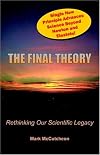
Interesting, this book, and not so much for what it says, especially. Here we have a book claiming to have a final, all-encompassing Theory of Everything, written by a guy with an EE degree. It is self-published. It has five-star ratings galore on Amazon, all written by folks who have never reviewed anything else on Amazon. Do some googling, and you'll find that negative reviews are quickly deleted by Amazon. All of this makes me wonder about just what is going on here: why is Amazon going show more out of its way to promote a self-published book? Why this book? It's all very mysterious and strange. The book itself is odd. Chapter One "debunks" Newton's theory of gravity, and reveals how little the author understands physics. (It does, however, remind me that no one really understands gravity, which is astounding, when you think about it.) Then we encounter Chapter Two, where the author presents his Big Idea, which is completely nonsensical. He offers no experimental evidence -- his "science" is all based on "common sense". I don't think he's out to make a quick buck, though I'm sure he's made a few. It's just another crackpot book by someone who feels the Establishment needs to be taken down and replaced by the will of the people. It's popularity is no doubt due to how it positions itself as an "outsider's" manifesto. It's written sort of in the Dummies style. So, if you're looking for A Final Theory for Dummies, you've found it. It's worth taking out of the library, for a few chuckles. Though it reveals more about the world of online booksellers and self-publishers than physics. show less
There is widespread belief that physics has essentially figured out the universe, yet if you take a good close look, the head-scratching, arguing camps, mysteries, paradoxes, and wild theories are everywhere (witness Dark Energy, Dark Matter, 11-Dimensional Superstrings, Quantum paradoxes, Relativity mysteries, etc.). Billions of dollars have been spent constructing experiments trying to prove historical theories that are now considered fact, yet whose fatal flaws are plain to see with just show more a little logic and modest critical analysis, all because there was no better alternative at the time and now we're locked in and heavily invested in them. The Final Theory takes a good hard look at this legacy and clearly exposes the fundamental reasons why all this is happening -- and would probably continue endlessly without this book, while providing solid new answers that have great potential to stop this insanity in its tracks.
The best way I could describe this new perspective is that it is a very far-reaching application of Einstein's equivalence principle, where the gravity we feel on the ground is indistinguishable from being continually accelerated upward in an elevator in deep space, only the theory takes this idea far more literally and goes way further than Einstein or anyone else ever took it, leading to the expansion of matter on all levels, both the atomic level and the sub-atomic level. The book is written in plain, clear and descriptive language that is accessible to everyone, with intriguing and challenging scientific discussions on nearly every page. For me this is by far the most viable and comprehensive explanation of the physical world I have ever encountered -- and ever expect to in my lifetime, frankly, which is why I treasure this find so much.
The first half of the book completely re-explains common physical events such as our weight on the ground, falling objects, orbits in our solar system, as well as grander issues such as inter-stellar travel and galactic and universe structure and formation -- all according to this new principle. And all of this is done with reference to actual measurements, experiences, observations and space missions, showing a far more sensible physics than Newton's proposal of an endless unpowered attracting force or Einstein's abstract warped space-time. The second half deals with energy in all its forms (light, electricity, magnetism, sub-atomic forces, etc.) and all the implications in view of this new principle, dealing also with Special Relativity, General Relativity, Quantum Mechanics and more along the way, still with the same clarity and straightforward approach as in the first half. By the end of the book, an entirely new and fully unified scientific view of everything is fully uncovered, all based on the same singular physics principle throughout, and with a depth and breadth that has never appeared anywhere yet that I'm aware of.
Judged both on its grounding in solid scientific principles and on Occam's Razor, which states that the simplest sensible explanation is usually the correct one, McCutcheon's Expansion Theory far outshines today's current theory in my opinion. If something seems needlessly, chronically and increasingly filled with mysteries, paradoxes and complexities, that is usually a strong indication that we should start looking elsewhere for answers, and this book gives a powerful new direction in which to look. Thankfully, I am now free of the same old repeated party lines I see every time I walk past the science magazine racks or see yet another documentary on our 'strange and incomprehensible universe'. Turns out it's just our odd theories that make it appear strange and incomprehensible when observations are repeatedly and singularly filtered through them and fed to us with no alternative viewpoint, hammering home the belief that our theories must be right and our universe must be a very bizzare place; yet it's actually a rather simple and beautiful place when seen from the right perspective.
In searching around, I can see there is a bit of controversy stirred up by the book, with some feeling justified in strongly vocalizing against it clearly without even bothering to read it first -- even here on Amazon's legitimate customer review page. This book powerfully demonstrates that everything we know and believe today may well need a major rethink, leveling the playing field and powerfully enabling anyone to stop and think twice, and that's not something everyone wants to hear. But as far as I'm concerned it's an absolutely fantastic find that will be relished by anyone who senses something is up with today's science and would like the opportunity to take another look at it for themselves from an entirely fresh scientific perspective that they simply won't hear from the heavily defended, unified front presented by today's scientific community and science media. show less
The best way I could describe this new perspective is that it is a very far-reaching application of Einstein's equivalence principle, where the gravity we feel on the ground is indistinguishable from being continually accelerated upward in an elevator in deep space, only the theory takes this idea far more literally and goes way further than Einstein or anyone else ever took it, leading to the expansion of matter on all levels, both the atomic level and the sub-atomic level. The book is written in plain, clear and descriptive language that is accessible to everyone, with intriguing and challenging scientific discussions on nearly every page. For me this is by far the most viable and comprehensive explanation of the physical world I have ever encountered -- and ever expect to in my lifetime, frankly, which is why I treasure this find so much.
The first half of the book completely re-explains common physical events such as our weight on the ground, falling objects, orbits in our solar system, as well as grander issues such as inter-stellar travel and galactic and universe structure and formation -- all according to this new principle. And all of this is done with reference to actual measurements, experiences, observations and space missions, showing a far more sensible physics than Newton's proposal of an endless unpowered attracting force or Einstein's abstract warped space-time. The second half deals with energy in all its forms (light, electricity, magnetism, sub-atomic forces, etc.) and all the implications in view of this new principle, dealing also with Special Relativity, General Relativity, Quantum Mechanics and more along the way, still with the same clarity and straightforward approach as in the first half. By the end of the book, an entirely new and fully unified scientific view of everything is fully uncovered, all based on the same singular physics principle throughout, and with a depth and breadth that has never appeared anywhere yet that I'm aware of.
Judged both on its grounding in solid scientific principles and on Occam's Razor, which states that the simplest sensible explanation is usually the correct one, McCutcheon's Expansion Theory far outshines today's current theory in my opinion. If something seems needlessly, chronically and increasingly filled with mysteries, paradoxes and complexities, that is usually a strong indication that we should start looking elsewhere for answers, and this book gives a powerful new direction in which to look. Thankfully, I am now free of the same old repeated party lines I see every time I walk past the science magazine racks or see yet another documentary on our 'strange and incomprehensible universe'. Turns out it's just our odd theories that make it appear strange and incomprehensible when observations are repeatedly and singularly filtered through them and fed to us with no alternative viewpoint, hammering home the belief that our theories must be right and our universe must be a very bizzare place; yet it's actually a rather simple and beautiful place when seen from the right perspective.
In searching around, I can see there is a bit of controversy stirred up by the book, with some feeling justified in strongly vocalizing against it clearly without even bothering to read it first -- even here on Amazon's legitimate customer review page. This book powerfully demonstrates that everything we know and believe today may well need a major rethink, leveling the playing field and powerfully enabling anyone to stop and think twice, and that's not something everyone wants to hear. But as far as I'm concerned it's an absolutely fantastic find that will be relished by anyone who senses something is up with today's science and would like the opportunity to take another look at it for themselves from an entirely fresh scientific perspective that they simply won't hear from the heavily defended, unified front presented by today's scientific community and science media. show less
I am astounded that I did not discover this remarkable book sooner. Though I am not really a zealous follower of theoretical science, I have always been fascinated by the possibility that a "theory of everything" might resolve some of the fundamental mysteries of our universe.
For example, although our current theory of gravity is that it is simply one of the four fundamental forces in nature, it is clear that we have little understanding of the physical foundations of gravity; that is why we show more have all the divergent hypotheses being put forward: gravity waves, gravity particles, warping of space-time, etc. Plus, there is a good argument that the earth's gravity, as is is modeled in Newtonian terms, does in fact do real work in "pulling" objects (though this is rarely openly acknowledged), including the moon, from an otherwise straight-line motion and into a circular orbit; doing this for millions of years with no known energy source to power this work. That concern is often obscured by what seems to me a bogus use of the "work function." Where does the energy come from to divert the moon, or any orbiting object, from its straight-line momentum? And if we go with relativity theory, why do objects in space create a warping of "space-time"? Isn't that just an ad hoc theoretical position to hide the gaps of knowledge without offering any real explanatory value?
This book addresses these and so many other stubborn gaps and contradictions in current theory.
There is much to recommend this book. It provides a unique alternative to today's inadequate jumble of theories. It provides a theory that might well completely unify our understanding of basic physical phenomena. Although it might be argued that to call this theory the "final theory" is premature, and I agree that that is so, the claim is (to my surprise) actually plausible once you reflect carefully the ideas presented.
Of course skepticism is always in order in any aspect of theory construction. But skepticism is a two edged sword. It is just as foolish to "will to believe" the status quo as it is to be a naive true believer of a new theory. Open mindedness does not mean that everything that comes along is plausible. But it does mean that new ideas are considered with sincerity and not dismissed or ridiculed simply because they are startling or because they completely overturn our current understanding. The ideas in The Final Theory are quite revolutionary and startling. But it is not surprising that an idea to make sense of what is now so mysterious would indeed to be revolutionary and startling.
As with any revolutionary new theory this theory will likely be fiercely resisted by many who have invested their careers and reputations in the current array of theoretical approaches. But I believe that there will inevitably be serious consideration of this theory by very qualified scientists. It will take time before we will see much evidence of it, however. Scientists must be very cautious. They have families to support, just as the rest of us. To prematurely voice support for a theory this revolutionary will be a great risk to both aspiring and established scientists. This theory is far more fundamentally revolutionary than the new theories we see every few years in cosmology.
The book is extremely well written. The concepts are carefully explained, often with the aid of helpful diagrams, so that the reader can easily grasp the concepts. I often have trouble with advanced mathematical treatments, but in this book the mathematics is tightly argued but easily comprehended even by the mathematically impaired. The author has put in a considerable effort to help the reader understand every step of the reasoning process and the evidence marshalled to support the theory.
I have commuicated with the author and I am convinced of his complete sincerity and his deep thirst for understanding. He seems to be the kind of person who I most admire for his curiosity, his integrity, and his courgage.
If you are open-minded, yet healthily skeptical, and have a taste for the intrepid and relentless pursuit of truth, I think you will not be disappointed with this book. It is one of the most intriguing books I have ever read. show less
For example, although our current theory of gravity is that it is simply one of the four fundamental forces in nature, it is clear that we have little understanding of the physical foundations of gravity; that is why we show more have all the divergent hypotheses being put forward: gravity waves, gravity particles, warping of space-time, etc. Plus, there is a good argument that the earth's gravity, as is is modeled in Newtonian terms, does in fact do real work in "pulling" objects (though this is rarely openly acknowledged), including the moon, from an otherwise straight-line motion and into a circular orbit; doing this for millions of years with no known energy source to power this work. That concern is often obscured by what seems to me a bogus use of the "work function." Where does the energy come from to divert the moon, or any orbiting object, from its straight-line momentum? And if we go with relativity theory, why do objects in space create a warping of "space-time"? Isn't that just an ad hoc theoretical position to hide the gaps of knowledge without offering any real explanatory value?
This book addresses these and so many other stubborn gaps and contradictions in current theory.
There is much to recommend this book. It provides a unique alternative to today's inadequate jumble of theories. It provides a theory that might well completely unify our understanding of basic physical phenomena. Although it might be argued that to call this theory the "final theory" is premature, and I agree that that is so, the claim is (to my surprise) actually plausible once you reflect carefully the ideas presented.
Of course skepticism is always in order in any aspect of theory construction. But skepticism is a two edged sword. It is just as foolish to "will to believe" the status quo as it is to be a naive true believer of a new theory. Open mindedness does not mean that everything that comes along is plausible. But it does mean that new ideas are considered with sincerity and not dismissed or ridiculed simply because they are startling or because they completely overturn our current understanding. The ideas in The Final Theory are quite revolutionary and startling. But it is not surprising that an idea to make sense of what is now so mysterious would indeed to be revolutionary and startling.
As with any revolutionary new theory this theory will likely be fiercely resisted by many who have invested their careers and reputations in the current array of theoretical approaches. But I believe that there will inevitably be serious consideration of this theory by very qualified scientists. It will take time before we will see much evidence of it, however. Scientists must be very cautious. They have families to support, just as the rest of us. To prematurely voice support for a theory this revolutionary will be a great risk to both aspiring and established scientists. This theory is far more fundamentally revolutionary than the new theories we see every few years in cosmology.
The book is extremely well written. The concepts are carefully explained, often with the aid of helpful diagrams, so that the reader can easily grasp the concepts. I often have trouble with advanced mathematical treatments, but in this book the mathematics is tightly argued but easily comprehended even by the mathematically impaired. The author has put in a considerable effort to help the reader understand every step of the reasoning process and the evidence marshalled to support the theory.
I have commuicated with the author and I am convinced of his complete sincerity and his deep thirst for understanding. He seems to be the kind of person who I most admire for his curiosity, his integrity, and his courgage.
If you are open-minded, yet healthily skeptical, and have a taste for the intrepid and relentless pursuit of truth, I think you will not be disappointed with this book. It is one of the most intriguing books I have ever read. show less
McCutcheon's book, which is iconoclastic and even heretical, is incredibly thought-provoking. I consider this one of the best popular science books I have read in that regard.
I could not help but think about Mordehai Milgrom, another challenger of standard gravitational theories, while reading McCutcheon's book. I built my review on a modest comparison of McCutcheon and Milgrom. Milgrom is a professor of physics at the Weizmann Institute in Israel. Bear with me to the end, and I hope you'll show more find the comparison useful in evaluating criticism of McCutcheon.
McCutcheon and Milgrom are examples of people who rejected the "invent a new particle" approach that is characteristic of modern physics. McCutcheon covers so many holes in Standard Theory that I cannot list them all here, but a few are: Olber's paradox; some problems with Red Shift; waste heat in superconductivity; raw mistakes in Einstein's math (one of which McCutcheon walks the reader through in detail); cases where Relativity Theory is contradicted, for example in the performance of real spacecraft; problems with the interpretation of experiments testing Einstein's Relativity; the expansion of ice; permanent magnets; and as I said, too many more to list.
Note that McCutcheon is just as critical of Quantum Theory as he is of Einstein and Newton.
Neither McCutcheon's Expansion Theory, nor Milgrom's theory, known as Modified Newtonian Dynamics (MOND), derive from kooky thought experiments. Both men are trying to explain real, intractable problems in Standard Theory. In Milgrom's case, he started with the rotational speeds of stars in spiral galaxies. Here's a quote from the Discover Magazine, August 2006 report on Milgrom, that could just as easily be applied to McCutcheon. Regarding galactic rotation, the article's author says: "Why don't the outer stars move more slowly than the inner ones? When confronting such a choice, scientists have only a few options: Question the data, question the theory, or invent something new...astronomers assumed the existence of a halo of dark matter around every spiral galaxy...the dark matter tugged on the stars, cranking up their speeds... The choice was reasonable, but it was still a choice."
And, "Even though dark matter has eluded all attempts at detection, most cosmologists are convinced it must be out there. Without it, there's no explanation for much of what they see in the cosmos."
"It was a solution Milgrom could not accept."
Of course go and look these things up, Reader, but please--please!--don't find a few facts in wikipedia, or opinions in a chat forum about McCutcheon and the issues mentioned above, and try to dismiss them based on those. McCutcheon's book covers dozens of unexplained phenomena or paradoxes in Standard Theory beyond the issue of gravity. Likewise, Mordehai Milgrom and his colleague Jacob Bekenstein have published a number of papers filled with much more data than my obtuse scribbles offer here.
McCutcheon's theory of gravity is intriguing as a mental exercise; it's so counter-intuitive on several points that it feels like a real accomplishment to get one's wits around it. His revision of momentum was the hardest part for me to accept. Keep in mind that I'm talking about understanding it, not necessarily believing it. It's not abstruse, like Einstein's Relativity theories, just counter-intuitive (like Einstein's Relativity theories).
Both Milgrom and McCutcheon had trouble getting published--McCutcheon so much so that he had to self-publish. Milgrom says, "I went back and looked at the history of science and saw this happens again and again. The marketplace can only handle so many heretical ideas at one time." This reminds me of Thomas Kuhn's paradigmatic view of science, which says that all science develops from assumptions. The normal cycle is for "revolutionary" science to replace the old assumptions with new ones, which gradually replace the old paradigms and become the basis of new, "normal" science. It also puts me in mind of Karl Popper's refutationist view of science, in which theories have to be falsifiable. The goal of science is to improve its theories, and to do that, we have to be able to entertain the possibility of change when someone claims to find mistakes in existing theories. We can't be so dogmatic about the current set of assumptions that to defend them, we engage in ad hominem attacks against new thinkers.
If you decide to read McCutcheon's book, don't get bogged down by the gravity discussion in the first half. If you become bored, before you give up, just get the basic idea of Expansion Theory, then jump forward to page 200 and treat yourself to some of his refutations of modern physics. The whole second half of the book moves along much more quickly than the first.
Of course Newton and Einstein were brilliant minds. But among the highlights in McCutcheon's book are the pages where he shows how a pair of very famous equations are not necessarily that innovative: Newton's gravity formula can be derived easily from Kepler's laws of motion, and E=mc^2 can easily be derived from the simple formula for kinetic motion. All in all, it's very entertaining if you're not religiously dogmatic about your science.
A couple of quotes to cap this off, the first from the Discover issue mentioned above, and the others from the back of McCutcheon's book:
"Science does not emerge in some perfect, complete crystalline form. Sometimes one must make extended conclusions from limited data. Why should all matter be in the visible sector? Dark matter was a simple solution to the problem." - James Peebles, cosmologist, Princeton University, Discover Magazine, August 2006.
"Only a few people understand--or think they understand--how a permanent magnet works. the magnet of everyday life is not a simple thing." - Tatiana Makarove, physicist, Umea University, Sweden, Discover Magazine, December 2002.
"Gravity may not be working as advertised. Spacecraft hurtling through the Solar System have been behaving so bizarrely that some scientists wonder whether our theories of gravity are wrong." - Charles Seife, New Scientist Magazine, September 1998.
"We don't know anything. Everything about gravity is mysterious." - Michael Martin Nieto, theoretical physicist, Los Alamos National Laboratory, Discover Magazine, October 2003. show less
I could not help but think about Mordehai Milgrom, another challenger of standard gravitational theories, while reading McCutcheon's book. I built my review on a modest comparison of McCutcheon and Milgrom. Milgrom is a professor of physics at the Weizmann Institute in Israel. Bear with me to the end, and I hope you'll show more find the comparison useful in evaluating criticism of McCutcheon.
McCutcheon and Milgrom are examples of people who rejected the "invent a new particle" approach that is characteristic of modern physics. McCutcheon covers so many holes in Standard Theory that I cannot list them all here, but a few are: Olber's paradox; some problems with Red Shift; waste heat in superconductivity; raw mistakes in Einstein's math (one of which McCutcheon walks the reader through in detail); cases where Relativity Theory is contradicted, for example in the performance of real spacecraft; problems with the interpretation of experiments testing Einstein's Relativity; the expansion of ice; permanent magnets; and as I said, too many more to list.
Note that McCutcheon is just as critical of Quantum Theory as he is of Einstein and Newton.
Neither McCutcheon's Expansion Theory, nor Milgrom's theory, known as Modified Newtonian Dynamics (MOND), derive from kooky thought experiments. Both men are trying to explain real, intractable problems in Standard Theory. In Milgrom's case, he started with the rotational speeds of stars in spiral galaxies. Here's a quote from the Discover Magazine, August 2006 report on Milgrom, that could just as easily be applied to McCutcheon. Regarding galactic rotation, the article's author says: "Why don't the outer stars move more slowly than the inner ones? When confronting such a choice, scientists have only a few options: Question the data, question the theory, or invent something new...astronomers assumed the existence of a halo of dark matter around every spiral galaxy...the dark matter tugged on the stars, cranking up their speeds... The choice was reasonable, but it was still a choice."
And, "Even though dark matter has eluded all attempts at detection, most cosmologists are convinced it must be out there. Without it, there's no explanation for much of what they see in the cosmos."
"It was a solution Milgrom could not accept."
Of course go and look these things up, Reader, but please--please!--don't find a few facts in wikipedia, or opinions in a chat forum about McCutcheon and the issues mentioned above, and try to dismiss them based on those. McCutcheon's book covers dozens of unexplained phenomena or paradoxes in Standard Theory beyond the issue of gravity. Likewise, Mordehai Milgrom and his colleague Jacob Bekenstein have published a number of papers filled with much more data than my obtuse scribbles offer here.
McCutcheon's theory of gravity is intriguing as a mental exercise; it's so counter-intuitive on several points that it feels like a real accomplishment to get one's wits around it. His revision of momentum was the hardest part for me to accept. Keep in mind that I'm talking about understanding it, not necessarily believing it. It's not abstruse, like Einstein's Relativity theories, just counter-intuitive (like Einstein's Relativity theories).
Both Milgrom and McCutcheon had trouble getting published--McCutcheon so much so that he had to self-publish. Milgrom says, "I went back and looked at the history of science and saw this happens again and again. The marketplace can only handle so many heretical ideas at one time." This reminds me of Thomas Kuhn's paradigmatic view of science, which says that all science develops from assumptions. The normal cycle is for "revolutionary" science to replace the old assumptions with new ones, which gradually replace the old paradigms and become the basis of new, "normal" science. It also puts me in mind of Karl Popper's refutationist view of science, in which theories have to be falsifiable. The goal of science is to improve its theories, and to do that, we have to be able to entertain the possibility of change when someone claims to find mistakes in existing theories. We can't be so dogmatic about the current set of assumptions that to defend them, we engage in ad hominem attacks against new thinkers.
If you decide to read McCutcheon's book, don't get bogged down by the gravity discussion in the first half. If you become bored, before you give up, just get the basic idea of Expansion Theory, then jump forward to page 200 and treat yourself to some of his refutations of modern physics. The whole second half of the book moves along much more quickly than the first.
Of course Newton and Einstein were brilliant minds. But among the highlights in McCutcheon's book are the pages where he shows how a pair of very famous equations are not necessarily that innovative: Newton's gravity formula can be derived easily from Kepler's laws of motion, and E=mc^2 can easily be derived from the simple formula for kinetic motion. All in all, it's very entertaining if you're not religiously dogmatic about your science.
A couple of quotes to cap this off, the first from the Discover issue mentioned above, and the others from the back of McCutcheon's book:
"Science does not emerge in some perfect, complete crystalline form. Sometimes one must make extended conclusions from limited data. Why should all matter be in the visible sector? Dark matter was a simple solution to the problem." - James Peebles, cosmologist, Princeton University, Discover Magazine, August 2006.
"Only a few people understand--or think they understand--how a permanent magnet works. the magnet of everyday life is not a simple thing." - Tatiana Makarove, physicist, Umea University, Sweden, Discover Magazine, December 2002.
"Gravity may not be working as advertised. Spacecraft hurtling through the Solar System have been behaving so bizarrely that some scientists wonder whether our theories of gravity are wrong." - Charles Seife, New Scientist Magazine, September 1998.
"We don't know anything. Everything about gravity is mysterious." - Michael Martin Nieto, theoretical physicist, Los Alamos National Laboratory, Discover Magazine, October 2003. show less
Lists
Awards


You May Also Like


Associated Authors
Statistics
- Works
- 20
- Members
- 2,721
- Popularity
- #9,440
- Rating
- 3.7
- Reviews
- 36
- ISBNs
- 64
- Languages
- 6