
John W. Robinson (1929–2018)
Author of Trails of the Angeles: 100 Hikes in the San Gabriels
About the Author
John W. Robinson, a retired teacher and historian, is the author of numerous books and articles on California history. He was awarded a Fellows Medallion by the Historical Society of Southern California.
Series
Works by John W. Robinson
Associated Works
Call Of The Mountains: The Beauty And Legacy Of Southern California's San Jacinto, San Bernadino And San Gabriel Mountai (2005) — Foreword — 11 copies
Will Thrall and the San Gabriels: A Man to Match the Mountains (Adventures in Cultural and Natural History) (2004) — Foreword — 3 copies
The Silver of the Sierra Madre: John Robinson, Boss Shepherd, and the People of the Canyons (2008) — Contributor — 2 copies
Tagged
Common Knowledge
- Birthdate
- 1929-07-08
- Date of death
- 2018-04-24
- Gender
- male
- Education
- University of Southern California, Los Angeles, B.A., 1951
Cal State University Long Beach, M.A., 1966 - Organizations
- Fellow of the Historical Society of Southern California (2005)
- Awards and honors
- Donald H. Pfluegar Award (Historical Society of Southern California, 1992)
Westerners International’s Coke Award (1990, 1994) - Nationality
- USA
- Birthplace
- Long Beach, California, USA
- Place of death
- Colorado, USA
- Associated Place (for map)
- USA
Members
Reviews

Fascinating accounts of the many mini-gold rushes ("mini" compared to the California Gold Rush upon Sutter Mill five years previously) that occured along the East Fork of the San Gabriel River beginning in 1854 and coninuing sporadically well into the 20th century. In fact, goldpanning enthusiasts still ply their patient trade in the East Fork's waters today, extracting three dollars worth of gold dust after a full days labor of love -- if they're lucky. Los Angelenos are lucky indeed for show more their close proximity to mountains, and mountains filled not just with dry chapparral, seasonal wildfires and mudslides (and hordes of buried bodies & covert marijuana "plantations" too) but with so much history and, if you know where to bushwhack off trail, surprising mining artifacts and related detritus.
On a recent hike up the East Fork with my inquisitive daughter, she stopped, knee deep in the East Fork's refreshing flow, pointed upward to a mountainslope and asked, "what's that pipe doing way up there?" I replied, as if I were an expert myself and had never even heard of John Robinson's "Mines of the East Fork," that there were once goldmines gallore up here, and that the pipes she saw were once used to transport water for the hydraulic mining they did, where they'd basically aim the end of a piece of pipe at a mountainside, and blast water at the mountain with the salivary hopes of finding the mother lode beneath.
"Why?" She asked, apparently not getting what I meant by "mother lode".
"So they could find gold and get rich."
"Oh."
Did anyone get rich from the East Fork back during its 1850s heyday of glory and excitement? Not especially. According to Robinson, even though the total historical yield from the canyon was estimated by the Los Angeles Star at $4 to $13 million, back in the 1850s & 60s, the average person took out only between $2 and $10 per day. Good money back then, true, but since the canyon was regularly flooded each winter, in particular the winters of 1859 and 1862 being extreme inundations (the latter, in fact, completely destroyed and left no evidence that the sprung-up-overnight-mining town of Eldoradoville ever existed) the cost of reconstructing flume lines and replacing & hauling mining materials back up the fifteen miles from the town of Azusa, ultimately proved insurmountable. Gold mining continued, floods or no floods, but even the invention of "mini, more easily transported hydraulics" in the 1890s, met with negligible profit and inevitable failure.
What John Muir meant a century ago to the mighty Sierra Nevada mountain range, John Robinson means to the San Gabriels and the East Fork. Robinson has researched the history and written more authoritatively on the mountains of Southern California than any person past or present and most likely to come. It's unfortunate that so few people besides avid hikers such as yours truly appreciate the mountains near Los Angeles and her swarming suburbs (besides arsonists of course); otherwise, John Robinson, in my book, would be as revered a figure, say, as an Edward Abbey or just mentioned John Muir.
If you ever visit LA, instead of Disneyland, Hollywood-and-Vine, or the beach, find an old out-of-print copy of John Robinson's, "Mines of the East Fork" (or borrow mine!) and explore one of Southern California's uncrowded jewels; one of its best kept historical secrets (I didn't even mention "The Bridge To Nowhere" did I?) and, who knows, grab a pan, sift through river sludge, and you just might strike it rich! show less
On a recent hike up the East Fork with my inquisitive daughter, she stopped, knee deep in the East Fork's refreshing flow, pointed upward to a mountainslope and asked, "what's that pipe doing way up there?" I replied, as if I were an expert myself and had never even heard of John Robinson's "Mines of the East Fork," that there were once goldmines gallore up here, and that the pipes she saw were once used to transport water for the hydraulic mining they did, where they'd basically aim the end of a piece of pipe at a mountainside, and blast water at the mountain with the salivary hopes of finding the mother lode beneath.
"Why?" She asked, apparently not getting what I meant by "mother lode".
"So they could find gold and get rich."
"Oh."
Did anyone get rich from the East Fork back during its 1850s heyday of glory and excitement? Not especially. According to Robinson, even though the total historical yield from the canyon was estimated by the Los Angeles Star at $4 to $13 million, back in the 1850s & 60s, the average person took out only between $2 and $10 per day. Good money back then, true, but since the canyon was regularly flooded each winter, in particular the winters of 1859 and 1862 being extreme inundations (the latter, in fact, completely destroyed and left no evidence that the sprung-up-overnight-mining town of Eldoradoville ever existed) the cost of reconstructing flume lines and replacing & hauling mining materials back up the fifteen miles from the town of Azusa, ultimately proved insurmountable. Gold mining continued, floods or no floods, but even the invention of "mini, more easily transported hydraulics" in the 1890s, met with negligible profit and inevitable failure.
What John Muir meant a century ago to the mighty Sierra Nevada mountain range, John Robinson means to the San Gabriels and the East Fork. Robinson has researched the history and written more authoritatively on the mountains of Southern California than any person past or present and most likely to come. It's unfortunate that so few people besides avid hikers such as yours truly appreciate the mountains near Los Angeles and her swarming suburbs (besides arsonists of course); otherwise, John Robinson, in my book, would be as revered a figure, say, as an Edward Abbey or just mentioned John Muir.
If you ever visit LA, instead of Disneyland, Hollywood-and-Vine, or the beach, find an old out-of-print copy of John Robinson's, "Mines of the East Fork" (or borrow mine!) and explore one of Southern California's uncrowded jewels; one of its best kept historical secrets (I didn't even mention "The Bridge To Nowhere" did I?) and, who knows, grab a pan, sift through river sludge, and you just might strike it rich! show less
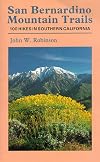
Overrall a good introductory hiking guide to the San Bernardino, San Jacinto, & Santa Rosa Mtns of Southern Calfornia. Robinson's strength as a guide are his encyclopedic knowledge of local mountain history, obvious love for the topic, and first hand accounts of adventurere, including his description of ascending the "ice tongue" of Mt. San Jacinto, a trailless scramble and rock climb straight up the northern gully from the Palm Springs Aerial Tram, and a section titled, "Trails That Used to show more be". His weaknesses are inaccuracies in trail mileages and obtuse, at times, directions.
Most people don't think of Southern California as offering any true wilderness areas for the backpacker or adventurer; this guide proves them wrong. Isolated, Sierra Nevada-like meadows and 11,000 foot-plus summits await those willing to give these lesser mountain ranges a try. show less
Most people don't think of Southern California as offering any true wilderness areas for the backpacker or adventurer; this guide proves them wrong. Isolated, Sierra Nevada-like meadows and 11,000 foot-plus summits await those willing to give these lesser mountain ranges a try. show less

Great book. shows all of the best trails and hikes. Only thing is I can not figure out the map to save my life.
You May Also Like


Associated Authors
Statistics
- Works
- 29
- Also by
- 4
- Members
- 383
- Popularity
- #63,100
- Rating
- 4.0
- Reviews
- 3
- ISBNs
- 43