
Richard Van Emden
Author of The Last Fighting Tommy: The Life of Harry Patch, the Only Surviving Veteran of the Trenches
About the Author
Works by Richard Van Emden
The Last Fighting Tommy: The Life of Harry Patch, the Only Surviving Veteran of the Trenches (2007) 301 copies, 4 reviews
All Quiet on the Home Front: An Oral History of Life in Britain During the First World War (2003) 86 copies
Britain’s Last Tommies: Final Memories from Soldiers of the 1914-18 War - In Their Own Words (2005) 58 copies, 1 review
The Quick and the Dead: Fallen Soldiers and Their Families in the Great War (2011) 50 copies, 2 reviews
Associated Works
The Vest Pocket Kodak & The First World War (Camera & Conflict) (2017) — Foreword — 10 copies, 1 review
Tagged
Common Knowledge
- Birthdate
- 1965
- Gender
- male
- Education
- Newcastle University (BA) (politics)
University of Reading (MA)
University of Reading (MPhil)
Cologne University - Occupations
- popular historian
television producer
journalist - Nationality
- UK
- Birthplace
- Nottingham, Nottinghamshire, England, UK
- Places of residence
- London, England, UK
Bramcote, Nottinghamshire, England, UK - Associated Place (for map)
- England, UK
Members
Reviews
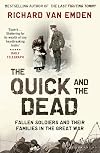
Most years around Remembrance Day I read a non-fiction book on a relevant theme and Richard van Emden's books tick all the right boxes: they let First World War veterans' and their families' stories speak for themselves within a well-balanced narrative that cover a wide range of human experience, avoiding cliches and over simplification of issues around this conflict whose course and conduct still give rise to strong emotions today, over a century after it ended. This book is the story of show more the surviving family members of those who died, particularly of their children. The author interviewed many such survivors, between the ages of 95 and 109, in the early 2000s. A number remained alive when this book was published in 2011 (I'm not sure if any remain alive now in 2019). Their stories cover a wide range of experiences and reactions: some had no memories of their fathers, but maybe owned a memento of him that acted as a personal link; others had memories of kissing him goodbye when he left for the front, and/or from brief encounters when he was back home for short spells of leave. Most of their memories were affected by the reactions of their mothers and other family members. Some mothers were so grief stricken they could never mention again the name of their dead husband, while others set up shrines in the family home to their memory. Some refused to marry again, while others did so fairly quickly, maybe for understandable economic reasons. Some refused to accept their loved one could possibly be dead and spent years hoping and waiting for them to turn up - appallingly, they were sometimes exploited by fraudsters claiming to have contacts who could help find them. In a very few cases, missing soldiers did turn up, only to find their wives or sweethearts, reasonably believing them dead, had found someone else. In short, they showed the same wide range of human emotions and reactions as any other group of people, though in the majority of cases they genuinely believed - or perhaps in some cases made themselves believe - their loved ones had died in a worthwhile cause. Further, in a country where belief in God was still almost universal, most also believed they would be reunited with them in an afterlife.
The book also deals with some other issues such as the campaign by a minority of family members for their loved ones' remains to be repatriated to Britain after the war. However, aside from the vast expense and emotional trauma the exhuming of remains in varying conditions would have caused, veterans' views were usually that the dead of their own regiments should rest together in death as they had fought together in life.
2019 is the centenary of the unveiling of the first, temporary wooden, Cenotaph and there is a description of that original ceremony, in which many family members took part, while others couldn't face it. In the same way, in later years, some families gained solace from visiting battlefield cemeteries and other graves, while others preferred not to (or could not afford to, though cheap packages were offered).
Overall, this offers a very human look at the after effects of war, while avoiding resorting to cliches. show less
The book also deals with some other issues such as the campaign by a minority of family members for their loved ones' remains to be repatriated to Britain after the war. However, aside from the vast expense and emotional trauma the exhuming of remains in varying conditions would have caused, veterans' views were usually that the dead of their own regiments should rest together in death as they had fought together in life.
2019 is the centenary of the unveiling of the first, temporary wooden, Cenotaph and there is a description of that original ceremony, in which many family members took part, while others couldn't face it. In the same way, in later years, some families gained solace from visiting battlefield cemeteries and other graves, while others preferred not to (or could not afford to, though cheap packages were offered).
Overall, this offers a very human look at the after effects of war, while avoiding resorting to cliches. show less
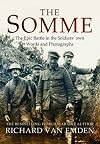
Historians can give us a big-picture view of major battles, but big-picture views don't necessarily reveal what that battle was really like for those on the battlefield. For that you need to hear from the soldiers themselves. And that is what makes Richard Van Emden's “The Somme: The Epic Battle in the Soldiers' Own Words and Photographs” (2016) something special.
By the time the Somme offensive against the German lines began early in July of 1917 (it continued almost until the end of the show more year), British soldiers were forbidden to have cameras, probably because the military did not want people back in England to see just how bad conditions were on the front lines. Still a number of soldiers, especially officers, did take cameras with them, and the photographs that survive are often stunning. Van Emden also includes photos taken by German soldiers.
Between the photographs, Van Emden shows us the progress of the battle (not that there was much actual progress) via excerpts from letters, diaries and memoirs written by soldiers on both sides.
British soldiers, being British, enjoyed their tea time even with a battle going on. "Oh, what should we do without our tea here!" one man writes. Officers often refer to their servants, whose service included doing their masters' bidding with bullets flying.
The men write about their chances of surviving the next attack (slim in the case of those ordered to advance against German machine guns), about the terrible wounds inflicted upon their fellows, about the constant noise, about the mud and the rats, and about the stink of decaying bodies (something war movies never seem to mention).
Deadly combat actually seems to have been viewed as fun by a couple of the writers. One of them says, "I say that this feeling of joy and lightheartedness does not come from any pleasure in killing — that's the rotten part — but in the risk of being killed. My days in the trenches were days of utter content; I cannot explain why, even to myself." Yet another soldier writes, "War is indescribably disgusting. Any man who has seen it and praises it is degenerate."
One man tells of being hugged by a German prisoner relieved to still be alive. Another tells of trying to take pictures of some of the men. "The snaps are not very good as I could not ask the troops to stand still and look pleasant!"
In the snaps Van Emden has collected, few of the troops look very pleasant. Still, like the written commentary by the soldiers, they are quite good on the whole, making the book something that should interest anyone with an interest in World War I in general or the battle of Somme in particular. show less
By the time the Somme offensive against the German lines began early in July of 1917 (it continued almost until the end of the show more year), British soldiers were forbidden to have cameras, probably because the military did not want people back in England to see just how bad conditions were on the front lines. Still a number of soldiers, especially officers, did take cameras with them, and the photographs that survive are often stunning. Van Emden also includes photos taken by German soldiers.
Between the photographs, Van Emden shows us the progress of the battle (not that there was much actual progress) via excerpts from letters, diaries and memoirs written by soldiers on both sides.
British soldiers, being British, enjoyed their tea time even with a battle going on. "Oh, what should we do without our tea here!" one man writes. Officers often refer to their servants, whose service included doing their masters' bidding with bullets flying.
The men write about their chances of surviving the next attack (slim in the case of those ordered to advance against German machine guns), about the terrible wounds inflicted upon their fellows, about the constant noise, about the mud and the rats, and about the stink of decaying bodies (something war movies never seem to mention).
Deadly combat actually seems to have been viewed as fun by a couple of the writers. One of them says, "I say that this feeling of joy and lightheartedness does not come from any pleasure in killing — that's the rotten part — but in the risk of being killed. My days in the trenches were days of utter content; I cannot explain why, even to myself." Yet another soldier writes, "War is indescribably disgusting. Any man who has seen it and praises it is degenerate."
One man tells of being hugged by a German prisoner relieved to still be alive. Another tells of trying to take pictures of some of the men. "The snaps are not very good as I could not ask the troops to stand still and look pleasant!"
In the snaps Van Emden has collected, few of the troops look very pleasant. Still, like the written commentary by the soldiers, they are quite good on the whole, making the book something that should interest anyone with an interest in World War I in general or the battle of Somme in particular. show less
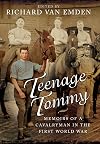
Not the blood and guts fest of some memoirs as this guy is definitely a product of his generation; brave, modest, gentlemanly... All those qualities we appear to have lost unfortunately.
At 16 he was barely old enough to leave school, but he defied his regiment (who wanted to leave him at home) and set off for war, being present at both the first shot of the Great War, and the last great cavalry charge of the British Army.
Legend.
I think this memory sums it all up; Ben relays to the show more interviewer that each cavalry battalion had a member of the pioneer corps attached to them, there to dig latrines x 4 each time they made camp and fill in the holes when they moved again. And what did Ben and his friends name these lucky fellows?
...the rear admiral.
Priceless.
The world is a poorer place without these old contemptibles. show less
At 16 he was barely old enough to leave school, but he defied his regiment (who wanted to leave him at home) and set off for war, being present at both the first shot of the Great War, and the last great cavalry charge of the British Army.
Legend.
I think this memory sums it all up; Ben relays to the show more interviewer that each cavalry battalion had a member of the pioneer corps attached to them, there to dig latrines x 4 each time they made camp and fill in the holes when they moved again. And what did Ben and his friends name these lucky fellows?
...the rear admiral.
Priceless.
The world is a poorer place without these old contemptibles. show less
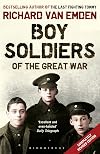
This is a fascinating and well-researched account of the very large number of boy soldiers who fought and in many cases died during the First World War. It focuses on those who were boys by the military standards of the time, which said that no one under the age of 19 should be fighting overseas (in this context it is worth remembering that the age of majority at this time and for over fifty years afterwards was, of course, 21). During the early years of the war, the rule was routinely show more breached, as boys as young as 13 (in the extreme case of George Maher) enlisted, though the majority of underage boys enlisting were 16-17. They were motivated by a mixture of feelings: patriotism; peer pressure or guilt at not doing their bit; the bravado of extreme youth; the desire for adventure and excitement; or a simple escapism from humdrum everyday life - many recruits from poor backgrounds had a much better diet, exercise and a sense of purpose in the army. So how were they able to get away with enlisting so young, when it must have been obvious in many cases that they were not the age they claimed to be? A combination of reasons - simply lying so they could fulfill one or more of the motivations above, especially with boys who were strong or tall; manpower shortages in the pre-conscription phase meaning that anyone willing to fight and not obviously decrepit was not turned away; combined with the perverse incentive caused by the bonus that recruiting sergeants and doctors conducting medical examinations received for every recruit admitted.
Due to public and Parliamentary pressure (especially from the Liberal MP Sir Arthur Markham), the rules were gradually better enforced, so that those underage were not sent to fight, and those underage boys already out fighting were removed from the front line and kept in reserve in the rear until they were old enough; but these rules were still often flouted, partly because the flow of volunteers was erratic and would sometimes decline after news of appalling losses reached Britain (though it would rise again on occasions such as the sinking of the Lusitania or the execution of Edith Cavell. The introduction of conscription in January 1916 changed the situation, though even then many commanders on the spot preferred to keep an underage boy who had proved himself rather than take on a perhaps reluctant conscript. From mid 1917, very few underage boys enlisted as the rules were tightened and better enforced, though during the desperate German Spring offensive of 1918, boys of eighteen years and a few months old had to fight as part of the mighty effort to push the Germans back and ensure final victory.
Complete with photos of a number of the boys whose stories are movingly told threaded throughout the generally chronological narrative, this is an excellent book and surely the definitive modern guide to this aspect of the Great War. show less
Due to public and Parliamentary pressure (especially from the Liberal MP Sir Arthur Markham), the rules were gradually better enforced, so that those underage were not sent to fight, and those underage boys already out fighting were removed from the front line and kept in reserve in the rear until they were old enough; but these rules were still often flouted, partly because the flow of volunteers was erratic and would sometimes decline after news of appalling losses reached Britain (though it would rise again on occasions such as the sinking of the Lusitania or the execution of Edith Cavell. The introduction of conscription in January 1916 changed the situation, though even then many commanders on the spot preferred to keep an underage boy who had proved himself rather than take on a perhaps reluctant conscript. From mid 1917, very few underage boys enlisted as the rules were tightened and better enforced, though during the desperate German Spring offensive of 1918, boys of eighteen years and a few months old had to fight as part of the mighty effort to push the Germans back and ensure final victory.
Complete with photos of a number of the boys whose stories are movingly told threaded throughout the generally chronological narrative, this is an excellent book and surely the definitive modern guide to this aspect of the Great War. show less
You May Also Like


Associated Authors
Statistics
- Works
- 31
- Also by
- 1
- Members
- 1,276
- Popularity
- #20,105
- Rating
- 3.8
- Reviews
- 19
- ISBNs
- 119
- Languages
- 1