
About the Author
Image credit: By Source, Fair use, https://en.wikipedia.org/w/index.php?curid=33608439
Series
Works by Workman Publishing
Everything You Need to Ace Math in One Big Fat Notebook: The Complete Middle School Study Guide (Big Fat Notebooks) (2016) 938 copies, 9 reviews
Everything You Need to Ace Science in One Big Fat Notebook: The Complete Middle School Study Guide (Big Fat Notebooks) (2016) 863 copies, 6 reviews
Workman Publishing Everything You Need to Ace English Language Arts in One Big Fat Notebook (Big Fat Notebooks) (2016) 754 copies, 1 review
Everything You Need to Ace World History in One Big Fat Notebook: The Complete Middle School Study Guide (Big Fat Notebooks) (2016) 712 copies, 4 reviews
Everything You Need to Ace American History in One Big Fat Notebook: The Complete Middle School Study Guide (Big Fat Notebooks) (2016) 619 copies, 1 review
Everything You Need to Ace Computer Science and Coding in One Big Fat Notebook: The Complete Middle School Study Guide (Big Fat Notebooks) (2020) 398 copies, 2 reviews
Everything You Need to Ace Chemistry in One Big Fat Notebook (Big Fat Notebooks) (2020) 214 copies, 2 reviews
Everything You Need to Ace Biology in One Big Fat Notebook (Big Fat Notebooks) (2021) 179 copies, 2 reviews
Everything You Need to Ace U.S. History in One Big Fat Notebook, 2nd Edition: The Complete Middle School Study Guide (Big Fat Notebooks) (2023) 92 copies, 2 reviews
The Big Fat Middle School Math Workbook: 600 Math Practice Exercises (Big Fat Notebooks) (2021) 65 copies, 2 reviews
Paint by Sticker Kids: Unicorns & Magic: Create 10 Pictures One Sticker at a Time! Includes Glitter Stickers (2019) 42 copies
The Big Fat High School Algebra 1 Workbook: 400+ Algebra 1 Practice Exercises (Big Fat Notebooks) (2023) 37 copies
Paint by Sticker Kids, The Original: Create 10 Pictures One Sticker at a Time! (Kids Activity Book, Sticker Art, No Mess Activity, Keep Kids Busy) (2016) 36 copies
Paint by Sticker Kids: Christmas: Create 10 Pictures One Sticker at a Time! Includes Glitter Stickers (2019) 29 copies
Paint by Sticker Kids: Outer Space: Create 10 Pictures One Sticker at a Time! Includes Glow-in-the-Dark Stickers (2021) 24 copies
The True Crime File: Serial Killers, Famous Kidnappings, Great Cons, Survivors & Their Stories, Forensics, Oddities & Absurdities, Quotes & Quizzes (2022) 22 copies
My First Brain Quest Shapes: A Question-and-Answer Book (Brain Quest Board Books, 4) (2023) 21 copies
Paint by Sticker: Music Icons: Re-create 12 Classic Photographs One Sticker at a Time! (2017) 21 copies
Paint by Sticker Kids: Beautiful Bugs: Create 10 Pictures One Sticker at a Time! (Kids Activity Book, Sticker Art, No Mess Activity, Keep Kids Busy) (2018) 20 copies
My First Brain Quest First Words: Science Around Us: A Question-and-Answer Book (Brain Quest Board Books, 6) (2023) 19 copies
My First Brain Quest First Words: Around the Home: A Question-and-Answer Book (Brain Quest Board Books, 5) (2023) 18 copies
My First Brain Quest Colors: A Question-and-Answer Book (Brain Quest Board Books, 3) (2023) 18 copies
The Big Fat Middle School English Language Arts Workbook: 100+ ELA Practice Exercises (Big Fat Notebooks) (2024) 15 copies
Paint by Sticker Kids: Halloween: Create 10 Pictures One Sticker at a Time! Includes Glow-in-the-Dark Stickers (2019) 12 copies
Paint by Sticker Kids: Rainbows Everywhere!: Create 10 Pictures One Sticker at a Time! (2022) 11 copies
My First Brain Quest Feelings: A Question-and-Answer Book (Brain Quest Board Books, 7) (2023) 10 copies
My First Brain Quest First Words: Community Helpers: A Question-and-Answer Book (Brain Quest Board Books, 9) (2023) 9 copies
Paint by Sticker: Plants and Flowers: Create 12 Stunning Images One Sticker at a Time (Paint by Sticker) (2022) 9 copies
Unofficial Taylor Swift Eras (The Sticker Version): 1,100 Stickers, 11 Eras, and More! (2025) 9 copies
Paint by Sticker: Works of Art: Re-create 12 Iconic Masterpieces One Sticker at a Time! (2023) 7 copies
Paint by Sticker Kids: Holly Jolly Christmas: Create 10 Pictures One Sticker at a Time! Includes Glitter Stickers (2022) 7 copies
Paint by Sticker Kids: Mermaids & Magic!: Create 10 Pictures One Sticker at a Time! Includes Glitter Stickers (2021) 7 copies
The Big Fat Complete Maths Workbook (UK Edition): Studying with the Smartest Kid in Class (Big Fat Notebook) (2021) 5 copies
My First Brain Quest Opposites: A Question-and-Answer Book (Brain Quest Board Books, 8) (2023) 4 copies
A Romance Reader's Sticker Book 4 copies
The Big Fat High School Algebra 2 Workbook: 400+ Algebra 2 Practice Exercises (Big Fat Notebooks) (2025) 3 copies
Paint by Sticker Kids: Love Is Everywhere!: Create 10 Pictures One Sticker at a Time! Includes Glitter Stickers (2024) 3 copies
Official National Football League Record and Fact Book 1986 (Official NFL Record & Fact Book) (1986) 3 copies
Audubon Green World Calendar 2012: A Year of Eco Adventure (Picture-A-Day Wall Calendars) (2011) 2 copies
Learn by Sticker: Beginning Phonics: Use Phonics to Create 10 Friendly Monsters! (Learn by Sticker, 2) (2023) 2 copies
Mensa 365 Brain Puzzlers Page-A-Day Calendar 2009 (Original Page a Day Calendars) (2008) 2 copies, 1 review
Fandex Kids: Bugs: Facts That Fit in Your Hand: 49 Incredible Insects, Spiders & More! (2022) 2 copies
Fandex Kids: Sharks: Facts That Fit in Your Hand: 51 Sharks, Prehistoric Predators, and More Inside! (2024) 1 copy
Eyelike Stickers: Valentines 1 copy
The Big Fat Complete English Language Workbook (UK Edition): 100+ ELA Practice Exercises (2024) 1 copy
Brain Quest Presidents Smart Cards: America's 250th Anniversary Edition (Brain Quest Smart Cards) (2026) 1 copy
Learn by Sticker: More Phonics: Use Phonics to Create 10 Sea Animals! (Learn by Sticker, 3) (2024) 1 copy
Learn by Sticker: More Addition & Subtraction: Use Math to Create 10 Fantasy Animals! (Learn by Sticker, 4) (2024) 1 copy
Post Cards of Bad Cats 1 copy
Animals Paint By Sticker 1 copy
The Original 365 Jokes, Puns & Riddles Page-A-Day Calendar 2009 (Original Page a Day Calendars) (2008) 1 copy
The New Yorker Caffeinated Calendar: Cartoons for 2004 Magnetic Kitchen Calendar 2004 (Workman Wall Calendars) (2003) 1 copy
Learn by Sticker: Addition and Subtraction: Use Math to Create 10 Baby Animals! (Learn by Sticker, 1) (2023) 1 copy
Human Skeleton 1 copy
Tagged
Common Knowledge
- Canonical name
- Workman Publishing
- Birthdate
- n/a
- Gender
- n/a
- Nationality
- USA
- Associated Place (for map)
- USA
Members
Reviews
Everything You Need to Ace Biology in One Big Fat Notebook: The Complete High School Study Guide by Workman Publishing

I'll start by saying that I am definitely not a high school student. I picked this up because I was curious about the format - if I enjoyed it, I figured I might try tackling one of the volumes on a subject I was shakier on.
This is divided into 12 units ("Basics of Biology," "The Chemistry of Life," "Cell Theory," "Bacteria, Viruses, Prions, and Viroids," "Protists," "Fungi," "Plants," "Animals," "The Human Body," "Genetics," "Life on Earth," and "Ecosystems and Habitats"). The text is set show more up to look like notes someone took on lined paper, with occasional highlighted bits, drawings in the margins, underlined portions, etc. Each chapter ends with review questions and answers.
My overall opinion of this is: meh. My eyes glazed over at about the same points where I generally had trouble in school (I'm looking at you, Unit 2). My favorite chapters were probably the ones on algae, molds, and fungi, because they covered info I don't recall learning before. That said, there are probably better, more memorable books out there on those topics for someone like myself, who is reading for enjoyment rather than to study for a test.
Speaking of the study guide aspects: I doubt just reading this book would ever have helped me much when I was a student, even if I forced myself to do the review questions. I did best with notes I actually took myself. This book also missed a bunch of opportunities to explicitly connect concepts mentioned across multiple chapters (not even a brief "remember, [Topic] was discussed in more detail back in Chapter X" - yes, there's an index, but in-text recognition of the relatedness of subjects would have been nice).
Assuming the other volumes are similar to this one, I don't think I'll be seeking out the rest.
(Original review posted on A Library Girl's Familiar Diversions.) show less
This is divided into 12 units ("Basics of Biology," "The Chemistry of Life," "Cell Theory," "Bacteria, Viruses, Prions, and Viroids," "Protists," "Fungi," "Plants," "Animals," "The Human Body," "Genetics," "Life on Earth," and "Ecosystems and Habitats"). The text is set show more up to look like notes someone took on lined paper, with occasional highlighted bits, drawings in the margins, underlined portions, etc. Each chapter ends with review questions and answers.
My overall opinion of this is: meh. My eyes glazed over at about the same points where I generally had trouble in school (I'm looking at you, Unit 2). My favorite chapters were probably the ones on algae, molds, and fungi, because they covered info I don't recall learning before. That said, there are probably better, more memorable books out there on those topics for someone like myself, who is reading for enjoyment rather than to study for a test.
Speaking of the study guide aspects: I doubt just reading this book would ever have helped me much when I was a student, even if I forced myself to do the review questions. I did best with notes I actually took myself. This book also missed a bunch of opportunities to explicitly connect concepts mentioned across multiple chapters (not even a brief "remember, [Topic] was discussed in more detail back in Chapter X" - yes, there's an index, but in-text recognition of the relatedness of subjects would have been nice).
Assuming the other volumes are similar to this one, I don't think I'll be seeking out the rest.
(Original review posted on A Library Girl's Familiar Diversions.) show less
Workman Publishing Company - To Ace Math in One Big Fat Notebook: The Complete Middle School Study Guide (Big Fat Notebooks) by Workman Publishing
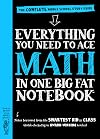
p. 195 and I've realized how much I miss unit reviews. Sure, every few pp. we get a quiz, and I'm fine on those, but not every bit of knowledge builds on every other and so I'm losing stuff. Also, here on exponents, we've lost word problems... apparently these are not things we use in every day life (which, to be fair, is, in my experience, mostly true, as they're maths shortcuts for huge or tiny numbers).
So, anyway, I've got some nits to pick with this book, but it's still the only one I've show more found that is neither ridiculously easy or much too difficult for me. I need to review what I should have learned in high school, but I'm starting here. So far (p. 195) so easy but we'll see....
---
p. 248 - finally word problems, and I'm going to get out pencil and paper instead of just using mental math, finally.
---
Ok, that section was actually too easy. Then geometry, which was one of my favorite subjects in HS because I had an Alice in Wonderland themed text and a good teacher, so that was easy
Now I'm in statistics, which should be easy, because I do use this stuff regularly. However, it's a very badly written chapter.
It introduces trickier concepts first, then backs up, and doesn't discuss the new to me concept of 'two-way tables' nearly enough except for a caution of 'read carefully' (but then doesn't say how to read them). It messes up the color coding.
And worst of all, in the brief section about sampling, the examples didn't even explore how to make sure one was getting an adequately representative sample... which we all know now is a huge problem (it's not just white males who have heart attacks, folks!).
---
Ack! I got a few pp on to read the Box and Whiskers section. The first and only example has 10 data points that it claims to put into quartiles. Ok... we can recognize that data from small samples isn't always going to fit nicely.... But then it says that the two points that are largest, that are in the top quartile, make up 25% of the total! I'd just like to see a student say that 2/10 = 25% at any time in class, even now!
Let's hope that when we move on to scatter plots and probability the author remembered to let an editor or at least a beta reader at the material before publication.
---
Ok I'm finally done. Yeah, I could keep picking nits. And there are a few more nice things I could say, too. But, bottom line, if this is the only book of its kind, use it to supplement your assigned text. If you can find a similar book, use that either instead or in addition to this.
I'm not feeling the kind of enrichment that I, personally, expected to. And so I would definitely welcome other suggestions. Do any of you know any middle school or lower level high school 'popular math' books? show less
So, anyway, I've got some nits to pick with this book, but it's still the only one I've show more found that is neither ridiculously easy or much too difficult for me. I need to review what I should have learned in high school, but I'm starting here. So far (p. 195) so easy but we'll see....
---
p. 248 - finally word problems, and I'm going to get out pencil and paper instead of just using mental math, finally.
---
Ok, that section was actually too easy. Then geometry, which was one of my favorite subjects in HS because I had an Alice in Wonderland themed text and a good teacher, so that was easy
Now I'm in statistics, which should be easy, because I do use this stuff regularly. However, it's a very badly written chapter.
It introduces trickier concepts first, then backs up, and doesn't discuss the new to me concept of 'two-way tables' nearly enough except for a caution of 'read carefully' (but then doesn't say how to read them). It messes up the color coding.
And worst of all, in the brief section about sampling, the examples didn't even explore how to make sure one was getting an adequately representative sample... which we all know now is a huge problem (it's not just white males who have heart attacks, folks!).
---
Ack! I got a few pp on to read the Box and Whiskers section. The first and only example has 10 data points that it claims to put into quartiles. Ok... we can recognize that data from small samples isn't always going to fit nicely.... But then it says that the two points that are largest, that are in the top quartile, make up 25% of the total! I'd just like to see a student say that 2/10 = 25% at any time in class, even now!
Let's hope that when we move on to scatter plots and probability the author remembered to let an editor or at least a beta reader at the material before publication.
---
Ok I'm finally done. Yeah, I could keep picking nits. And there are a few more nice things I could say, too. But, bottom line, if this is the only book of its kind, use it to supplement your assigned text. If you can find a similar book, use that either instead or in addition to this.
I'm not feeling the kind of enrichment that I, personally, expected to. And so I would definitely welcome other suggestions. Do any of you know any middle school or lower level high school 'popular math' books? show less
Everything You Need to Ace Science in One Big Fat Notebook: The Complete Middle School Study Guide (Big Fat Notebooks) by Workman Publishing
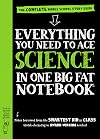
This book acts as one giant summary of science concepts that middle schoolers will use. This book acts as an informational text in the art form of a student’s notes. The first page acts as a letter to the reader saying that this book was from the smartest kid in class and will help the student pass their class (But will only substitute as the class). The information presented is organized into different color highlighters and is very visually appealing. I can see this book used as a form show more of frontloading for concepts that should already be established with students. I like this book due to the student-friendly approach it was created in. I would most definitely not (wink wink) photocopy some of these pages to hand out to students as resources to keep in their binder/notebooks so they can use as a quick resource. show less
Everything You Need to Ace World History in One Big Fat Notebook: The Complete Middle School Study Guide (Big Fat Notebooks) by Workman Publishing
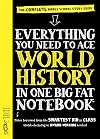
Everything You Need to Ace History In One Big Fat Notebook, is a informational style textbook that covers the main historical topics middle schoolers will use. Just like in the other Everything You Need to Ace books, the first page acts as a letter to the reader saying that this book was from the smartest kid in class and will help the student pass their class (But will not substitute as the class). The information presented is organized neatly and goes over the definitions, applications, show more and example problems. I can see this book used as a form of frontloading for concepts that should already be established with students. I can also see this book used as a beginning point where students can research a historical figure for a project. This book is very appealing to students due to the graphic nature it was created in, show less
Lists
el (1)
You May Also Like


Associated Authors
Statistics
- Works
- 329
- Members
- 7,344
- Popularity
- #3,328
- Rating
- 4.3
- Reviews
- 34
- ISBNs
- 420
- Languages
- 1