
Virginia Heffernan
Author of Magic and Loss: The Internet as Art
Works by Virginia Heffernan
Associated Works
Tagged
Common Knowledge
- Birthdate
- 1969-08-08
- Gender
- female
- Education
- University of Virginia
Harvard University - Occupations
- journalist
critic
columnist - Organizations
- The New York Times
The New York Times Magazine - Nationality
- USA
- Associated Place (for map)
- USA
Members
Reviews
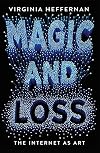
Every now and again you read a book that inspires envy on a sort of ridiculously deep level. This was, for a moment there, definitely one of those books for me. Hefferman's insightful and at time hilarious book relishes the web -- especially its weird, unfettered, pre-Facebook corners -- while also understanding that it represents loss for certain sectors of the culture too. The internet favors some virtues over others, she argues. What is lost and gained online is still being worked out, show more but you won't easily avoid the question once you slip into this book. show less
Free review copy. Heffernan is a culture writer for the NYT, and this book is a bunch of meditations on the aesthetics of the internet. From the internet, she argues, we can truly appreciate things like America’s culture of overincarceration, when we find huge message boards dealing with inmates and their families. There are benefits and costs to this new way of being; one cost, she suggests, is dignity—she recounts doing journalism-lite for a website, and compares Michael Pollan’s show more suggestion not to eat anything your grandmother wouldn’t have recognized as food; her grandmother wouldn’t have recognized rewriting headlines to draw clicks as journalism. She analogizes the rise of apps to the rise of gated communities, making the experience for app users cleaner, safer, more expensive, and “classier” than the buzzing, blooming confusion of the web at large. She analogizes Google’s stated mission to “organize the world’s information” as the echo of “the founding tale of Western ambition: Faust’s deranged craving for unlimited knowledge.” But she also defends Twitter’s brevity, pointing out that “[t]o plenty of poets in plenty of languages, 140 symbols is expansive. Confucius’s adages were rarely longer than twenty Chinese characters.”
And, in a “the more things change” moment, she points to criticisms of early bound books as not “really” reading, compared to the effort required to find something in a scroll. She also reminds us that novels were once considered dangerous to women’s minds, and then that the Kindle was designed for people to read long-form and offline—that is, for women. Best line on gender: “For years technology had seemed to be the masculine form of the word culture.”
Heffernan also argues that reading for information, for highlighting, for good quotes (like I did for this review) is the American way of reading; and yet, she suggests, online, participatory reading—reading to comment, for example—is regarded by cultural gatekeepers as “impure,” inferior, to “serious” reading which is done in books and without immediate response. I was charmed by the idea that “America in the age of rye surplus used to be a nation of drunks, then the overproduction of corn turned us into overeaters, [and] as words have proliferated hypertrophically on the internet, we’ve become a population of overreaders, of hyperlexics.” Guilty.
Heffernan doesn’t like headphones (isolating, especially from the communal experience of listening to music) or MP3s (like trying to dine on painted grapes). She concludes that other people agree with her that something is missing from digital music because of the renaissance in live music, which is an interesting aesthetic take on what many others have presented as a business issue due to declining revenues from recorded music sales. show less
And, in a “the more things change” moment, she points to criticisms of early bound books as not “really” reading, compared to the effort required to find something in a scroll. She also reminds us that novels were once considered dangerous to women’s minds, and then that the Kindle was designed for people to read long-form and offline—that is, for women. Best line on gender: “For years technology had seemed to be the masculine form of the word culture.”
Heffernan also argues that reading for information, for highlighting, for good quotes (like I did for this review) is the American way of reading; and yet, she suggests, online, participatory reading—reading to comment, for example—is regarded by cultural gatekeepers as “impure,” inferior, to “serious” reading which is done in books and without immediate response. I was charmed by the idea that “America in the age of rye surplus used to be a nation of drunks, then the overproduction of corn turned us into overeaters, [and] as words have proliferated hypertrophically on the internet, we’ve become a population of overreaders, of hyperlexics.” Guilty.
Heffernan doesn’t like headphones (isolating, especially from the communal experience of listening to music) or MP3s (like trying to dine on painted grapes). She concludes that other people agree with her that something is missing from digital music because of the renaissance in live music, which is an interesting aesthetic take on what many others have presented as a business issue due to declining revenues from recorded music sales. show less
(Reprinted from the Chicago Center for Literature and Photography [cclapcenter.com]. I am the original author of this essay, as well as the owner of CCLaP; it is not being reprinted illegally.)
So for what it's worth, I tried very earnestly to be a fan of Virginia Heffernan's Magic and Loss, a new collection of academic essays concerning "what the internet really means." I was attracted to it when first coming across it because her main conceit is that the internet is the largest act of show more performance art in human history; not the individual parts that make up the internet, which ultimately are nothing special (shooting a video for YouTube is fundamentally the same process as shooting a video for VHS; writing an essay for a blog is fundamentally the same process as writing an essay for a paper magazine), but rather the way these trillion pieces of content come together, the way they influence each other, the way that humans' lives have fundamentally changed through the act of being exposed to these trillion pieces of content all at once.
But books of academic essays are a hit-and-miss proposition for non-academes like me; and for every great, accessible academic writer like Malcolm Gladwell you come across, there seems to be an equal amount of books like this one, essentially 300 pages of high-falutin' masturbation, ten-dollar words, Emily Dickinson references, and endless goddamn callbacks to other academic talks at SXSW and TED. It made me grow weary of this book rather quickly, which will be the reaction of most non-academes to this as well; although if you are a full-time resident of the ivory tower, by all means take a chance on it, because doubtless you'll have a better experience than me.
Out of 10: 6.5, or 8.5 for full-time academes show less
So for what it's worth, I tried very earnestly to be a fan of Virginia Heffernan's Magic and Loss, a new collection of academic essays concerning "what the internet really means." I was attracted to it when first coming across it because her main conceit is that the internet is the largest act of show more performance art in human history; not the individual parts that make up the internet, which ultimately are nothing special (shooting a video for YouTube is fundamentally the same process as shooting a video for VHS; writing an essay for a blog is fundamentally the same process as writing an essay for a paper magazine), but rather the way these trillion pieces of content come together, the way they influence each other, the way that humans' lives have fundamentally changed through the act of being exposed to these trillion pieces of content all at once.
But books of academic essays are a hit-and-miss proposition for non-academes like me; and for every great, accessible academic writer like Malcolm Gladwell you come across, there seems to be an equal amount of books like this one, essentially 300 pages of high-falutin' masturbation, ten-dollar words, Emily Dickinson references, and endless goddamn callbacks to other academic talks at SXSW and TED. It made me grow weary of this book rather quickly, which will be the reaction of most non-academes to this as well; although if you are a full-time resident of the ivory tower, by all means take a chance on it, because doubtless you'll have a better experience than me.
Out of 10: 6.5, or 8.5 for full-time academes show less
It's refreshing to read a book of culture criticism that is Internet-positive. I think the Text, Images, and Video chapters were stronger and had a stronger argument. Heffernan lost me for awhile in the last chapter when she discusses her philosophical and religious backgrounds, but she brought it back to her argument back at the very end.
Lists
Awards


You May Also Like
Associated Authors
Statistics
- Works
- 2
- Also by
- 2
- Members
- 155
- Popularity
- #135,096
- Rating
- 3.6
- Reviews
- 7
- ISBNs
- 10