
Donna R. Gabaccia
Author of We Are What We Eat: Ethnic Food and the Making of Americans
About the Author
Donna R. Gabaccia is Charles H. Stone Professor of American History at the University of North Carolina, Charlotte.
Image credit: Donna R. Gabaccia
Works by Donna R. Gabaccia
From Sicily to Elizabeth Street: Housing and Social Change Among Italian Immigrants, 1880-1930 (1984) 16 copies
AMERICAN DREAMING GLOBAL REALITIES: Rethinking U.S. Immigration History (Statue of Liberty Ellis Island) (2006) 10 copies
Italian Workers of the World: Labor Migration and the Formation of Multiethnic States (Statue of Liberty Ellis Island) (2001) 9 copies
Seeking common ground : multidisciplinary studies of immigrant women in the United States (1992) 5 copies
Connecting Seas and Connected Ocean Rims : Indian, Atlantic, and Pacific Oceans and China Seas Migrations from the 1830s to the 1930s (2011) 4 copies
Associated Works
Tagged
Common Knowledge
- Legal name
- Gabaccia, Donna Rae
- Birthdate
- 1949-09-24
- Gender
- female
- Education
- University of Michigan
Mount Holyoke College - Occupations
- historian
- Organizations
- University of Minnesota
University of Toronto at Scarborough
Social Science History Association
Society for the History of the Gilded Age and Progressive Era
Free University of Berlin
Mercy College (show all 11)
University of North Carolina, Charlotte
University of Pittsburgh
Urban History Association
Organization of American Historians
Immigration and Ethnic History Society - Awards and honors
- University of Minnesota Community Service Award for Faculty (2013)
- Nationality
- USA
- Associated Place (for map)
- USA
Members
Reviews
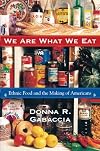
Gabaccia compares the food cultures of immigrant Italians, Irish, and Eastern European Jews, offering rich insights into each, as well as valuable comparisons. I have used this book numerous times in undergraduate food history courses--students are fascinated to learn that their own food has a history. Highly recommended!
I picked up this book in hope of mitigating the intensity of reading back-to-back some very tenacious literature and historical fiction. It was a miscalculation. We Are What We Eat, though interesting in the premise, is nothing but a harangue of facts and data. Some cheese were 80 cents to $1.60 a pound. Some 60,000 people in the industry in 1910 produced some 50 million gallons of wine in California. Nationwide, consumers of inexpensive meals spend $29 million in small mom-and-pop show more restaurants and $23 billion in fast food chains. New Yorkers tend to patronize less on fast food because family values are emphasized more. The facts go on and on.
The book is a tantalizing (well, it really tires) treatise that examines the evolution and identity of our nation through the ethnically diverse food/cuisines Americans intake from colonial periods to the present. The account begins with the "first Americans", namely the first peoples on the continent: the Native Americans, European-Americans, and African Americans. The subgroups of the European Americans formed some of the major food manufacturers and grocery chains that influentially set the so-called American eating-habits (often too ashamed to be known as American cuisine). From there, the book is a tale of mixing and borrowing and intermingling within the recipes and tastes of different cultural groups, between entrepreneurship and connoisseurship.
The book certainly aims higher than it actually manages. While the author substantially focuses on the origins and thus the fortunes of the enterprising immigrant cooks and grocers, the book fails to discuss and pinpoint the crossing between food and culture. Such deficiency is especially salient in the chapter titled "Nouvelle Creole", in which the Asian influence of dining was mentioned in passing over two pages. The establishment of Benihana (which I do not consider an authentic Japanese restaurant) was mentioned and nothing specific from Chinese cooking was discussed at all. And what about Malaysian cuisine that shaped the dining industry in New York? And the Puerto Rican?
The bottomline of the book is really the acceptance or rejection of ethnic foods in America, instead of an objective, fine-balanced, and compendious account on the impact food has on the American culture. While the book discusses in gush details some of the major (especially the well-known ones from the East Coast) food products and brand names that shape the national identity, it completely ignores the minority cuisines and tastes. show less
The book is a tantalizing (well, it really tires) treatise that examines the evolution and identity of our nation through the ethnically diverse food/cuisines Americans intake from colonial periods to the present. The account begins with the "first Americans", namely the first peoples on the continent: the Native Americans, European-Americans, and African Americans. The subgroups of the European Americans formed some of the major food manufacturers and grocery chains that influentially set the so-called American eating-habits (often too ashamed to be known as American cuisine). From there, the book is a tale of mixing and borrowing and intermingling within the recipes and tastes of different cultural groups, between entrepreneurship and connoisseurship.
The book certainly aims higher than it actually manages. While the author substantially focuses on the origins and thus the fortunes of the enterprising immigrant cooks and grocers, the book fails to discuss and pinpoint the crossing between food and culture. Such deficiency is especially salient in the chapter titled "Nouvelle Creole", in which the Asian influence of dining was mentioned in passing over two pages. The establishment of Benihana (which I do not consider an authentic Japanese restaurant) was mentioned and nothing specific from Chinese cooking was discussed at all. And what about Malaysian cuisine that shaped the dining industry in New York? And the Puerto Rican?
The bottomline of the book is really the acceptance or rejection of ethnic foods in America, instead of an objective, fine-balanced, and compendious account on the impact food has on the American culture. While the book discusses in gush details some of the major (especially the well-known ones from the East Coast) food products and brand names that shape the national identity, it completely ignores the minority cuisines and tastes. show less
A short book on how immigration has affected U.S. foreign policy.
You May Also Like


Associated Authors
Statistics
- Works
- 18
- Also by
- 1
- Members
- 266
- Popularity
- #86,735
- Rating
- 3.8
- Reviews
- 3
- ISBNs
- 47
- Languages
- 1


