
Drewey Wayne Gunn (1939–2018)
Author of The Gay Male Sleuth in Print and Film: A History and Annotated Bibliography
About the Author
Drewey Wayne Gunn is a professor emeritus of English at Texas AM University-Kingsville. He is the author, editor or translator of twelve previous books, including two Lambda Literary Award finalists.
Works by Drewey Wayne Gunn
The Gay Male Sleuth in Print and Film: A History and Annotated Bibliography (2005) 30 copies, 1 review
Escritores norteamericanos y británicos en México : selección (Lecturas Mexicanas) (Spanish Edition) (1985) 11 copies
Tagged
Common Knowledge
- Birthdate
- 1939
- Date of death
- 2018-04-21
- Gender
- male
- Occupations
- bibliographer
professor
author - Short biography
- Drewey Wayne Gunn grew up a farmboy in North Carolina. He received his B.A. from Wake Forest University and his M.A. and Ph.D. from the University of North Carolina at Chapel Hill. He taught for two years at Presbyterian College in Clinton, S.C. In 1968 he joined the faculty at Texas A&I University located in the heart of King Ranch country. He visited Europe for the first time in 1972 as a Fulbright teacher to Denmark. The next year he met and fell in love with Jacques Murat, a translator for Air France. He taught at the Institut Reine in Versailles and at the Université de Metz. As it became harder for Americans to hold a green card, he returned to A&I in 1977 (it became Texas A&M University–Kingsville in 1993), and he and Jacques began a long-distance marriage made bearable by the generous vacations both received and by large phone bills with AT&T. Jacques died of a heart attack in 1994, the year after he retired. Wayne retired in 2001 and was named Professor Emeritus the following year. While taking care of his mother during the last stages of her cancer, he returned to reading gay mysteries, and a whole new career was formed as he delved more deeply into his gay heritage. Two of his books were finalists for a Lambda Literary Award. Bill Parish on facebook
- Nationality
- USA
- Associated Place (for map)
- USA
Members
Reviews
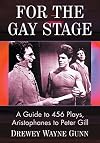
Gunn continues his ground-breaking scholarship charting the contributions of gay literature to gay culture and through its pervasive influence to the broader culture by turning his attention to theatrical works with "For the Gay Stage: A Guide to a 456 Plays, Aristophanes to Peter Gill." This guide, like his others, shows academic rigor yet it is accessible, informative, thoughtful, eye-opening, and, most especially, entertaining. I highly recommend this book.
I’m an avid theatergoer show more typically seeing forty or more productions a year. So, I thought I knew a lot about gay theater. Well, Gunn, as he has a way of doing, opens an expansive view exploring chronologically the development of gay theater as it both reflects and pushes societal norms. Though I have seen around forty of the entries, I had never heard of the majority of the plays and I had only a passing knowledge of most of the rest. Gunn with a discerning selective eye puts these plays and their playwrights into social and historical context with an emphasis on their contributions to shaping and challenging conventional culture. Reading his summaries a reader can plot the progression of gay culture through sex, politics, identity, AIDS, relationships and most recently, marriage and domestic issues. But beyond the social scholarship, I often said to myself: I need to see or read that play, it sounds interesting and entertaining.
While I might quibble with Gunn over his descriptions of a small number of plays – in my opinion both 'Six Degrees of Separation"' and "The Nance" are dramas not comedies – these differences of opinion bring up an important distinction between works of theater and artistic endeavors in other media that Gunn had to grapple with: It is very different to experience a play in full production than to listen to a reading of it and even more different than reading a script. Gunn does an admirable job of focusing on the impact of the plays’ words and plots and not getting caught up in the vagaries of any number of productions. Gunn gives plot summaries and themes and evaluates their cultural impact.
Which brings me back to Gunn’s significant contribution: casting a spotlight on plays I knew little to nothing about and underscoring that without the efforts of Gunn and others, the lack of awareness and acknowledgement of significant works of gay literature would be a lamentable loss to the gay community and to culture at large. show less
I’m an avid theatergoer show more typically seeing forty or more productions a year. So, I thought I knew a lot about gay theater. Well, Gunn, as he has a way of doing, opens an expansive view exploring chronologically the development of gay theater as it both reflects and pushes societal norms. Though I have seen around forty of the entries, I had never heard of the majority of the plays and I had only a passing knowledge of most of the rest. Gunn with a discerning selective eye puts these plays and their playwrights into social and historical context with an emphasis on their contributions to shaping and challenging conventional culture. Reading his summaries a reader can plot the progression of gay culture through sex, politics, identity, AIDS, relationships and most recently, marriage and domestic issues. But beyond the social scholarship, I often said to myself: I need to see or read that play, it sounds interesting and entertaining.
While I might quibble with Gunn over his descriptions of a small number of plays – in my opinion both 'Six Degrees of Separation"' and "The Nance" are dramas not comedies – these differences of opinion bring up an important distinction between works of theater and artistic endeavors in other media that Gunn had to grapple with: It is very different to experience a play in full production than to listen to a reading of it and even more different than reading a script. Gunn does an admirable job of focusing on the impact of the plays’ words and plots and not getting caught up in the vagaries of any number of productions. Gunn gives plot summaries and themes and evaluates their cultural impact.
Which brings me back to Gunn’s significant contribution: casting a spotlight on plays I knew little to nothing about and underscoring that without the efforts of Gunn and others, the lack of awareness and acknowledgement of significant works of gay literature would be a lamentable loss to the gay community and to culture at large. show less
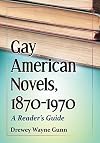
Each of the entries in this book discusses one or more novels in which a gay male character plays a significant role. The book is a good reminder that LGBT characters are not a recent invention, although the way they are portrayed has varied widely, both in terms of how explicit their sexuality is and in how positive or negative (mostly negative) they have been portrayed. In earlier works, making a character homosexual was often just a method of indicating that he is untrustworthy. But there show more are also more in-depth reflections on what it means to be gay.
Many of the works discussed in this book were written pseudonymously, and Gunn has done a diligent job of searching out information on the authors. show less
Many of the works discussed in this book were written pseudonymously, and Gunn has done a diligent job of searching out information on the authors. show less
 This review was written for LibraryThing Early Reviewers.
You can face this essay in many different ways (guess what is mine?)...
- as one who was there and reading all the books and authors named in it, has that common feeling of 'oh, yes, I remember that', or rather than, 'wow, I almost forget that it was like that'.
- as one who was not there, but that for all his life has loved and searched for the things from the past, a past that maybe seems better than the one he is living in. And all the vintage covers you will find inside the book will show more make your inner collector gone crazy, you will probably print copy the final references page, Index of Fiction Discussed, and start to doing the check, I have, I haven't.
- as one who did it, maybe it's even named among the authors, or maybe not, maybe he did not have the courage to do the same things those authors did, and now he is regretting the choice.
- as one who wants to understand better what was before, a newbie that, till last year believed that the gay romance was a recent phenomena, maybe even thought it was something who was fated to decline, and now realizes that it's only another roar of an old lion, who was only taking a nap.
Maybe the last one is not represented among the crowd of authors who contributed to this essay, but all the others are. There is love in this essay, love for an era that was your own one, or that you consider as inspiring. And there are different perspective: for example there is who love an author, and another one who thinks he was sugary and unrealistic, there is who dissects the genre trying to find an hidden meaning, and who, more or less, said that those paperbacks were the only flight from a reality that was not the one he wanted to live in.
There is not hate in this essay. Yes, maybe there is a bit of proud in the words of some authors, stating that, 'hey, I was there way before someone started to speak of 'Gay Literature'', but more or less, to everyone who contributed in the field of the Gay Fiction was given the right credit.
Who has to read this book? the newbie gay author who wants to write the Great American Novel? it could be useful, it's always useful to know who was before you. But most of all, this essay is directed to the questioning mind, to who is fascinated by those names, by those authors who have at least 20 pen names, who wonders, 'how it was to live and write in a world where there wasn't internet?', when to find those novels you had to do miles and miles, maybe to that only bookstore you knew had in store the books you wanted. When you were judged not for who you were, but for what you read... Wait, Am I speaking of 40 years ago, or of today?! See time is passed, but things maybe are not changed so much. And so yes, you can still learn something from an essay like The Golden Age of Gay Fiction.
And no, I will not summarize all the essays inside it as maybe some of you are expecting, and I will not say who was my favorite: they are all my favorite, I love the presentation, the layout, all those little covers scattered around. I love the writers, they made me feel the love they have for the genre. And now I'm also damning them, since my 'to read' list is bigger than ever!
http://www.amazon.com/dp/1608200485/?tag=elimyrevandra-20 show less
- as one who was there and reading all the books and authors named in it, has that common feeling of 'oh, yes, I remember that', or rather than, 'wow, I almost forget that it was like that'.
- as one who was not there, but that for all his life has loved and searched for the things from the past, a past that maybe seems better than the one he is living in. And all the vintage covers you will find inside the book will show more make your inner collector gone crazy, you will probably print copy the final references page, Index of Fiction Discussed, and start to doing the check, I have, I haven't.
- as one who did it, maybe it's even named among the authors, or maybe not, maybe he did not have the courage to do the same things those authors did, and now he is regretting the choice.
- as one who wants to understand better what was before, a newbie that, till last year believed that the gay romance was a recent phenomena, maybe even thought it was something who was fated to decline, and now realizes that it's only another roar of an old lion, who was only taking a nap.
Maybe the last one is not represented among the crowd of authors who contributed to this essay, but all the others are. There is love in this essay, love for an era that was your own one, or that you consider as inspiring. And there are different perspective: for example there is who love an author, and another one who thinks he was sugary and unrealistic, there is who dissects the genre trying to find an hidden meaning, and who, more or less, said that those paperbacks were the only flight from a reality that was not the one he wanted to live in.
There is not hate in this essay. Yes, maybe there is a bit of proud in the words of some authors, stating that, 'hey, I was there way before someone started to speak of 'Gay Literature'', but more or less, to everyone who contributed in the field of the Gay Fiction was given the right credit.
Who has to read this book? the newbie gay author who wants to write the Great American Novel? it could be useful, it's always useful to know who was before you. But most of all, this essay is directed to the questioning mind, to who is fascinated by those names, by those authors who have at least 20 pen names, who wonders, 'how it was to live and write in a world where there wasn't internet?', when to find those novels you had to do miles and miles, maybe to that only bookstore you knew had in store the books you wanted. When you were judged not for who you were, but for what you read... Wait, Am I speaking of 40 years ago, or of today?! See time is passed, but things maybe are not changed so much. And so yes, you can still learn something from an essay like The Golden Age of Gay Fiction.
And no, I will not summarize all the essays inside it as maybe some of you are expecting, and I will not say who was my favorite: they are all my favorite, I love the presentation, the layout, all those little covers scattered around. I love the writers, they made me feel the love they have for the genre. And now I'm also damning them, since my 'to read' list is bigger than ever!
http://www.amazon.com/dp/1608200485/?tag=elimyrevandra-20 show less
Gay American Novels, 1870-1970 is a scholarly labor of love examining various novels and shorter pieces of literature that depict the gay experience for the hundred-year period between 1870 and 1970. Dewey Wayne Gunn has selected books he feels show how gay male fiction developed over that time period. No lesbian fiction has been included, although some of the authors of the books that Gunn examines are females writing about the gay male experience, something that was welcome to see.
133 show more different pieces of literature were chosen by Gunn for examination, and for each one he provides an in-depth analysis, presenting a bit of the plot and a look at the piece's significance as gay literature. Some of the selections are predictable: works by John Rechy, Christopher Isherwood, Gore Vidal, and Gordon Merrick. Others are obscure works or ones that might intrigue someone into thinking: "That's gay literature? Really?" Many of Gunn's choices fall into this latter category, and serious students of gay literature are going to seek out some of the lesser known titles for a read. Other selections suggest books that many may have already read, but will want to re-read for a closer examination.
Overall, Gunn's work is a very good compilation of books combined with thoughtful analysis. Although the book is subtitled "A Reader's Guide," the reader may be frustrated for authors are not listed alphabetically in the front, only by entry number. Likewise, instead of beginning the work with a list of titles of the books reviewed within, one must go to the index at the end to find a title with a corresponding entry number. A list of book titles by page number would have been helpful. But, with the exception of these missing pieces of organization, the rest of the book serves its purpose. It will find a home on the shelf of any teacher, student, or serious reader of gay literature. show less
133 show more different pieces of literature were chosen by Gunn for examination, and for each one he provides an in-depth analysis, presenting a bit of the plot and a look at the piece's significance as gay literature. Some of the selections are predictable: works by John Rechy, Christopher Isherwood, Gore Vidal, and Gordon Merrick. Others are obscure works or ones that might intrigue someone into thinking: "That's gay literature? Really?" Many of Gunn's choices fall into this latter category, and serious students of gay literature are going to seek out some of the lesser known titles for a read. Other selections suggest books that many may have already read, but will want to re-read for a closer examination.
Overall, Gunn's work is a very good compilation of books combined with thoughtful analysis. Although the book is subtitled "A Reader's Guide," the reader may be frustrated for authors are not listed alphabetically in the front, only by entry number. Likewise, instead of beginning the work with a list of titles of the books reviewed within, one must go to the index at the end to find a title with a corresponding entry number. A list of book titles by page number would have been helpful. But, with the exception of these missing pieces of organization, the rest of the book serves its purpose. It will find a home on the shelf of any teacher, student, or serious reader of gay literature. show less
This review was written for LibraryThing Early Reviewers.Awards


Statistics
- Works
- 14
- Members
- 158
- Popularity
- #133,025
- Rating
- 4.4
- Reviews
- 8
- ISBNs
- 24
- Languages
- 1
