
Oki S. Han
Author of Sir Whong and the Golden Pig
Works by Oki S. Han
Associated Works
Tagged
Common Knowledge
There is no Common Knowledge data for this author yet. You can help.
Members
Reviews

Celebrated for his wisdom and generosity, Sir Whong is nevertheless surprised when a complete stranger approaches him for a large loan in this picture book retelling of a traditional Korean folktales from Oki S. Han and Stephanie Haboush Plunkett. Convinced of the stranger's good faith by his offering of a golden pig as surety, our hero later discovers that he has been tricked. The stranger, in the meantime, far from spending the money on his sick mother, as he promised to do, wastes it on show more pleasurable living. Realizing he is unlikely to get his thousand nyung back, Sir Whong decides he must take steps, starting a false rumor to bring the stranger out into the open...
Published in 1993, Sir Whong and the Golden Pig was the debut collaboration between author/illustrator Han and co-author Plunkett, followed in 1994 by Kongi and Potgi: A Cinderella Story from Korea. As it happens, I read that later title first, during a themed Cinderella project, and then requested this earlier book from the library. I'm glad I did, as I found it very engaging. The story itself is entertaining—it's always satisfying to see the con-man get tricked!—and the accompanying watercolor artwork lovely. I particularly appreciated the decorative borders on many of the pages, as well as the author's brief introduction, giving cultural background on historical Korea. Recommended to young folklore enthusiasts, and to those looking for children's books with a Korean cultural background. show less
Published in 1993, Sir Whong and the Golden Pig was the debut collaboration between author/illustrator Han and co-author Plunkett, followed in 1994 by Kongi and Potgi: A Cinderella Story from Korea. As it happens, I read that later title first, during a themed Cinderella project, and then requested this earlier book from the library. I'm glad I did, as I found it very engaging. The story itself is entertaining—it's always satisfying to see the con-man get tricked!—and the accompanying watercolor artwork lovely. I particularly appreciated the decorative borders on many of the pages, as well as the author's brief introduction, giving cultural background on historical Korea. Recommended to young folklore enthusiasts, and to those looking for children's books with a Korean cultural background. show less

A kindhearted young girl named Kongi is happy when her widowed father decides to remarry, aware that he needs companionship, but her new stepmother Doki and stepsister Potgi end up bringing great misery into her life in this picture book retelling of a traditional Korean folktale. Made to do all of the household chores and much of the outside work as well, Kongi is also exiled from her own bedroom to the cold room off the pantry. Slowly becoming exhausted and downtrodden, she is aided by a show more series of animals who help her with difficult tasks. When the prince hosts a great party in order to seek a bride, and Kongi is told she can attend only after a seemingly impossible task is completed, she is helped once again, this time by sparrows, and then by a troupe of angels who descend to earth to prepare her for the party. Enchanting the prince, Kongi becomes embarrassed, fleeing the party but leaving her slipper behind...
Co-written by Oki S. Han and Stephanie Haboush Plunkett and illustrated by Han, who previously collaborated on Sir Whong and the Golden Pig, which also retells a Korean folktale, Kongi and Potgi: A Cinderella Story from Korea is one of a number of global Cinderella variants I have read, and the second from Korea, following upon Shirley Climo & Ruth Heller's The Korean Cinderella. I found it charming, enjoying the story itself and many of its details—the Brothers Grimm version of this story, unlike the more famous version from Perrault, also features a heroine aided by birds—as well as the watercolor illustrations. I also appreciated the author's note at the beginning, which gives information on the Korean cultural background of the story, as well as her source, which in this case was her father's telling. Recommended to young folk and fairy-tale lovers, to those interested in Cinderella variants from around the world, and to anyone seeking picture books with a Korean cultural background. show less
Co-written by Oki S. Han and Stephanie Haboush Plunkett and illustrated by Han, who previously collaborated on Sir Whong and the Golden Pig, which also retells a Korean folktale, Kongi and Potgi: A Cinderella Story from Korea is one of a number of global Cinderella variants I have read, and the second from Korea, following upon Shirley Climo & Ruth Heller's The Korean Cinderella. I found it charming, enjoying the story itself and many of its details—the Brothers Grimm version of this story, unlike the more famous version from Perrault, also features a heroine aided by birds—as well as the watercolor illustrations. I also appreciated the author's note at the beginning, which gives information on the Korean cultural background of the story, as well as her source, which in this case was her father's telling. Recommended to young folk and fairy-tale lovers, to those interested in Cinderella variants from around the world, and to anyone seeking picture books with a Korean cultural background. show less
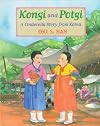
The book begins with “Some Facts About Korean Culture”. It explains the landscape, houses, dishes, marketplaces, and folktales as well as some vocabulary.
The story plays out much like the traditional Cinderella story until Kongi needs help working in the stony field. At this point an ox speaks to her and helps her to plow. Next a toad helps her to fill a water jar with a hole in the bottom.
When the Prince invites all eligible young ladies to a party in order to find a bride, Kongi is show more told she may not attend until the rice jar is full. She must take the bundles of grain from the bin, put the grain to dry, and remove each kernel brace from its hard outer shell. Sparrows come to help her.
Radiant angels come from a rainbow and dress her and provide a sedan chair to bring her to the party. There is no stroke of midnight. Kongi, flustered by the prince’s attention, leaves and loses her jewellike slipper.
In the end, Kongi forgives her stepfamily who, learning from her good example, eventually change to help others and do good deeds.
The colorful illustrations show much about Korean culture, food, and dress.
This is an interesting version of the Cinderella story. show less
The story plays out much like the traditional Cinderella story until Kongi needs help working in the stony field. At this point an ox speaks to her and helps her to plow. Next a toad helps her to fill a water jar with a hole in the bottom.
When the Prince invites all eligible young ladies to a party in order to find a bride, Kongi is show more told she may not attend until the rice jar is full. She must take the bundles of grain from the bin, put the grain to dry, and remove each kernel brace from its hard outer shell. Sparrows come to help her.
Radiant angels come from a rainbow and dress her and provide a sedan chair to bring her to the party. There is no stroke of midnight. Kongi, flustered by the prince’s attention, leaves and loses her jewellike slipper.
In the end, Kongi forgives her stepfamily who, learning from her good example, eventually change to help others and do good deeds.
The colorful illustrations show much about Korean culture, food, and dress.
This is an interesting version of the Cinderella story. show less
The classic fairy tale story of Cinderella but from Korea instead. Kongi may have been a slave in her step mother and sisters eyes, but she is a patient and caring person. Her innocent and hard working personality was able to win the Prince's heart and become his wife. The illustrations are very detailed and colorful. It was able to capture the Korean culture and landscape. Teachers can use this book by showing their students a different view of Cinderella coming from another country and show more culture. It gives a chance for students to learn a bit of the Korean culture but see the use of the classical story line of Cinderella. I love really how there is a Korean version of Cinderella, but it is told their point of view. It's nice to see a different view of a classical story that has been going on for many decades now. show less
Awards


You May Also Like
Associated Authors
Statistics
- Works
- 2
- Also by
- 6
- Members
- 66
- Popularity
- #259,058
- Rating
- 3.8
- Reviews
- 6
- ISBNs
- 5