
John R. Donahue
Author of Sacra Pagina: The Gospel of Mark
About the Author
Rev. John R. Donahue, SJ, received a doctorate in New Testament from the University of Chicago. He is the former president of the Catholic Biblical Association of America and has served on national and international ecumenical dialogues. Fr. Donahue also served as an advisor to the United States show more Catholic bishops' committee that drafted Economic Justice for All. He is the Raymond E. Brown Distinguished Professor of New Testament Studies (Emeritus) at St. Mary's Seminary and University, Baltimore, Maryland. show less
Series
Works by John R. Donahue
Life In Abundance: Studies Of John's Gospel In Tribute To Raymond E. Brown, S.s (2002) — Editor — 29 copies, 1 review
Theology and Setting of Discipleship in the Gospel of Mark (Pere Marquette Theology Lecture) (1983) 19 copies
What Does the Lord Require? A Bibliographical Essay on the Bible and Social Justice (1993) 14 copies, 1 review
Associated Works
Tagged
Common Knowledge
- Gender
- male
Members
Reviews
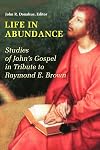
I introduced Raymond Brown a couple books back as one of the most important theologians of the 20th century. A few years after his sudden death in 1998, St. Mary’s Seminary and University in Baltimore hosted a conference titled “Life in Abundance,” to follow Brown’s lead in discussing the state of Johannine studies. This volume brings together presentations by scholars there.
Anyone who is a student of John’s Gospel will recognize many of the contributors: Alan Culpepper, Robert show more Kysar, D. Moody Smith and more. The articles are grouped into four categories: [1] Johannine Studies: Challenges and Prospects, [2] Historical Context and the Gospel of John, [3] Johannine Theology, and [4] Interpreting the Work of Raymond Brown.
Brown, according to Culpepper, “represents an advance over both the skepticism of Bultmann (and more recently the Jesus Seminar) on the one hand and the conservatism of Dodd, Robinson, and later D.A. Carson on the other hand.” For example, Brown originally accepted the traditional identification of the Beloved Disciple as John, son of Zebedee, but later changed his mind.
Brown entered the world of Johannine scholarship at the perfect time, it seems, just as the discovery of the Dead Sea Scrolls revealed a Jewish sect in first-century Palestine that expressed itself in much the same dualistic, exclusivistic terminology as John’s Gospel. We no longer need to explain the Fourth Gospel in terms of Hellenistic or Gnostic thought, for we now know there were similar forms of Jewish thought contemporaneous with the birth of Christianity. When in verse 5:24, John explains that “those who hear and believe have entered eternal life and have passed from death to life,” we can see traces of John’s realized eschatology, without completely rejecting the future eschatology displayed in the verses immediately following. Life in abundance … both now and later.
This is a scholarly book, very good for those wanting to catch up on the latest thinking about John’s Gospel. For that purpose, I give it five stars. If you’re looking for inspirational reading, this is probably not the right book. show less
Anyone who is a student of John’s Gospel will recognize many of the contributors: Alan Culpepper, Robert show more Kysar, D. Moody Smith and more. The articles are grouped into four categories: [1] Johannine Studies: Challenges and Prospects, [2] Historical Context and the Gospel of John, [3] Johannine Theology, and [4] Interpreting the Work of Raymond Brown.
Brown, according to Culpepper, “represents an advance over both the skepticism of Bultmann (and more recently the Jesus Seminar) on the one hand and the conservatism of Dodd, Robinson, and later D.A. Carson on the other hand.” For example, Brown originally accepted the traditional identification of the Beloved Disciple as John, son of Zebedee, but later changed his mind.
Brown entered the world of Johannine scholarship at the perfect time, it seems, just as the discovery of the Dead Sea Scrolls revealed a Jewish sect in first-century Palestine that expressed itself in much the same dualistic, exclusivistic terminology as John’s Gospel. We no longer need to explain the Fourth Gospel in terms of Hellenistic or Gnostic thought, for we now know there were similar forms of Jewish thought contemporaneous with the birth of Christianity. When in verse 5:24, John explains that “those who hear and believe have entered eternal life and have passed from death to life,” we can see traces of John’s realized eschatology, without completely rejecting the future eschatology displayed in the verses immediately following. Life in abundance … both now and later.
This is a scholarly book, very good for those wanting to catch up on the latest thinking about John’s Gospel. For that purpose, I give it five stars. If you’re looking for inspirational reading, this is probably not the right book. show less
What does the Lord require?: A bibliographical essay on the Bible and social justice (Series IV : Studies in Jesuit Topics) by John R. Donahue

a bibliographical essay on the Bible and social justice ... a bibliographical essay on the Bible and social justice by Donahue, John R; Seminar on Jesuit Spirituality. Publication date 1993 Topics Jesuits, Bible, Christianity and justice, Sociology, Biblical, Social problems
Breaking Down the Dividing Wall of Hostility: A Biblical Mandat for the New Millenium [based on the teaching foSt Paul] by S.J. J.R. Donahue

Santa Clara University Lecture, 8 Febbruary 1998pbk., 21 pp.
You May Also Like


Associated Authors
Statistics
- Works
- 14
- Also by
- 2
- Members
- 652
- Popularity
- #38,720
- Rating
- 4.4
- Reviews
- 5
- ISBNs
- 20
- Languages
- 3