
Papa Leone XIII (1810–1903)
Author of Rerum Novarum: On the Condition of the Working Classes
About the Author
Image credit: 1903 photograph of painting (LoC Prints and Photographs, LC-USZ62-124242)
Works by Papa Leone XIII
The Great Encyclical Letters of Pope Leo Xiii, 1878-1903: Or a Light in the Heavens (1995) 108 copies
Makers of Modern Christian Social Thought: Leo XIII and Abraham Kuyper on the Social Question (2016) — Contributor — 33 copies
The rosary of Mary. Translations of the encyclical and apostolic letters of Pope Leo XIII (2011) 7 copies
Education of the Clergy 3 copies
St Peter Canisius 2 copies
Sts Cyril and Methodius 2 copies
Catholicism in the U.S. 2 copies
Social Conditions in Belgium 2 copies
The Columbus Quadricentennial 2 copies
Lettres Apostoliques de S. S. Léon XIII, Encycliques, Brefs, Etc. Tome 4 (Religion) (French Edition) (2013) 2 copies
The Abolition of Slavery 2 copies
Devotion to St Joseph 2 copies
Seven Great Encyclicals 2 copies
Leone XIII (1878-1903) 2 copies
Pope Leo XIII: His Life and Letters 2 copies
Actes de Leòn XIII : encycliques mohn propio, bugs, allocutions avec de traduction française — Author — 1 copy, 1 review
The Liberty of the Church 1 copy
Exeunte Jam Anno 1 copy
The Pope and the People 1 copy
Lettres apostoliques de S. S. Léon XIII, encycliques, brefs, etc. Tome 5 (Religion) (French Edition) (2013) 1 copy
The Encyclicals of a Century 1 copy
Arcanum 1 copy
Encyclical Letters 1 copy
Index librorum prohibitorum (Leonis XIII Sum. Pont. Auctoritate) — Author — 1 copy
Religious Orders in Portugal 1 copy
His Sacerdotal Jubilee 1 copy
The Church in the U.S. 1 copy
The Hungarian Millenium 1 copy
On Christian Education 1 copy
On Mission Societies 1 copy
On Boycotting in Ireland 1 copy
Seminaries for Native Clergy 1 copy
Pope Leo XIII - Pamphlets 1 copy
INIMICA VIS On Freemasonry 1 copy
Annum sacrum 1 copy
Auspicato Concessum 1 copy
Catholicism in Germany 1 copy
The Manitoba School Question 1 copy
The Civil Marriage Law 1 copy
Italian Immigrants 1 copy
The Reunion of Christendom 1 copy
The Church in Portugal 1 copy
Religious Union 1 copy
The Morality of Dueling 1 copy
The Churches of the East 1 copy
Unity Among the Greeks 1 copy
The Church in Bavaria 1 copy
The Church in Ireland 1 copy
Marriage Legislation 1 copy
Conditions in Spain 1 copy
The Church in Hungary 1 copy
Slavery in the Missions 1 copy
The Church in Scotland 1 copy
St Francis of Assisi 1 copy
Associated Works
The Sheed and Ward Anthology of Catholic Philosophy (A Sheed & Ward Classic) (2005) — Contributor — 33 copies
Tagged
Common Knowledge
- Other names
- Pecci, Vincenzo Gioacchino Raffaele Luigi (birth name)
- Birthdate
- 1810-03-02
- Date of death
- 1903-07-20
- Gender
- male
- Education
- Sapienza University (Canon and Civil Law)
- Occupations
- Roman Catholic cleric (1837)
Delegate (Civil Governor ∙ Benevento ∙ Papal province ∙ 1838)
Delegate (Civil Governor ∙ Perugia ∙ Papal province ∙ 1841)
Nuncio to Brussels (1843-1846)
Archbishop of Damiata, Egypt (titular ∙ 1843-1846)
Archbishop of Perugia (1846-1878) (show all 9)
cardinal (1853)
Camerlengo of the Holy Roman Church (1877-1878)
Pope (1878-1903) - Organizations
- Roman Catholic Church
- Short biography
- Pope Leo XIII (2 March 1810 – 20 July 1903), born Vincenzo Gioacchino Raffaele Luigi Pecci to an Italian comital family, was Pope from 20 February 1878 to his death in 1903. He was the oldest pope (reigning until the age of 93), and had the third longest pontificate, behind that of Pope Pius IX (his immediate predecessor) and Pope John Paul II. He is the most recent pontiff to date to take the pontifical name of "Leo" upon being elected to the pontificate.
- Nationality
- France (birth) (region part of Napoleonic French Empire in 1810)
Papal States (1814) (restored after fall of Napoleon)
Italy (1870) (annexed) - Birthplace
- Carpineto Romano, Rome, French Empire
- Places of residence
- Carpineto Romano, Italy
- Place of death
- Rome, Italy
- Burial location
- Archbasilica of St. John Lateran, Rome, Italy
- Map Location
- Italien
- Associated Place (for map)
- Italy
Members
Reviews
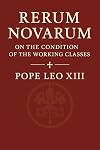
Pope Leo XIII was pope from 1878 to his death in 1903. He experienced the dramatic changes that occurred worldwide during the Industrial Revolution and saw the increasingly desperate plights of the working class as well as the growing economic inequality of the Gilded Age. He also saw the rise of Socialism and Socialist parties which he considered a threat to the church.
This encyclical was published in 1891 and was subtitled On the Condition of the Working Classes. He provides his thinking show more on the social aspects of Capital and Labor. This Kindle edition of the encyclical has recently been rereleased as a result of the ascension of Pope Leo XIV increasing curiosity about the previous Leo. The Kindle edition has added footnotes that provide additional historical context, a short biography of Pope Leo XIII, and one-line summaries of each of the paragraphs of the encyclical.
The encyclical begins with a declaration that it has become necessary for the church to address the issues of capital and labor noting that it is urgently necessary to find remedies to the current miseries of members of the working class. He then proceeds to explain the evils of Socialism saying that it is a bad solution for society and for the working class as well. He is primarily upset with Socialism wanting to eliminate private property so several sections are spent defending the importance of private property.
The encyclical then continues with a condemnation of strikes and with a list of the duties of workers and the duties of employers. The duties he prescribes for workers are numerous and very specific in contrast to the duties of employers which can generously be described as appealing to the better natures of employers so they will treat their employees well. He wants everyone in society to follow Christian principles in order to bring the relationship between workers and employers into balance. He does, however, discuss the role of the State for regulating work but generally wants the State to remain neutral.
Pope Leo regretted the elimination of the trade guilds because of the ways that they looked out for worker welfare. As a substitute he favors workers forming mutual aid societies that can help members who become injured or sick.
The work is interesting to read as first efforts to address social welfare issues during the Industrial Revolution and Gilded Age. His analysis and recommendations appear almost timid to modern ears although the encyclical was considered very progressive when it was first released. show less
This encyclical was published in 1891 and was subtitled On the Condition of the Working Classes. He provides his thinking show more on the social aspects of Capital and Labor. This Kindle edition of the encyclical has recently been rereleased as a result of the ascension of Pope Leo XIV increasing curiosity about the previous Leo. The Kindle edition has added footnotes that provide additional historical context, a short biography of Pope Leo XIII, and one-line summaries of each of the paragraphs of the encyclical.
The encyclical begins with a declaration that it has become necessary for the church to address the issues of capital and labor noting that it is urgently necessary to find remedies to the current miseries of members of the working class. He then proceeds to explain the evils of Socialism saying that it is a bad solution for society and for the working class as well. He is primarily upset with Socialism wanting to eliminate private property so several sections are spent defending the importance of private property.
The encyclical then continues with a condemnation of strikes and with a list of the duties of workers and the duties of employers. The duties he prescribes for workers are numerous and very specific in contrast to the duties of employers which can generously be described as appealing to the better natures of employers so they will treat their employees well. He wants everyone in society to follow Christian principles in order to bring the relationship between workers and employers into balance. He does, however, discuss the role of the State for regulating work but generally wants the State to remain neutral.
Pope Leo regretted the elimination of the trade guilds because of the ways that they looked out for worker welfare. As a substitute he favors workers forming mutual aid societies that can help members who become injured or sick.
The work is interesting to read as first efforts to address social welfare issues during the Industrial Revolution and Gilded Age. His analysis and recommendations appear almost timid to modern ears although the encyclical was considered very progressive when it was first released. show less


Lists
You May Also Like


Associated Authors
Statistics
- Works
- 132
- Also by
- 4
- Members
- 1,148
- Popularity
- #22,369
- Rating
- 4.6
- Reviews
- 8
- ISBNs
- 57
- Languages
- 7
- Favorited
- 1


