
Li Qingzhao
Author of Complete Poems
About the Author
Image credit: Li Qingzhao statue in Li Qingzhao Memorial, Jinan. Photo by user Gisling / Wikimedia Commons
Works by Li Qingzhao
Associated Works
A Book of Luminous Things: An International Anthology of Poetry (1996) — Contributor — 941 copies, 12 reviews
World Poetry: An Anthology of Verse from Antiquity to Our Time (1998) — Contributor — 497 copies, 2 reviews
Women in Praise of the Sacred: 43 Centuries of Spiritual Poetry by Women (1994) — Contributor — 385 copies, 5 reviews
Tagged
Common Knowledge
- Canonical name
- Li Qingzhao
- Other names
- Li Ch'ing-chao (Wade-Giles)
- Birthdate
- 1084
- Gender
- female
- Nationality
- China
- Birthplace
- Zhangqiu, Shandong, China
- Place of death
- Shaoxing, Zhejiang, China
- Map Location
- China
Members
Reviews
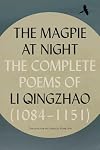
Li Qingzhao is one of the few ancient Chinese women poets whose work continues to be preserved and accessible to us, and Wendy Chen's translation extends that access to English-speakers as well. These are beautiful, gem-like poems, full of stark longing and sorrow, joy and regret. She experienced rare acclaim, as well as a fulfilling and happy marriage to Zhao Mingchen, a writer himself who was not afraid to admit his wife's superior talent in poetry. His untimely death informs much of her show more writing: later poems are tense with grief and loneliness.
I think often about how my relative ignorance of Chinese literature results in the fact that I don't know of the towering influence that so many writers and poets have had on generations of people. These limitations of language are only overcome when we gain access to translations like this. Although I normally prefer footnotes to endnotes, in this case, I think Chen was absolutely right in leaving notes to the end, allowing each poem to stand alone. Going to back to the notes, I then revisited each poem in this collection: twice-read, they lose nothing.
If I have one quibble - and it's only one - Chen should not have bothered to call Li Qingzhao's work 'Dickinsonian'. While comparisons to Emily Dickinson are not inapt, this reductive tendency to locate any non-American/English writer inside the American/English canon must be resisted because it only limits.
I'm including below the poem that gives this collection its title. I think of all her works, I like these poems, which reflect on her craft and work, the most.
"These feelings I make into poems
Are like the magpie at night
circling three times, unable to settle."
Also from a fragment titled 'The Fisherman's Pride':
"My journey is long, I say,
and the sun setting.
I have studied poetry
and attempted startling phrases
to no use." show less
I think often about how my relative ignorance of Chinese literature results in the fact that I don't know of the towering influence that so many writers and poets have had on generations of people. These limitations of language are only overcome when we gain access to translations like this. Although I normally prefer footnotes to endnotes, in this case, I think Chen was absolutely right in leaving notes to the end, allowing each poem to stand alone. Going to back to the notes, I then revisited each poem in this collection: twice-read, they lose nothing.
If I have one quibble - and it's only one - Chen should not have bothered to call Li Qingzhao's work 'Dickinsonian'. While comparisons to Emily Dickinson are not inapt, this reductive tendency to locate any non-American/English writer inside the American/English canon must be resisted because it only limits.
I'm including below the poem that gives this collection its title. I think of all her works, I like these poems, which reflect on her craft and work, the most.
"These feelings I make into poems
Are like the magpie at night
circling three times, unable to settle."
Also from a fragment titled 'The Fisherman's Pride':
"My journey is long, I say,
and the sun setting.
I have studied poetry
and attempted startling phrases
to no use." show less

Li Ch'ing-chao (1084-c1151, who lived late in the Sung Dynasty) is considered China's greatest women's poet. her poetry is both strong and delicately rendered: "I hear that Spring at Two Rivers/ Is still beautiful./ I had hoped to take a boat there,/ But I know so fragile a vessel/ Won't bear such a weight of sorrow." i've been rereading it in the wake of the second book of Guy Gavriel Kay's Under Heaven trilogy, River of Stars, which portrays her life as the Sung Dynasty begins to fall apart.
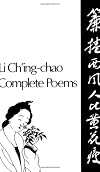
Li Ch’ing Chao (1084-1151) is regarded as one of China’s greatest women poets and the poetry of heartbreak and loneliness from a thousand years ago in Sung Dynasty China touches a chord even today, but there isn’t enough range here for my taste. Here are a couple of poems I liked that give you a sample:
Remorse
------------
Deep in the silent inner room
Every fiber of my soft heart
Turns to a thousand strands of sorrow.
I loved the Spring,
But the Spring is gone
As rain hastens the falling show more petals.
I lean on the balustrade,
Moving from one end to the other,
My emotions are still disordered.
Where is he?
Withered grass stretches to the horizon
And hides from sight
Any road by which he might return.
Spring Ends
---------------
The River of Heaven turns across the sky.
All the world is covered with bed curtains.
It grows cold.
Tear stains spread on my mat and pillow.
I get up and take off my clothes
And listlessly ask “How late at night is it?”
The green feather pattern of lotus pod,
The gold thread design of lotus leaves,
Seem small and sparse on my gauze sleeping robe.
The same weather as in the old days,
The same dress I wore then,
Only my arms are empty of love,
And our past is gone forever. show less
Remorse
------------
Deep in the silent inner room
Every fiber of my soft heart
Turns to a thousand strands of sorrow.
I loved the Spring,
But the Spring is gone
As rain hastens the falling show more petals.
I lean on the balustrade,
Moving from one end to the other,
My emotions are still disordered.
Where is he?
Withered grass stretches to the horizon
And hides from sight
Any road by which he might return.
Spring Ends
---------------
The River of Heaven turns across the sky.
All the world is covered with bed curtains.
It grows cold.
Tear stains spread on my mat and pillow.
I get up and take off my clothes
And listlessly ask “How late at night is it?”
The green feather pattern of lotus pod,
The gold thread design of lotus leaves,
Seem small and sparse on my gauze sleeping robe.
The same weather as in the old days,
The same dress I wore then,
Only my arms are empty of love,
And our past is gone forever. show less
Thank you NetGalley and Farrar, Straus and Giroux for the chance to read and review this! Just in time for the publication I might add!
Honestly, I didn't want to finish this book; it's truly a gem and I can't list down the number of poems, the number of moments, that have hitched my breath in my throat.
My next steps are to get a physical copy of the book so I can read and re-read at leisure and write notes and underline things and just enjoy myself!
Honestly, I didn't want to finish this book; it's truly a gem and I can't list down the number of poems, the number of moments, that have hitched my breath in my throat.
My next steps are to get a physical copy of the book so I can read and re-read at leisure and write notes and underline things and just enjoy myself!
Lists
Awards

You May Also Like
Associated Authors
Statistics
- Works
- 21
- Also by
- 5
- Members
- 140
- Popularity
- #146,472
- Rating
- 4.1
- Reviews
- 5
- ISBNs
- 20
- Languages
- 5
- Favorited
- 1