
Tom Lathrop
Author of Brasil! Língua e Cultura
About the Author
Works by Tom Lathrop
The Legend of the Siete Infantes de Lara : (refundicion toledana de la cronica de 1344 version) (1972) 3 copies
Studies in Spanish Literature in Honor of Daniel Eisenberg (Juan de La Cuesta Hispanic Monographs) (2009) 1 copy
Brasil! Lingua e Cultura Third Edition, Instructor's Manual and Key to the Writing Manual & Audio Lessons (2003) 1 copy
Zola: Thérèse Raquin 1 copy
Associated Works
Tagged
Common Knowledge
- Gender
- male
Members
Reviews

I have never taken a formal class in Portuguese but am mostly self-taught, with help from Brasilian friends along the way. I learned Portuguese in Brasil by staying with Brasilian families in areas where no English was spoken for hundreds of miles. In that event, it was learn or starve; not only didn't I starve, but learned to love Brasilian food!
When I returned to the US, I could speak a rudimentary form of Portuguese but could not read or write it. On the recommendation of a friend, I show more bought this textbook and was immediately delighted with it.
The target audience for this book is a college or university class. It follows the tradition of focusing, therefore, on student activiteis and lives. However, this book focuses on Brasilian, rather than American, student lives, using the fiction of an American student, Scott, spending one or more years at the University of São Paulo in São Paulo. It's very effective.
The lessons are more or less standard in their layout and progression, concentrating on gender of nouns and adjectives in the beginning, the present tense, irregular verbs, etc. But the text is very clearly written, the examples are both excellent and interesting, and the ancillary material--about Brasilian universities, student life, Brasilian families, culture, São Paulo itself, the economy--are fascinating. There is always a reading from an interview with a real student, for example, giving a particular viewpoint.
I found the grammar sections easy to follow, which is good, because Portuguese grammar is not for the faint-hearted. In particular, I found the approach to distinguishing the preterite and imperfect novel and highly useful. The sections explaining the personal infinitve and subjunctive were excellent in easing the student into what can be difficult material. In fact, I found it all easy until about Chapter 15 (out of 20), whjere I started to have difficulty. Still I was able to pick up very useful knowledge despite being slowed down.
The vocabulary sections are adequate. The index is not. You are NOT going to leaern to pronounce Portuguese, with its extreme nasality (only French is more so) from this book. But that's not it's purpose.
Highly recommended. show less
When I returned to the US, I could speak a rudimentary form of Portuguese but could not read or write it. On the recommendation of a friend, I show more bought this textbook and was immediately delighted with it.
The target audience for this book is a college or university class. It follows the tradition of focusing, therefore, on student activiteis and lives. However, this book focuses on Brasilian, rather than American, student lives, using the fiction of an American student, Scott, spending one or more years at the University of São Paulo in São Paulo. It's very effective.
The lessons are more or less standard in their layout and progression, concentrating on gender of nouns and adjectives in the beginning, the present tense, irregular verbs, etc. But the text is very clearly written, the examples are both excellent and interesting, and the ancillary material--about Brasilian universities, student life, Brasilian families, culture, São Paulo itself, the economy--are fascinating. There is always a reading from an interview with a real student, for example, giving a particular viewpoint.
I found the grammar sections easy to follow, which is good, because Portuguese grammar is not for the faint-hearted. In particular, I found the approach to distinguishing the preterite and imperfect novel and highly useful. The sections explaining the personal infinitve and subjunctive were excellent in easing the student into what can be difficult material. In fact, I found it all easy until about Chapter 15 (out of 20), whjere I started to have difficulty. Still I was able to pick up very useful knowledge despite being slowed down.
The vocabulary sections are adequate. The index is not. You are NOT going to leaern to pronounce Portuguese, with its extreme nasality (only French is more so) from this book. But that's not it's purpose.
Highly recommended. show less
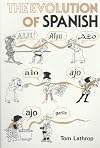
One of the more interesting parts of a language is how individual words form over the years. In English, some words were formed from the fusing together of two existing words or from the spontaneous creation of a word that fills a gap in our collective description. Most of the time, however, words just evolve. Starting with one spelling and meaning, they slowly morph into new forms and new contexts. The same process happens in nearly every language in the world. Thomas Lathrop’s Evolution show more of Spanish is a look into the roots of the language, and from these roots, he hopes new understanding can grow.
Lathrop’s history of the Spanish language starts with a look at Vulgar Latin. Because Spain and Italy are so proximal and Spanish is Latinate in origin, it stands to reason that an understanding of Latin is necessary for an understanding of modern Spanish. While a lot of this may not be exciting, it is actually the only real expository section of the book. After this is page after page of pairs of word lists and verb conjugations. These lists show the evolution of the one word to the next, starting with simple vowel shifts and then moving to various grammatical forms. For linguistic historians, this is a nice compilation and a basis for a more in-depth comparative analysis, but for a casual reader, it is bone dry. Thankfully, it wasn’t too terribly long. show less
Lathrop’s history of the Spanish language starts with a look at Vulgar Latin. Because Spain and Italy are so proximal and Spanish is Latinate in origin, it stands to reason that an understanding of Latin is necessary for an understanding of modern Spanish. While a lot of this may not be exciting, it is actually the only real expository section of the book. After this is page after page of pairs of word lists and verb conjugations. These lists show the evolution of the one word to the next, starting with simple vowel shifts and then moving to various grammatical forms. For linguistic historians, this is a nice compilation and a basis for a more in-depth comparative analysis, but for a casual reader, it is bone dry. Thankfully, it wasn’t too terribly long. show less
Awards
You May Also Like
Associated Authors
Statistics
- Works
- 15
- Also by
- 1
- Members
- 144
- Popularity
- #143,280
- Rating
- 4.1
- Reviews
- 2
- ISBNs
- 27
- Languages
- 2