
Yves Sente
Author of The Voronov Plot
About the Author
Series
Works by Yves Sente
The Sarcophagi of the Sixth Continent, Part 1: The Global Threat (2003) — Author — 237 copies, 3 reviews
The Sarcophagi of the Sixth Continent, Part 2: Battle of the Spirits (2004) — Author; Author — 208 copies, 2 reviews
The Valley of the Immortals, Part 2: The Thousandth Arm of the Mekong (2019) — Author — 114 copies, 4 reviews
La vengeance du comte Skarbek, Tome 2 : Un coeur de bronze : Second chapitre (2005) 40 copies, 2 reviews
La Vengeance du Comte Skarbek - Intégrale complète - tome - La Vengeance du comte Skarbek - Intégrale complète (2009) 6 copies, 1 review
Les Sarcophages du 6e Continent Vol I and II - Les Aventures de Blake et Mortimer (La Menace Universelle Tome I et II) (2013) 1 copy
A AMEAÇA ATLANTE 1 copy
Tagged
Common Knowledge
- Birthdate
- 1964-01-17
- Gender
- male
- Nationality
- Belgium
- Associated Place (for map)
- Belgium
Members
Reviews
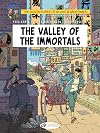
Unlike the Adventures of Tintin, with which the Adventures of Blake and Mortimer are closely linked, Blake and Mortimer survived the death of their creator. Edgar P Jacobs set up a studio to continue the series, and it’s been churning them out ever since. And, to be honest, the studio’s stories have been better than Jacobs’s ever were. Until, it seems, this one. Sort of. The Adventures of Blake & Mortimer 25: The Valley of the Immortals is a sequel to one of Jacobs’s most famous show more stories, The Secret of the Swordfish, which was pretty much a Yellow Peril narrative. To be fair, The Adventures of Blake & Mortimer 25: The Valley of the Immortals soon leaves Jacobs’s invented Asian evil empire – actually called the Yellow Empire – behind, and focuses on real Chinese history, specifically the Communists and Kuomintang, both of which are after a recently discovered artefact from third-century BCE China. As is a warlord who plans to use it to declare himself emperor. Mostly, this is all good stuff, but while dragging in the Yellow Empire slots the story into the Blake and Mortimer universe, and gives continuity to the characters, it leaves a bad taste and the book would have been better for ignoring it. One of the good things about the series has been that it has changed with the times. Tintin’s earlier adventures are racist as shit, and because The Adventures of Tintin ended with Hergé’s death, there are no new stories to offset those early works. Because Jacobs founded a studio to continue the Adventures of Blake and Mortimer, we have new stories – more, I think, than Jacobs actually wrote – which have kept pace with sensibilities (and have also become increasingly sophisticated in their stories). If you like Tintin, then you should be reading the Adventures of Blake and Mortimer. There are twenty-five of them, so you’ve got some catching up to do. show less
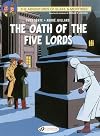
I'm finding the variety of the adventures into which Blake and Mortimer get themselves enmeshed one of the pleasures of this series. From militaristic, gung-ho, pulp-style war heroics, to Flash Gordonesque science fantasy antics or Quatermass-style scientific speculation, to magic, mysticism and ghosts, or spy adventures and "The Great Game" of Empires.
In The Oath of the Five Lords, Yves Sante delivers a murder mystery, combining political intrigue with a revenge vendetta. As the readers and show more the protagonists of the stories become further separated in time, the writers of the new adventures feel able to bring in historical characters contemporary with Blake and Mortimer, in this instance, T.E. Lawrence "of Arabia". We're also given some further flashbacks into Blake's back story, which proves integral to the plot.
There are some neat background clues as to suspects and motives for the observant reader,the 'Hamlet' theatre poster in Alfred's room being my favourite , and while the mystery isn't so hard to fathom, the details as to motive, the blending of fiction and fact, and the ambiguity as to Lawrence's intentions are handled well. I thoroughly enjoyed it! show less
In The Oath of the Five Lords, Yves Sante delivers a murder mystery, combining political intrigue with a revenge vendetta. As the readers and show more the protagonists of the stories become further separated in time, the writers of the new adventures feel able to bring in historical characters contemporary with Blake and Mortimer, in this instance, T.E. Lawrence "of Arabia". We're also given some further flashbacks into Blake's back story, which proves integral to the plot.
There are some neat background clues as to suspects and motives for the observant reader,
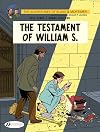
I’ve been picking these up as Cinebook publish the English translations, and if that’s not a testament to their quality, then I don’t know what is. Perversely, they’ve improved considerably since the series creator, Edgar P Jacobs, died. In most cases, the originator does it best – Hergé refused to let anyone continue the Tintin series after him; but the Asterix and Obelix series is generally considered to have declined now that both Goscinny and Uderzo are dead. But Jacobs’s show more stories for Blake and Mortimer were very much of their time – even offensively so: the villains for several stories is the “Yellow Empire”, ffs – and the science fiction elements were complete bollocks. Since the Edgar P Jacobs Studio has been producing the books, they’ve turned into clever alternate history conspiracy thrillers – such as this one. The William S. of the title is the Bard himself, and the story revolves around two societies who have been feuding for decades over who actually wrote the plays and sonnets. One believes it was indeed Shakespeare; the other believes it was the Earl of Oxford. But a clue hinting at vital evidence proving the claim of one of the societies is unexpectedly discovered in Venice, and, since there’s a huge bequeathed fortune tied up in the answer, the race is on to puzzle out the hidden location of the evidence, and either publish it or destroy it. Good stuff. show less
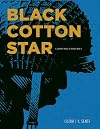
This is an African American spin on Monuments Men, with the action amped up closer to Saving Private Ryan levels and a hit of National Treasure added for spice. And yet it is dull as dirt.
During World War II, a North Carolina college student named Johanna Bolton discovers the Revolutionary War diary of a Black woman who altered Betsy Ross' very first American flag by sneaking a black star representing all African Americans under one of the thirteen white stars. Somehow dominoes fall and show more Bolton's brother who has been serving in support positions in the U.S. military in England is attached to the Monuments, Fine Arts, and Archives program with his two closest buddies to track down the flag which has made its way to German-occupied France by way of a Hessian mercenary.
Everything in the plot seems highly unlikely, the dialogue is wooden, and the ending is just awful. Possibly in an attempt to make up for the flatness of the characters in the script, the artist seems to draw the three soldiers with the likenesses of Denzel Washington, Forest Whitaker, and Sammy Davis, Jr.
Despite the focus on American race relations, the work is created by what look like a couple of white Belgian dudes. This originally appeared in print in French but I find no translator credited on this edition. I'm going to assume Edward Gauvin because he seems to translate all the boring French graphic novels I read. show less
During World War II, a North Carolina college student named Johanna Bolton discovers the Revolutionary War diary of a Black woman who altered Betsy Ross' very first American flag by sneaking a black star representing all African Americans under one of the thirteen white stars. Somehow dominoes fall and show more Bolton's brother who has been serving in support positions in the U.S. military in England is attached to the Monuments, Fine Arts, and Archives program with his two closest buddies to track down the flag which has made its way to German-occupied France by way of a Hessian mercenary.
Everything in the plot seems highly unlikely, the dialogue is wooden, and the ending is just awful. Possibly in an attempt to make up for the flatness of the characters in the script, the artist seems to draw the three soldiers with the likenesses of Denzel Washington, Forest Whitaker, and Sammy Davis, Jr.
Despite the focus on American race relations, the work is created by what look like a couple of white Belgian dudes. This originally appeared in print in French but I find no translator credited on this edition. I'm going to assume Edward Gauvin because he seems to translate all the boring French graphic novels I read. show less
Lists
Awards
You May Also Like


Associated Authors
Statistics
- Works
- 63
- Members
- 3,176
- Popularity
- #8,047
- Rating
- 3.6
- Reviews
- 48
- ISBNs
- 383
- Languages
- 10