
Alex Austin (1)
Author of End Man
For other authors named Alex Austin, see the disambiguation page.
Works by Alex Austin
Pseudocoma 1 copy
Associated Works
Black Clock 8 — Contributor — 1 copy
Tagged
Common Knowledge
Members
Reviews

Reading Nakamura Reality by Alex Austin is like riding a perfect wave. In its exhilarating, grips-you-from-the-get-go prologue, "slabs of water, rhinos the surfers called them" are booming off shore. Closer, the shore break "sounded sharply like a gunshot." As you read Nakamura Reality (and do know it will be difficult not to complete it in one sitting), keep in mind this dualism Austin first evokes here with the imagery of waves: inside versus outside, far versus near. Incoming infinitely, show more ephemeral as they are, Austin's waves foreshadow and harbor clues in Nakamura Reality's epic prologue.
Alex Austin is a practiced illusionist in words and images. He's been a playwright; he's witnessed his words and images staged in Los Angeles and New York. He's published many stories both online and in print, including publication in two issues of Black Clock. You could safely say, as I will, because yes I know Alex, that he has a special way with words and images; employing them both to pull the wave over your eyes! Tricking you over and over again, for 272 mesmerizing pages -- I wished it would never end. For Nakamura Reality amazes me, as I consider how many intricate, interwoven, parallel dramas, realities, and confabulations of fiction and fact are introduced -- in action -- simultaneously. Even seemingly insignificant details Austin includes are imbued with foreboding, or longing or loss, like those pesky seagulls we'll see "swooping down" and "mewing insistently" throughout the mysterious narrative(s) of the novel. I just can't help wondering what the seagulls portend.
We meet at least three (but maybe more) of the major players in the prologue: Hugh and his twin sons Takumi and Hitoshi. They are on the beach in a supposed paradise in southern California, surveying those "rhinos" whose "chaotic" enormity is reminiscent to me of those magnificent rhinos in the grand finale of Big Wednesday. Once in a lifetime day. And what a likewise rare day for two boys and their Dad. To surf, or not to surf? That is the question; the question that preoccupied the double-minded indecisive Hugh who must decide for his eleven year old sons.
Twelve years pass from the prologue to chapter one. Hugh's sons, you probably figured, are long gone. Presumed dead. Disappeared. Likely drowned. Hugh's Japanese wife, Setsuko, resultantly divorces him. How could Hugh, she must have thought even if she never exactly stated so, though her relatively swift abandonment of Hugh clearly implied as much, be so reckless, so irresponsible, so stupid as to let Takumi and Hitoshi, her only sons, her defenseless children senselessly put in unnecessary danger for crying out loud!; how could Hugh let them paddle out into the surf that damnable day? And if it wasn't the recklessness of that dangerous surf, it was bows and arrows, and who knows what else! How could Hugh -- a schoolteacher for junior high punks (think pawns Aaron and Anna) because he couldn't make it as a writer; couldn't make it like her father -- let her boys play at archery unsupervised? What a dunce! Ergo, divorce was predictable. Perhaps her return to Japan, where she had first met Hugh at the university, was inevitable too. Home to the house of her famous father, a man of unimaginable power and influence as we'll soon find out; and whom, if we're to believe the boasting of his bodyguard, has "fans among the Yakuza -- big fans," Japan's most popular literary author next to Haruki Murakami, the magical realist, Kazuki Ono.
Once we meet Kazuki Ono, Nakamura Reality goes rogue wave. A novel-within-a-novel emerges. Fingal's Cave, Kazuki Ono's novel-in-progress, the novel we get to see him write and we get to read as we turn each successive page in the parallel time and the parallel life of Kazuki Ono's super real realityfiction. A lifelike realityfiction as believable and plausibly enacted as, say, The Truman Show's realityfiction. I can't help being reminded also of the cosmic puppeteers in Frank Herbert's The Heaven Makers, jaded and bored by eternity, playing God and making rook or knight moves in the finite realities of pathetic little earthlings. Let's just say Kazuki Ono treats his former son-in-law, Hugh, like a pathetic little earthling and leave it at that.
What an experience, reading a novel that's really two novels in one, the second novel (Fingal's Cave) like some experimental commentary on the first novel (Nakamura Reality); the former serving as both a biography and fantasy future history in the fated life of an unfortunate and unjustly bereaved man who did not deserve, no matter how many idiotic and impulsive and regrettable flings and affairs he had, the cold and bewildering punishment served to him by that shady conglomerate we never really see and can only imagine known as "Nakamura Reality".
~~~~~
Nakamura Reality is slated for publication by The Permanent Press in February, 2016. Heartfelt thanks to Alex Austin for titling the novel that was Fingal's Cave's predecessor what he did -- I like it a lot! -- and for thinking enough of the novel (was it Kazuki Ono's tenth?) that Kazuki read an excerpt from it at Pasadena's revered independent bookstore, Huddle's (I think that was 2010 or 2011, right?), when Ono's book tour arrived in Los Angeles. May that novel of Kazuki Ono's, the one preceding Fingal's Cave, come out of realityfiction someday soon and shine like the brilliance that is Nakamura Reality's. show less
Alex Austin is a practiced illusionist in words and images. He's been a playwright; he's witnessed his words and images staged in Los Angeles and New York. He's published many stories both online and in print, including publication in two issues of Black Clock. You could safely say, as I will, because yes I know Alex, that he has a special way with words and images; employing them both to pull the wave over your eyes! Tricking you over and over again, for 272 mesmerizing pages -- I wished it would never end. For Nakamura Reality amazes me, as I consider how many intricate, interwoven, parallel dramas, realities, and confabulations of fiction and fact are introduced -- in action -- simultaneously. Even seemingly insignificant details Austin includes are imbued with foreboding, or longing or loss, like those pesky seagulls we'll see "swooping down" and "mewing insistently" throughout the mysterious narrative(s) of the novel. I just can't help wondering what the seagulls portend.
We meet at least three (but maybe more) of the major players in the prologue: Hugh and his twin sons Takumi and Hitoshi. They are on the beach in a supposed paradise in southern California, surveying those "rhinos" whose "chaotic" enormity is reminiscent to me of those magnificent rhinos in the grand finale of Big Wednesday. Once in a lifetime day. And what a likewise rare day for two boys and their Dad. To surf, or not to surf? That is the question; the question that preoccupied the double-minded indecisive Hugh who must decide for his eleven year old sons.
Twelve years pass from the prologue to chapter one. Hugh's sons, you probably figured, are long gone. Presumed dead. Disappeared. Likely drowned. Hugh's Japanese wife, Setsuko, resultantly divorces him. How could Hugh, she must have thought even if she never exactly stated so, though her relatively swift abandonment of Hugh clearly implied as much, be so reckless, so irresponsible, so stupid as to let Takumi and Hitoshi, her only sons, her defenseless children senselessly put in unnecessary danger for crying out loud!; how could Hugh let them paddle out into the surf that damnable day? And if it wasn't the recklessness of that dangerous surf, it was bows and arrows, and who knows what else! How could Hugh -- a schoolteacher for junior high punks (think pawns Aaron and Anna) because he couldn't make it as a writer; couldn't make it like her father -- let her boys play at archery unsupervised? What a dunce! Ergo, divorce was predictable. Perhaps her return to Japan, where she had first met Hugh at the university, was inevitable too. Home to the house of her famous father, a man of unimaginable power and influence as we'll soon find out; and whom, if we're to believe the boasting of his bodyguard, has "fans among the Yakuza -- big fans," Japan's most popular literary author next to Haruki Murakami, the magical realist, Kazuki Ono.
Once we meet Kazuki Ono, Nakamura Reality goes rogue wave. A novel-within-a-novel emerges. Fingal's Cave, Kazuki Ono's novel-in-progress, the novel we get to see him write and we get to read as we turn each successive page in the parallel time and the parallel life of Kazuki Ono's super real realityfiction. A lifelike realityfiction as believable and plausibly enacted as, say, The Truman Show's realityfiction. I can't help being reminded also of the cosmic puppeteers in Frank Herbert's The Heaven Makers, jaded and bored by eternity, playing God and making rook or knight moves in the finite realities of pathetic little earthlings. Let's just say Kazuki Ono treats his former son-in-law, Hugh, like a pathetic little earthling and leave it at that.
What an experience, reading a novel that's really two novels in one, the second novel (Fingal's Cave) like some experimental commentary on the first novel (Nakamura Reality); the former serving as both a biography and fantasy future history in the fated life of an unfortunate and unjustly bereaved man who did not deserve, no matter how many idiotic and impulsive and regrettable flings and affairs he had, the cold and bewildering punishment served to him by that shady conglomerate we never really see and can only imagine known as "Nakamura Reality".
~~~~~
Nakamura Reality is slated for publication by The Permanent Press in February, 2016. Heartfelt thanks to Alex Austin for titling the novel that was Fingal's Cave's predecessor what he did -- I like it a lot! -- and for thinking enough of the novel (was it Kazuki Ono's tenth?) that Kazuki read an excerpt from it at Pasadena's revered independent bookstore, Huddle's (I think that was 2010 or 2011, right?), when Ono's book tour arrived in Los Angeles. May that novel of Kazuki Ono's, the one preceding Fingal's Cave, come out of realityfiction someday soon and shine like the brilliance that is Nakamura Reality's. show less

Raphael Lennon works as an End Man at the Norval Corporation, which gathers up the digital life of every recently deceased person and makes that data available to their loved ones (at a price). But Norval has much more ambitious goals, and when Raphael goes on the trail of a possible "possum" (person who may have faked their death) he's drawn into the intrigue. Raphael also struggles with an unique mental condition, whereby he's physically unable to step outside of a square mile area in Los show more Angeles, known as the Miracle Mile (not to be confused with areas by the same name in Chicago and Las Vegas). This issue complicates his investigation, but also possibly informs it?
This book has a lot going on, and as with a lot of science fiction, it takes a while to get used to the terminology and the geography. I'm not sure whether I was helped or hindered by my familiarity with the area in which the story takes place. A reader who'd never been there might not have been as distracted by trying to figure out which of the specified landmarks are currently in existence.
The concept is an intriguing one, and definitely explores an area of sci-fi that seems imminent and also familiar. We're already invited to bequeath our gmail and facebook accounts to a "trusted friend" .. what if there was a corporation that aggregated all of our online life, including stuff we thought we deleted, and dressed it up in a nice package for sale? What's the logical next step to that?
Besides the complexity of Raphael's character, there are also some fascinating secondary and tertiary characters. I enjoyed reading about Pink, an unhoused woman who sells data on the street, and Geo the megalomaniacal Norval CEO with a digital eyeball. I would have liked more back story on both.
Overall, I enjoyed reading the book very much, and thank the author not only for the original Early Reviewers copy, but also a digital copy he sent over when I lost the paper one. show less
This book has a lot going on, and as with a lot of science fiction, it takes a while to get used to the terminology and the geography. I'm not sure whether I was helped or hindered by my familiarity with the area in which the story takes place. A reader who'd never been there might not have been as distracted by trying to figure out which of the specified landmarks are currently in existence.
The concept is an intriguing one, and definitely explores an area of sci-fi that seems imminent and also familiar. We're already invited to bequeath our gmail and facebook accounts to a "trusted friend" .. what if there was a corporation that aggregated all of our online life, including stuff we thought we deleted, and dressed it up in a nice package for sale? What's the logical next step to that?
Besides the complexity of Raphael's character, there are also some fascinating secondary and tertiary characters. I enjoyed reading about Pink, an unhoused woman who sells data on the street, and Geo the megalomaniacal Norval CEO with a digital eyeball. I would have liked more back story on both.
Overall, I enjoyed reading the book very much, and thank the author not only for the original Early Reviewers copy, but also a digital copy he sent over when I lost the paper one. show less
 This review was written for LibraryThing Early Reviewers.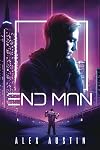
What if, in just another 10 or 15 years, most of us are so immersed in our onlineness, tweeting and swiping and streaming our way through so much of life, while every online action adds to a data composition so increasingly complex and complete that it could fuel an AI simulation of ourselves for family and friends to visit after we pass?
Not that much of a stretch?
In End Man, Alex Austin does a good job realistically extrapolating today's increasingly common online-obsessiveness into such a show more state, and anticipating some emerging entrepreneureal opportunities that would follow, even to the point of Marketing Necrologist fitting right in as a perfectly valid occupation.
Take this odd near-future setting, drop in a vividly hallucinatory dromophobic skateboarding necrologist, a maybe-dead physicist with a relentless passion for quantum entanglement applications, and a little ruthless corporate product development, and things get interesting rather quickly.
I did trip over a distracting scene continuity or causality hiccup once in a while (e.g., he strode out of the cubicle and then couldn't exit the cubicle? and the connective story tissue before and after the three-forty feels a little out-of-nowhere to me), and even after everything that happened Raphael's final personal win still felt like a bit of a sudden unexplained leap. But these were a relatively few minor wobbles in a story that otherwise flowed and engaged and entertained quite nicely while illustrating a few interesting (and disturbing) questions. show less
Not that much of a stretch?
In End Man, Alex Austin does a good job realistically extrapolating today's increasingly common online-obsessiveness into such a show more state, and anticipating some emerging entrepreneureal opportunities that would follow, even to the point of Marketing Necrologist fitting right in as a perfectly valid occupation.
Take this odd near-future setting, drop in a vividly hallucinatory dromophobic skateboarding necrologist, a maybe-dead physicist with a relentless passion for quantum entanglement applications, and a little ruthless corporate product development, and things get interesting rather quickly.
I did trip over a distracting scene continuity or causality hiccup once in a while (e.g., he strode out of the cubicle and then couldn't exit the cubicle? and the connective story tissue before and after the three-forty feels a little out-of-nowhere to me), and even after everything that happened Raphael's final personal win still felt like a bit of a sudden unexplained leap. But these were a relatively few minor wobbles in a story that otherwise flowed and engaged and entertained quite nicely while illustrating a few interesting (and disturbing) questions. show less
This review was written for LibraryThing Early Reviewers.
Vivid, gritty rendition of a rock 'n' roll youth amid the borders of the counterculture and the criminal culture in a decaying port town in late-'60s New Jersey. Austin tells a well-paced story about hurt, sad people who are yet-and-still full of wild youthful joy and hatchet-faced ambition, in a milieu that--lest we take "Summer of Love" too literally--is a hell of a lot grimmer and more violent than ours here now. I guess there was a war on,but you forget how ugly shit was--seemingly was, show more must have been. The casualness of the violence, and not just on the part of the mob guys, but the way all the men were ready to fight all the fucking time. It seems unpleasantly tense. But then, Austin also captures so well the intensity of the life, the loves, the sex--maybe a little violence, a little dabbling in the dark side, has a similar magnetic draw. Maybe people were all a little less mediated back then, not all offices and cafes and internet and shopping. Maybe. Maybe I'm being essentialist. It's interesting how easily Sam slides from greaser to hippie,making you think maybe it was all just counterculture, street life for those who needed such things. Certainly we wouldn't dream of drawing such impermeable subcultural boundaries now, but there is a too-intense-for-this-world romance still around the hippies, yeah? I mean the real old psychedelic bacchanal-spirits with menace-rimmed eyes, not yer modern pothead types. But maybe if I had been born in 1945 I would have just been a greaser and then a hippie and then an English professor and now I'd be getting all up some kid's ass for letting his class go early before the Olympics (let said kid remain nameless, but let it also be known that he's a little pissy about being in trouble over this). Maybe no time is singular--or rather, every time is. show less
You May Also Like
Associated Authors
Statistics
- Works
- 6
- Also by
- 2
- Members
- 58
- Popularity
- #284,345
- Rating
- 4.0
- Reviews
- 29
- ISBNs
- 21
- Languages
- 1

