

Peter Gottschalk (1)
Author of American Heretics: Catholics, Jews, Muslims, and the History of Religious Intolerance
For other authors named Peter Gottschalk, see the disambiguation page.
About the Author
Peter Gottschalk is Assistant Professor in the Department of Religion and Philosophy at Southwestern University.
Works by Peter Gottschalk
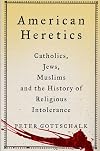
American Heretics: Catholics, Jews, Muslims, and the History of Religious Intolerance (2013) 55 copies, 12 reviews
Tagged
Common Knowledge
Members
Reviews
American Heretics: Catholics, Jews, Muslims, and the History of Religious Intolerance by Peter Gottschalk
We Americans are always proud of the First Amendment to the Constitution, but we aren’t always sure what it says or what it means.
To refresh: Congress shall make no law respecting an establishment of religion, or prohibiting the free exercise thereof; or abridging the freedom of speech, or of the press; or the right of the people peaceably to assemble, and to petition the government for a redress of grievances.
The problem, as Peter Gottschalk ably explains, is that we really don’t live show more up to those words. We quibble over what a religion is to start and then what it means to allow others to exercise their beliefs. From the start, the Massachusetts Bay Colony whose founders came to the New World because of religious prosecution, determined that everyone need to worship in the same way and to believe the same things. Roger Williams left to found Rhode Island and Mary Dyer, a member of the Society of Friends (Quakers) was hung.
From those beginnings, we proceeded to discrimination against Catholics, Jews, Mormons, various cults, and, now Muslims. Gottschalk makes a strong case for his belief that religious discrimination is often tied to racial/ethnic discrimination and often arises when a majority feels threatened by difference.
Our founders wanted to be different from England where the head of state – the Queen – is also the head of the Church of England. Gottschalk argues this lead to the desire to found a secular state and to the First Amendment.
I have to say that I found myself cringing at times as Gottschalk recounts how and why we mistreated so many throughout our history. This is a good, relatively short, history of our religious intolerance. show less
To refresh: Congress shall make no law respecting an establishment of religion, or prohibiting the free exercise thereof; or abridging the freedom of speech, or of the press; or the right of the people peaceably to assemble, and to petition the government for a redress of grievances.
The problem, as Peter Gottschalk ably explains, is that we really don’t live show more up to those words. We quibble over what a religion is to start and then what it means to allow others to exercise their beliefs. From the start, the Massachusetts Bay Colony whose founders came to the New World because of religious prosecution, determined that everyone need to worship in the same way and to believe the same things. Roger Williams left to found Rhode Island and Mary Dyer, a member of the Society of Friends (Quakers) was hung.
From those beginnings, we proceeded to discrimination against Catholics, Jews, Mormons, various cults, and, now Muslims. Gottschalk makes a strong case for his belief that religious discrimination is often tied to racial/ethnic discrimination and often arises when a majority feels threatened by difference.
Our founders wanted to be different from England where the head of state – the Queen – is also the head of the Church of England. Gottschalk argues this lead to the desire to found a secular state and to the First Amendment.
I have to say that I found myself cringing at times as Gottschalk recounts how and why we mistreated so many throughout our history. This is a good, relatively short, history of our religious intolerance. show less
 This review was written for LibraryThing Early Reviewers.
American Heretics: Catholics, Jews, Muslims, and the History of Religious Intolerance by Peter Gottschalk
Gottschalk's American Heretics is a well-written overview of the growing pains faced by a nation in search of religious diversity and freedom. Tracing his theme from the Massachusetts witch-hunts, through anti-Catholic sentiments, to post 9/11 Islamophobia (the title of his previous book), the author sets out to demonstrate two underlying truths: "Celebrating the idea of secularism proves far easier than establishing a society based on it," and that there is hope for those who find show more themselves under current persecution (47).
Gottschalk serves as professor of religion at Wesleyan University, but writes from a more religious historical viewpoint. Rather than casting judgments upon a particular heresy's beliefs, the author is more interested in the religious opposition it faced. Were the colonial Quakers' beliefs justified? The author deftly leads the reader to ignore such a question and ask if their suffering was just. Were the Irish Catholics a violent bunch? The author focuses on the atrocities committed against them, rather than by their hand. Examples abound. The author is strictly concerned with the plight of the downtrodden and outcast.
Ultimately, this work presents a religious historical look at the American story and the situation in which we find ourselves. History attests that there is hope beyond the religious fears that mark our generation. Rather than passively waiting for that day to come, the author encourages his reader to work for that day. His last chapter, "We Can Do Better," presents his vision for the manner in which we must. show less
Gottschalk serves as professor of religion at Wesleyan University, but writes from a more religious historical viewpoint. Rather than casting judgments upon a particular heresy's beliefs, the author is more interested in the religious opposition it faced. Were the colonial Quakers' beliefs justified? The author deftly leads the reader to ignore such a question and ask if their suffering was just. Were the Irish Catholics a violent bunch? The author focuses on the atrocities committed against them, rather than by their hand. Examples abound. The author is strictly concerned with the plight of the downtrodden and outcast.
Ultimately, this work presents a religious historical look at the American story and the situation in which we find ourselves. History attests that there is hope beyond the religious fears that mark our generation. Rather than passively waiting for that day to come, the author encourages his reader to work for that day. His last chapter, "We Can Do Better," presents his vision for the manner in which we must. show less
This review was written for LibraryThing Early Reviewers.American heretics : Catholics, Jews, Muslims, and the history of religious intolerance by Peter Gottschalk
An absolutely interesting take on the intolerance of one religion toward another in American history. Beginning with the Puritans who came to American to escape persecution and then practiced what they learned against 'non-believers' to the current era when once again religious people discriminated against other religions, this book is a chronicle of the violence perpetrated by 'god fearing' people. Give me non-believers every time.
Having read widely on the early eras I was not surprised show more that new information was not there. But having lived through the Koresh era and 9/11 I was greatly surprised to learn a great deal of new information. How refreshing. I guess it is the forest and the trees. The conclusion was an eye-opener and well worth the book. If only those intolerant would read it. show less
Having read widely on the early eras I was not surprised show more that new information was not there. But having lived through the Koresh era and 9/11 I was greatly surprised to learn a great deal of new information. How refreshing. I guess it is the forest and the trees. The conclusion was an eye-opener and well worth the book. If only those intolerant would read it. show less
This review was written for LibraryThing Early Reviewers.American Heretics: Catholics, Jews, Muslims, and the History of Religious Intolerance by Peter Gottschalk
I received this book through the Early Reviewers program.
I am both a religious person and a historian, so I thought this would be an interesting read. This book is a series of short essays, making the case that Americans have a history of religious intolerance. The author addresses the history of Quakers in colonial America. He then moves on to the experience of immigrant Irish Catholics. He connects hose two experiences with the repression of Native Americans, using the case study of the show more Sioux ghost dance. He addresses anti-Semitism, with the interesting choice of the Ku Klux Klan as a focal point. He then looks at the history of the Mormon Church, and at the Branch Davidians. The penultimate chapter focuses on anti-Muslim extremism.
One of my concerns about the book is I don't really feel like it hangs together. It's not really a single narrative, but a bundle of shorter narratives that had been unified by casting each story under the heading of religious intolerance. The strength of the book is that it provides a coherent introduction to each one of these topics. I would recommend it to a student, not for the strength of the whole, but for the chapters, which could serve as a springboard for further research . show less
I am both a religious person and a historian, so I thought this would be an interesting read. This book is a series of short essays, making the case that Americans have a history of religious intolerance. The author addresses the history of Quakers in colonial America. He then moves on to the experience of immigrant Irish Catholics. He connects hose two experiences with the repression of Native Americans, using the case study of the show more Sioux ghost dance. He addresses anti-Semitism, with the interesting choice of the Ku Klux Klan as a focal point. He then looks at the history of the Mormon Church, and at the Branch Davidians. The penultimate chapter focuses on anti-Muslim extremism.
One of my concerns about the book is I don't really feel like it hangs together. It's not really a single narrative, but a bundle of shorter narratives that had been unified by casting each story under the heading of religious intolerance. The strength of the book is that it provides a coherent introduction to each one of these topics. I would recommend it to a student, not for the strength of the whole, but for the chapters, which could serve as a springboard for further research . show less
This review was written for LibraryThing Early Reviewers.Lists
All Things India (1)
Statistics
- Works
- 5
- Members
- 143
- Popularity
- #144,061
- Rating
- 3.7
- Reviews
- 13
- ISBNs
- 32
- Languages
- 1
