
David McGill (1)
Author of A Dictionary of Kiwi Slang
For other authors named David McGill, see the disambiguation page.
Works by David McGill
Tagged
Common Knowledge
- Gender
- male
- Education
- Victoria University of Wellington, New Zealand
- Occupations
- publisher
author
social historian - Nationality
- New Zealand
- Birthplace
- Auckland, New Zealand
- Places of residence
- Wellington, New Zealand
Paekakariki, New Zealand - Associated Place (for map)
- New Zealand
Members
Reviews

I read this book while researching Henry Garrett. I'd already read some of the primary sources and parts of Lance Tonkin's research which McGill draws from. I hoped this book would give me a good overview of Garrett's life and exploits, as well as maybe any angles on the enigmatic Bushranger I may have missed.
It seems that McGill chose to take a lot of his language and phrasing directly from the original sources rather than translate them into his own words and the modern vernacular, show more resulting in the jarring use of phrases and metaphors straight out of the 1800s. He also seems to have had difficulty in synthesising his sources into a coherent narrative, resulting in chapters that seem to wander confusingly back and forth.
Despite this, McGill was able to evoke strongly the cruelty of the penal system, arousing in the reader a sense of helpless injustice that surely reflects Garrett's own outrage. I went into the book believing that Garrett was most likely a charming sociopath, but now feel that the truth must have been more complex. show less
It seems that McGill chose to take a lot of his language and phrasing directly from the original sources rather than translate them into his own words and the modern vernacular, show more resulting in the jarring use of phrases and metaphors straight out of the 1800s. He also seems to have had difficulty in synthesising his sources into a coherent narrative, resulting in chapters that seem to wander confusingly back and forth.
Despite this, McGill was able to evoke strongly the cruelty of the penal system, arousing in the reader a sense of helpless injustice that surely reflects Garrett's own outrage. I went into the book believing that Garrett was most likely a charming sociopath, but now feel that the truth must have been more complex. show less
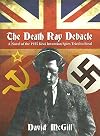
THE DEATH RAY DEBACLE is fiction built around unexpected facts from the period leading up to World War II. New Zealand inventor Victor Penny ran a bus company by day and at night he worked on producing a death ray. His government sanctioned, amateur scientific pursuits did indeed lead to an electric bolt system powerful enough to implode a matchbox, and they certainly created enough interest to make him a target of German spies.
Even though it appears that Penny remains pretty well unknown show more in New Zealand, let alone the rest of the world, his enthusiasm for invention led him to produce a prototype laser, an electric gyro compass for use in submarines, and an early version of a parabolic microphone, used by Radio New Zealand in the end. In a further interesting twist, the British Government used Penny's research materials when developing the radar systems used with great success once the war was underway.
New Zealand Historian, David McGill uses a young detective to tell the story of Penny, his inventions, the Auckland German Club, and an unexpected theatrical connection. Starting out with the attempted theft of the research and the assault of Penny right through to Penny's government induced moves to Wellington firstly and then onto Somes Island for his own safety, as well as the protection of the death-ray project.
The German Auckland Club were already well known for the spying activities, tracking down Germans for conscription into the military and compiling lists of Jews so when the story of their interest in Penny emerges, the British Government weigh in also, sending their own investigating officer, ensuring Penny's movement and a small military guard on the supposedly secure island government facility.
McGill's writing shines where he is building a sense of place, and time in which THE DEATH RAY DEBACLE is set. Not just in the physicality of the locations, but in the workings of a society on the brink of war, with the complications of expectations, suspicions, and loyalty versus long-term residency. It's particularly strong on the minutia of life in that period as well - the food, the clothes, the behaviour of people and the feel of places that they occupy really come to life.
Bogged down occasionally by the sheer amount of detail, the balance between thriller and historical retelling does get a little wobbly at points, although overall pace and action hang in there. To be fair not a surprising outcome given how absolutely fascinating the story of Penny and the Death-Ray are.
It's hard to come away from THE DEATH RAY DEBACLE without thinking you've learned an awful lot about something previously completely unknown, oh and there was something in there about spies as well. Which should not be taken as a suggestion that the book isn't a fabulous read. Overall THE DEATH RAY DEBACLE was quite a journey.
https://www.austcrimefiction.org/review/review-death-ray-debacle-david-mcgill show less
Even though it appears that Penny remains pretty well unknown show more in New Zealand, let alone the rest of the world, his enthusiasm for invention led him to produce a prototype laser, an electric gyro compass for use in submarines, and an early version of a parabolic microphone, used by Radio New Zealand in the end. In a further interesting twist, the British Government used Penny's research materials when developing the radar systems used with great success once the war was underway.
New Zealand Historian, David McGill uses a young detective to tell the story of Penny, his inventions, the Auckland German Club, and an unexpected theatrical connection. Starting out with the attempted theft of the research and the assault of Penny right through to Penny's government induced moves to Wellington firstly and then onto Somes Island for his own safety, as well as the protection of the death-ray project.
The German Auckland Club were already well known for the spying activities, tracking down Germans for conscription into the military and compiling lists of Jews so when the story of their interest in Penny emerges, the British Government weigh in also, sending their own investigating officer, ensuring Penny's movement and a small military guard on the supposedly secure island government facility.
McGill's writing shines where he is building a sense of place, and time in which THE DEATH RAY DEBACLE is set. Not just in the physicality of the locations, but in the workings of a society on the brink of war, with the complications of expectations, suspicions, and loyalty versus long-term residency. It's particularly strong on the minutia of life in that period as well - the food, the clothes, the behaviour of people and the feel of places that they occupy really come to life.
Bogged down occasionally by the sheer amount of detail, the balance between thriller and historical retelling does get a little wobbly at points, although overall pace and action hang in there. To be fair not a surprising outcome given how absolutely fascinating the story of Penny and the Death-Ray are.
It's hard to come away from THE DEATH RAY DEBACLE without thinking you've learned an awful lot about something previously completely unknown, oh and there was something in there about spies as well. Which should not be taken as a suggestion that the book isn't a fabulous read. Overall THE DEATH RAY DEBACLE was quite a journey.
https://www.austcrimefiction.org/review/review-death-ray-debacle-david-mcgill show less

This is now the second book by NZ author David McGill that I've read, both of which share a central detecting character, and a style being a combination of true history and crime fiction. The first novel, THE DEATH RAY DEBACLE was set in 1935, and this one, THE PLOT TO KILL PETER FRASER, is in the period around the end of World War II and, interestingly, in the early days of the development of the United Nations. Peter Fraser was the 24th Prime Minister of New Zealand, serving in that role show more from March 1940 until December 1949. A Labour Party member, he was renowned for leading New Zealand during the Second World War. Originally born in Scotland, he moved to New Zealand at the age of 26 seemingly because of its progressive spirit. After the end of the war he turned his attentions to the formation of the United Nations and gained considerable international acclaim for his efforts and his contribution.
From this central theme, the novel, THE PLOT TO KILL PETER FRASER, rises. His making of local enemies and the existence of a plot to kill him by would-be Nazi assassins, appears to be fictional, although, it's so cleverly inserted into the facts about the ex-Prime Minister it's hard to know for sure without doing the research. As with the earlier novel mentioned above, the historical setting and the interweaving of fact and fiction is seamless and absolutely fascinating.
Dan Delaney has returned from the first novel as well. In the first he was a Temporary Acting Detective, seconded to Special Branch, the forerunner of the Security Intelligence Service. Here he's seeking a quiet life with his refugee bride, until he, and his wife, are dragged into active service by his old boss, and things start to get very complicated. Nazi assassins, British and Soviet spies, American undercover operations, Cabaret, Italian Fishing village, yachting havens, and black-market complicated.
The strong part of this novel is undoubtedly the historical setting. It's a clever idea to incorporate such an important figure at the centre of a novel like this and create a feasible plot around him and his profile. What works less well is the ancillary love interests which are supported by some seriously heavy lifting to force plot twists and turns that don't come across as particularly convincing. All in all THE PLOT TO KILL PETER FRASER was an interesting history lesson that isn't quite as well served by the thriller components as it could have been.
https://www.austcrimefiction.org/review/plot-kill-peter-fraser-david-mcgill show less
From this central theme, the novel, THE PLOT TO KILL PETER FRASER, rises. His making of local enemies and the existence of a plot to kill him by would-be Nazi assassins, appears to be fictional, although, it's so cleverly inserted into the facts about the ex-Prime Minister it's hard to know for sure without doing the research. As with the earlier novel mentioned above, the historical setting and the interweaving of fact and fiction is seamless and absolutely fascinating.
Dan Delaney has returned from the first novel as well. In the first he was a Temporary Acting Detective, seconded to Special Branch, the forerunner of the Security Intelligence Service. Here he's seeking a quiet life with his refugee bride, until he, and his wife, are dragged into active service by his old boss, and things start to get very complicated. Nazi assassins, British and Soviet spies, American undercover operations, Cabaret, Italian Fishing village, yachting havens, and black-market complicated.
The strong part of this novel is undoubtedly the historical setting. It's a clever idea to incorporate such an important figure at the centre of a novel like this and create a feasible plot around him and his profile. What works less well is the ancillary love interests which are supported by some seriously heavy lifting to force plot twists and turns that don't come across as particularly convincing. All in all THE PLOT TO KILL PETER FRASER was an interesting history lesson that isn't quite as well served by the thriller components as it could have been.
https://www.austcrimefiction.org/review/plot-kill-peter-fraser-david-mcgill show less
You May Also Like
Associated Authors
Statistics
- Works
- 34
- Members
- 180
- Popularity
- #119,864
- Rating
- 3.0
- Reviews
- 3
- ISBNs
- 60