
Jennifer Jordan (2)
Author of Savage Summit: The Life and Death of the First Women of K2
For other authors named Jennifer Jordan, see the disambiguation page.
Works by Jennifer Jordan
Tagged
Common Knowledge
- Birthdate
- 20th Century
- Gender
- female
- Occupations
- author
screenwriter
filmmaker - Nationality
- USA
- Associated Place (for map)
- USA
Members
Reviews
Savage Summit: The True Stories of the First Five Women Who Climbed K2, the World's Most Feared Mountain by Jennifer Jordan
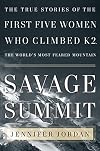
I'm a little obsessed with reading about alpine mountain climbing in the sense that I have yet to read a book about it that I haven't found fascinating. This one was no exception, but I will say I was on the fence a bit about the writing itself.
The book tells the detailed life stories of five women who reached the summit of K2, something only achieved by 18 women as late as 2014. All five perished while pursuing their dreams of climbing. Their backgrounds are fascinating . . .as you might show more imagine, these women were not traditionalists and to some extent, they put their families second to their passion for the sport.
The author creates essentially mini biographies of each woman from young childhood to death, and I found each of them fascinating to read. However, unlike my favorite [b:Into Thin Air: A Personal Account of the Mount Everest Disaster|1898|Into Thin Air A Personal Account of the Mount Everest Disaster|Jon Krakauer|https://i.gr-assets.com/images/S/compressed.photo.goodreads.com/books/1463384482l/1898._SX50_.jpg|1816662], I didn't have the suspenseful feelings as if I were on the mountain with these women. The way she writes about mountain climbing itself seemed much more arms length. There's nothing wrong with that per se, but it made for a flatter read without as much emotional impact.
Also, this book really focused on the gender issues with climbing, and even though there were many men who helped these women achieve their goals, somehow the book left you with the feeling that sexism was a tremendous barrier, and every man was in constant sexual pursuit. And maybe that's how it was, but for some reason it seemed as though aspects of the stories might have been exaggerated to make the themes of the book seem more important somehow.
At any rate, I still would recommend it to those who enjoy books about risk takers, but not necessarily to those looking for say, a gripping survival tale. show less
The book tells the detailed life stories of five women who reached the summit of K2, something only achieved by 18 women as late as 2014. All five perished while pursuing their dreams of climbing. Their backgrounds are fascinating . . .as you might show more imagine, these women were not traditionalists and to some extent, they put their families second to their passion for the sport.
The author creates essentially mini biographies of each woman from young childhood to death, and I found each of them fascinating to read. However, unlike my favorite [b:Into Thin Air: A Personal Account of the Mount Everest Disaster|1898|Into Thin Air A Personal Account of the Mount Everest Disaster|Jon Krakauer|https://i.gr-assets.com/images/S/compressed.photo.goodreads.com/books/1463384482l/1898._SX50_.jpg|1816662], I didn't have the suspenseful feelings as if I were on the mountain with these women. The way she writes about mountain climbing itself seemed much more arms length. There's nothing wrong with that per se, but it made for a flatter read without as much emotional impact.
Also, this book really focused on the gender issues with climbing, and even though there were many men who helped these women achieve their goals, somehow the book left you with the feeling that sexism was a tremendous barrier, and every man was in constant sexual pursuit. And maybe that's how it was, but for some reason it seemed as though aspects of the stories might have been exaggerated to make the themes of the book seem more important somehow.
At any rate, I still would recommend it to those who enjoy books about risk takers, but not necessarily to those looking for say, a gripping survival tale. show less
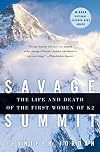
This is a very interesting book, both about the K2 and also the background/profile of the few women who climbed.
Perhaps a lot people do not know that being the second tallest mountain in the world, K2 is a much harder climb than Everest and contrarily to it, here alpine style is the rule.
To be honest I found the book a bit depressive and sad and it put me a bit off of ice climbing for the foreseen future; I'm sure there must be something interesting and fascinating about climbing K2 (and big show more ice mountains in general)...? if there is, I did not see it in this book; I only saw lots of masochistic pain and suffering all the way...
Very easy read, though (don't read it, if you re into 8000 meters mountains!) show less
Perhaps a lot people do not know that being the second tallest mountain in the world, K2 is a much harder climb than Everest and contrarily to it, here alpine style is the rule.
To be honest I found the book a bit depressive and sad and it put me a bit off of ice climbing for the foreseen future; I'm sure there must be something interesting and fascinating about climbing K2 (and big show more ice mountains in general)...? if there is, I did not see it in this book; I only saw lots of masochistic pain and suffering all the way...
Very easy read, though (don't read it, if you re into 8000 meters mountains!) show less
Savage Summit: The True Stories of the First Five Women Who Climbed K2, the World's Most Feared Mountain by Jennifer Jordan
While I was very excited to read about the women to climb K2, I just couldn't finish this book because I couldn't take any more of Jennifer Jordan's writing. I'm as feminist as the next girl, but her overarching theme that mountaineers are all sexist and offended by the very thought of women climbers is a bit much.
For example, I've read several books about the 1975 American expedition of K2... and all agree the expedition was a disaster because of the strained relationships between all of show more the climbers (all of whom wanted to be on the summit "A" team and refused to do any carrying for anything else if they were on the "B" team.) Was Dianne Roberts a point of contention on that expedition? Absolutely. Was she the reason is fell apart? Absolutely not... those climbers had problems with nearly everyone, including the men. They were angry because the expedition leader, Dianne's husband, was picking members of the "A" team and had family relationships with two crew members.
And the 1978 expedition had problems with Cherie Bech not because she was female, but because she was having an affair with another climber while her husband was also on the expedition. While her husband was okay with this situation, the other climbers felt uncomfortable watching her share a tent with another man... wouldn't you be find this uncomfortable? It's telling that the men were also uncomfortable with the male expedition member involved in this whole situation too, not just Cherie.
Jordan's zeal to point out every instance of possible sexism amongst climbers got so irritating, that I ended up putting the book aside early on. I would have enjoyed reading about these female climbers if the book was written by an author with less of an agenda. show less
For example, I've read several books about the 1975 American expedition of K2... and all agree the expedition was a disaster because of the strained relationships between all of show more the climbers (all of whom wanted to be on the summit "A" team and refused to do any carrying for anything else if they were on the "B" team.) Was Dianne Roberts a point of contention on that expedition? Absolutely. Was she the reason is fell apart? Absolutely not... those climbers had problems with nearly everyone, including the men. They were angry because the expedition leader, Dianne's husband, was picking members of the "A" team and had family relationships with two crew members.
And the 1978 expedition had problems with Cherie Bech not because she was female, but because she was having an affair with another climber while her husband was also on the expedition. While her husband was okay with this situation, the other climbers felt uncomfortable watching her share a tent with another man... wouldn't you be find this uncomfortable? It's telling that the men were also uncomfortable with the male expedition member involved in this whole situation too, not just Cherie.
Jordan's zeal to point out every instance of possible sexism amongst climbers got so irritating, that I ended up putting the book aside early on. I would have enjoyed reading about these female climbers if the book was written by an author with less of an agenda. show less
This is an interesting, and sadly rare, book about the women who climb mountains, in this case the first five women to stand on the summit of K2. Although not the deadliest mountain to climb, that honour is held by Annapurna, this is a much harder mountain to scale than Everest and for every four people who reach the summit, once dies on the descent and of the first five women to scale the mountain three died on the way down, leading to an accusation of a Ks having a curse on women - this show more curse has now been broken as since completion of the book five women have successfully summated and descended from the mountain, although not without personal cost.
What is interesting about this book is how different in personality and approach the five women were - two were married with children and their husbands stayed home to care for the children whilst their wives climbed (its interesting to note that these were the two British women, Alison Hargreaves and Julie Tulles), one, Liliane Barrard climbed, and perished, alongside her husband. Hargreaves was posthumously demonised for abandoning her children, but from the book I sense that both spiritually and financially she had little choice.
All the women were suffered at the hands of other, male, climbers, Rutkiewicz was demonised for her seemingly selfish determination, Barrard seems to have lived, willingly, in her husband's shadow, Tullis and Mauduit were sexually harassed and all seem to have suffered allegations from other, male, mountaineers, that they hadn't actually summited mountains that they had climbed.
This is an interesting read which balances out the testosterone fuelled world of mountaineering books. show less
What is interesting about this book is how different in personality and approach the five women were - two were married with children and their husbands stayed home to care for the children whilst their wives climbed (its interesting to note that these were the two British women, Alison Hargreaves and Julie Tulles), one, Liliane Barrard climbed, and perished, alongside her husband. Hargreaves was posthumously demonised for abandoning her children, but from the book I sense that both spiritually and financially she had little choice.
All the women were suffered at the hands of other, male, climbers, Rutkiewicz was demonised for her seemingly selfish determination, Barrard seems to have lived, willingly, in her husband's shadow, Tullis and Mauduit were sexually harassed and all seem to have suffered allegations from other, male, mountaineers, that they hadn't actually summited mountains that they had climbed.
This is an interesting read which balances out the testosterone fuelled world of mountaineering books. show less
Lists
Awards

You May Also Like


Statistics
- Works
- 2
- Members
- 253
- Popularity
- #90,474
- Rating
- 3.7
- Reviews
- 8
- ISBNs
- 50
- Languages
- 4