

Robert Williams (6) (1977–)
Author of Luke and Jon
For other authors named Robert Williams, see the disambiguation page.
Works by Robert Williams
Tagged
Common Knowledge
Members
Reviews
On the 11th April, at 4.27pm, thirteen-year-old Luke’s mother is killed in a car crash and his life changes in an instant. Immersed in grief and a whisky bottle, his now near-silent father stops paying the household bills and, by the early summer, their home has been re-possessed. After all the debts have been paid, the only house they can afford is a remote, neglected cottage on a fellside above a scruffy northern town; it is here, away from everything familiar, that they must try to show more create a future for themselves.
Soon after moving in Luke meets Jon, a boy of the same age who lives close by, in an even more ramshackle house, with his frail, elderly grandparents. Wearing clothes more suited to the 1950s, with a side-parting in his hair and an almost obsessional habit of amassing facts and figures, Jon appears quite eccentric but, both outsiders, the two boys soon strike up a friendship. Luke becomes aware that Jon is keeping a secret and, when he discovers what it is, their friendship becomes pivotal in changing their lives.
I found this a beautifully written and very moving story about bereavement, mourning, the power of family and friendship, bullying and the struggles faced by characters who are trying to rebuild lives shattered by loss. The author’s acute observations of the many, and changing, faces of grief felt entirely credible and I soon found myself drawn into the lives of the characters as they each found ways to deal with their feelings of pain and grief. I liked the fact that rather than dividing the story into formal chapters, the author used frequent headings (sometimes a couple per page, sometimes one every two or three pages) to move the story forward in a convincing fashion. As the story is told in Luke’s voice, the narrative was given an immediacy which effectively captured not only his emotional journey, but also those of his father and of Jon. I loved the fact that each of the characters found a different way of dealing with his demons: Luke through his paintings, his father through sculpting with wood and Jon through immersing himself in books. I think that the author effectively showed how these activities were used, initially as defences and, ultimately, as ways of being able to move forward.
There is absolutely nothing sentimental about this story; the pain described is raw and powerful but the holding out of hope, and the restorative nature of love are evoked in an equally powerful way. The writing is made more effective by the fact that it is so restrained, with barely a word feeling unnecessary. This was marketed as a novel for young adults, but its psychological integrity means that it is a story which will appeal to a much wider readership – it’s a remarkable debut novel. show less
Soon after moving in Luke meets Jon, a boy of the same age who lives close by, in an even more ramshackle house, with his frail, elderly grandparents. Wearing clothes more suited to the 1950s, with a side-parting in his hair and an almost obsessional habit of amassing facts and figures, Jon appears quite eccentric but, both outsiders, the two boys soon strike up a friendship. Luke becomes aware that Jon is keeping a secret and, when he discovers what it is, their friendship becomes pivotal in changing their lives.
I found this a beautifully written and very moving story about bereavement, mourning, the power of family and friendship, bullying and the struggles faced by characters who are trying to rebuild lives shattered by loss. The author’s acute observations of the many, and changing, faces of grief felt entirely credible and I soon found myself drawn into the lives of the characters as they each found ways to deal with their feelings of pain and grief. I liked the fact that rather than dividing the story into formal chapters, the author used frequent headings (sometimes a couple per page, sometimes one every two or three pages) to move the story forward in a convincing fashion. As the story is told in Luke’s voice, the narrative was given an immediacy which effectively captured not only his emotional journey, but also those of his father and of Jon. I loved the fact that each of the characters found a different way of dealing with his demons: Luke through his paintings, his father through sculpting with wood and Jon through immersing himself in books. I think that the author effectively showed how these activities were used, initially as defences and, ultimately, as ways of being able to move forward.
There is absolutely nothing sentimental about this story; the pain described is raw and powerful but the holding out of hope, and the restorative nature of love are evoked in an equally powerful way. The writing is made more effective by the fact that it is so restrained, with barely a word feeling unnecessary. This was marketed as a novel for young adults, but its psychological integrity means that it is a story which will appeal to a much wider readership – it’s a remarkable debut novel. show less
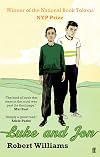
The bland image of the two teenaged boys standing, one behind the other, on a craggy stretch of uninhabitable-looking land was not especially appealing as a cover. (This was particularly true as my advance edition of the novel held this image in various shades of grey!) The title was dull and hinted at little except the significance of this central relationship between the two boys, and the blurb could have sent me to sleep. ‘Luke’s mum is dead…Then he meets Jon. Jon is show more strange…[eventually] both their lives are changed for good.’ *yawn* In summary, I don’t think the book was packaged particularly well, which is a shame, because it actually is quite an appealing story. Of course, it is also a very simple story – there are no complex subplots here, just a steady movement towards resolution of a kind – and the packaging does adequately reflect that, so I really shouldn’t criticise overly much. Really, the novel inside does what it says on the tin.
Besides, judging from the writer’s website, the cover is now in colour and the blurb tweaked to make it more engaging, although it has also been minimised to allow room for rather too many other writers and critics singing their praises of the book. Do the publishers not trust the prose to sell itself? I actually think that it would, but suspect that I wouldn’t bother to read the opening pages in a bookshop as the whole offering looks rather too worthy. However, I would suggest that potential readers shouldn’t be put off: this is a first offering by new author Robert Williams and it’s really rather good, in a quiet way.
What actually happens?
After the death of his mum, Luke and his dad move to a random, quiet community and buy a falling down house. There is a sound practical reason for this: it’s all they can afford. Luke is not bothered because it’s not really home without his mum in it anyway, and his dad isn’t bothered because he’s discovered the temporary healing powers of whisky. Luke is bothered about that but doesn’t know what to say.
The tension and pain in the small family quickly gather your sympathy, but the pain is not mawkish or overly sentimental. There are no long, meaningful talks or incredibly significant memories that recur again and again. Instead, the reader is faced with the silence between father and son as Luke quietly explains to us what his mum was like. Gradually, we learn that life was never exactly simple, and a question begins to develop over the exact nature of her death.
Meanwhile, a knowledgeable local teen, Jon, begins to visit in the mornings and spend time with Luke and his dad. Although Luke appreciates that his new friend is odd – he dresses in clothes from the 1950s – it is not until he starts his new school in September that he begins to learn anything about Jon’s life. Jon is bullied, badly, but he has a sadder secret that is only gradually revealed. When it is, Luke and his dad are given a chance to begin again. Can they take it?
How is the story told?
Although Jon’s life seems very sad, his determination reinforces the strength of the human spirit and he is part of a vision that emphasises our ability to survive the cruelties of existence, if we can only support and care for each other. It sounds terribly trite, but the way Williams creates this vision is anything but. Approaching the themes of loss and grief through the eyes of a fairly introverted teenage boy allows the author to create a quietly compelling tale.
I thought that choosing a first person narrator worked well. Luke’s impressions capture the world around him perfectly, creating a sense of his experience through the details that stuck. Luke’s simple honesty is what makes this tale so appealing and initially so heartbreaking. When he tries to go back to school after his mum’s death, his teacher drives him home and tells him to only come back when he felt better. Luke says, ‘It seemed unlikely that I would ever feel better so I went back the next day.’ His quiet grief is powerfully encapsulated within such simple statements. Luke’s first person narration also gives us a keen insight into how his dad is coping, which is badly. Matter of factly, Luke tells us that his dad had never been good with the ‘day-to-day stuff’ and that ‘He wasn’t going to start now’. This acceptance of his dad’s limitations helps to show Luke’s own maturity and strength, which makes him an appealing central character.
Unlike many younger first person narrators, there is no attempt to write ‘as a teenage boy might speak’. I think this was a good choice as it allowed Williams to adopt a simple, yet almost poetic, mode of writing which suits the story very well. (I’m not convinced that the narrator describing his feelings as ‘well awful’, for example, would have helped me to appreciate his grief!) It does make Luke feel slightly wiser than his years at points, but this is realistic as the death of a parent can have that effect, especially if you feel that the remaining parent is not quite staying on the rails. I found his character convincing and that I could empathise with him, which increased my interest in the story.
In some respects, the novel feels rather ‘old’. Its preoccupations – family, the redemptive power of art and friendship – feel as if they belong to an earlier generation of writers. This is not intended as a criticism. Although the book touches on darkness, the way it is told is somehow light and airy; it is not a book that will make you cry. After reading, the book that came to mind as a comparison was Michelle Magorian’s ‘Goodnight Mister Tom’, although in some respects that is a darker novel, dealing as it does with child abuse as well as death. However, I felt that there were similar concerns and a similar sense of redemption through connections to others, so if you read and enjoyed that (as I did) I think you’re also likely to enjoy this.
Structure
There are no chapters in the book, but it is divided loosely into sections as a new heading is introduced every other or every couple of pages. Initially I found this disconcerting (I like to have a definite stopping place and chapters certainly facilitate that) but I did grow used to it, and it helped create the sense that this was a young boy telling me his story, as he recalled it, in small ‘chunks’, rather than carefully honed chapters. (Although as I said above, the actual style is rather mature.)
The narrative follows four main threads: the growing friendship between Luke and Jon; the uncovering of Jon’s secret and its consequences; the official mystery surrounding Luke’s mum’s death; and the development of Luke’s dad’s greatest piece of art yet. These four storylines are closely interwoven and all develop at a nice pace. There are no sudden, shocking disclosures. Everything that happens is gently hinted at before it is revealed. I liked this style of writing because it felt realistic and honest. It also allowed me time to anticipate what would happen, so the interest in the book lay in following the characters’ development, rather than in the plot developments (though obviously the two are closely related). Even the official ‘mystery’ surrounding the cause of Luke’s mum’s death is really not a mystery and more of an opportunity for Luke and his dad to actually talk about his mum and begin to address the hole she has left behind. I felt that this was engaging to read about, and actually more appealing than a genuine ‘what-happened’ mystery would have been.
Conclusions
At only 177 pages, this is a brief read, but I found that it was compelling in an understated way. I read most of it in one night! The characters are realistic and damaged in a way that encourages you to empathise rather than simply pity them. The focus of the story is on their developing relationships and the process of dealing with grief, rather than on dramatic plot developments (although there is plenty of ‘story’ to enjoy). The writing style is clear and organised, allowing the reader to follow it easily. I enjoyed reading this quiet novel and I’ll be looking out for Robert Williams’ next book. Recommended. show less
Besides, judging from the writer’s website, the cover is now in colour and the blurb tweaked to make it more engaging, although it has also been minimised to allow room for rather too many other writers and critics singing their praises of the book. Do the publishers not trust the prose to sell itself? I actually think that it would, but suspect that I wouldn’t bother to read the opening pages in a bookshop as the whole offering looks rather too worthy. However, I would suggest that potential readers shouldn’t be put off: this is a first offering by new author Robert Williams and it’s really rather good, in a quiet way.
What actually happens?
After the death of his mum, Luke and his dad move to a random, quiet community and buy a falling down house. There is a sound practical reason for this: it’s all they can afford. Luke is not bothered because it’s not really home without his mum in it anyway, and his dad isn’t bothered because he’s discovered the temporary healing powers of whisky. Luke is bothered about that but doesn’t know what to say.
The tension and pain in the small family quickly gather your sympathy, but the pain is not mawkish or overly sentimental. There are no long, meaningful talks or incredibly significant memories that recur again and again. Instead, the reader is faced with the silence between father and son as Luke quietly explains to us what his mum was like. Gradually, we learn that life was never exactly simple, and a question begins to develop over the exact nature of her death.
Meanwhile, a knowledgeable local teen, Jon, begins to visit in the mornings and spend time with Luke and his dad. Although Luke appreciates that his new friend is odd – he dresses in clothes from the 1950s – it is not until he starts his new school in September that he begins to learn anything about Jon’s life. Jon is bullied, badly, but he has a sadder secret that is only gradually revealed. When it is, Luke and his dad are given a chance to begin again. Can they take it?
How is the story told?
Although Jon’s life seems very sad, his determination reinforces the strength of the human spirit and he is part of a vision that emphasises our ability to survive the cruelties of existence, if we can only support and care for each other. It sounds terribly trite, but the way Williams creates this vision is anything but. Approaching the themes of loss and grief through the eyes of a fairly introverted teenage boy allows the author to create a quietly compelling tale.
I thought that choosing a first person narrator worked well. Luke’s impressions capture the world around him perfectly, creating a sense of his experience through the details that stuck. Luke’s simple honesty is what makes this tale so appealing and initially so heartbreaking. When he tries to go back to school after his mum’s death, his teacher drives him home and tells him to only come back when he felt better. Luke says, ‘It seemed unlikely that I would ever feel better so I went back the next day.’ His quiet grief is powerfully encapsulated within such simple statements. Luke’s first person narration also gives us a keen insight into how his dad is coping, which is badly. Matter of factly, Luke tells us that his dad had never been good with the ‘day-to-day stuff’ and that ‘He wasn’t going to start now’. This acceptance of his dad’s limitations helps to show Luke’s own maturity and strength, which makes him an appealing central character.
Unlike many younger first person narrators, there is no attempt to write ‘as a teenage boy might speak’. I think this was a good choice as it allowed Williams to adopt a simple, yet almost poetic, mode of writing which suits the story very well. (I’m not convinced that the narrator describing his feelings as ‘well awful’, for example, would have helped me to appreciate his grief!) It does make Luke feel slightly wiser than his years at points, but this is realistic as the death of a parent can have that effect, especially if you feel that the remaining parent is not quite staying on the rails. I found his character convincing and that I could empathise with him, which increased my interest in the story.
In some respects, the novel feels rather ‘old’. Its preoccupations – family, the redemptive power of art and friendship – feel as if they belong to an earlier generation of writers. This is not intended as a criticism. Although the book touches on darkness, the way it is told is somehow light and airy; it is not a book that will make you cry. After reading, the book that came to mind as a comparison was Michelle Magorian’s ‘Goodnight Mister Tom’, although in some respects that is a darker novel, dealing as it does with child abuse as well as death. However, I felt that there were similar concerns and a similar sense of redemption through connections to others, so if you read and enjoyed that (as I did) I think you’re also likely to enjoy this.
Structure
There are no chapters in the book, but it is divided loosely into sections as a new heading is introduced every other or every couple of pages. Initially I found this disconcerting (I like to have a definite stopping place and chapters certainly facilitate that) but I did grow used to it, and it helped create the sense that this was a young boy telling me his story, as he recalled it, in small ‘chunks’, rather than carefully honed chapters. (Although as I said above, the actual style is rather mature.)
The narrative follows four main threads: the growing friendship between Luke and Jon; the uncovering of Jon’s secret and its consequences; the official mystery surrounding Luke’s mum’s death; and the development of Luke’s dad’s greatest piece of art yet. These four storylines are closely interwoven and all develop at a nice pace. There are no sudden, shocking disclosures. Everything that happens is gently hinted at before it is revealed. I liked this style of writing because it felt realistic and honest. It also allowed me time to anticipate what would happen, so the interest in the book lay in following the characters’ development, rather than in the plot developments (though obviously the two are closely related). Even the official ‘mystery’ surrounding the cause of Luke’s mum’s death is really not a mystery and more of an opportunity for Luke and his dad to actually talk about his mum and begin to address the hole she has left behind. I felt that this was engaging to read about, and actually more appealing than a genuine ‘what-happened’ mystery would have been.
Conclusions
At only 177 pages, this is a brief read, but I found that it was compelling in an understated way. I read most of it in one night! The characters are realistic and damaged in a way that encourages you to empathise rather than simply pity them. The focus of the story is on their developing relationships and the process of dealing with grief, rather than on dramatic plot developments (although there is plenty of ‘story’ to enjoy). The writing style is clear and organised, allowing the reader to follow it easily. I enjoyed reading this quiet novel and I’ll be looking out for Robert Williams’ next book. Recommended. show less
 This review was written for LibraryThing Early Reviewers.
Luke and Jon tells the story of a teenage boy and his father coming to terms with the death of his mother. They find that their intended escape into a solitary existence in the rural north finally evolves into a new, more meaningful life together, as Luke's quiet compassion for the strange boy, Jon, who lives near them on the fell, begins to pull father and son away from their grief.
It's Williams' retelling of their grief which makes this story very real and touching. There are no floods of show more tears or fierce keening; Luke and his father simply become quietly detached from the world around them. The worry with this kind of novel is that the redemption of the main characters becomes too saccharin sweet, but Williams' writing does not succumb to this and the book has a great air of honesty from start to finish. show less
It's Williams' retelling of their grief which makes this story very real and touching. There are no floods of show more tears or fierce keening; Luke and his father simply become quietly detached from the world around them. The worry with this kind of novel is that the redemption of the main characters becomes too saccharin sweet, but Williams' writing does not succumb to this and the book has a great air of honesty from start to finish. show less
This review was written for LibraryThing Early Reviewers."Luke & Jon" is the story of Luke, a teenager trying to cope after the death of his mother and the friendship he forms with Jon, who, in his own way, is also troubled.
Given its subject matter this book could have felt mawkish or tired, but instead it was subtle and moving - something achieved by its honesty and humanity. Despite the relatively small scale of its narrative it was a compelling read brightened by believable characters and a quiet humour.
Williams has a gift for language and show more description, especially of place. His similes particularly are to be savoured, such as the unsettled narrator describing himself as feeling 'like a licked finger in a cold wind'.
The book is particularly impressive for being a first novel and it is written with assurance and style. It will definitely stay with me, from its striking opening to its witty final line. show less
Given its subject matter this book could have felt mawkish or tired, but instead it was subtle and moving - something achieved by its honesty and humanity. Despite the relatively small scale of its narrative it was a compelling read brightened by believable characters and a quiet humour.
Williams has a gift for language and show more description, especially of place. His similes particularly are to be savoured, such as the unsettled narrator describing himself as feeling 'like a licked finger in a cold wind'.
The book is particularly impressive for being a first novel and it is written with assurance and style. It will definitely stay with me, from its striking opening to its witty final line. show less
This review was written for LibraryThing Early Reviewers.Lists
Awards


Statistics
- Works
- 3
- Members
- 136
- Popularity
- #149,925
- Rating
- 3.7
- Reviews
- 16
- ISBNs
- 140
- Languages
- 7
