
Charles Petzold
Author of Code: The Hidden Language of Computer Hardware and Software
About the Author
Charles Petzold has been programming for Windows since obtaining a beta Windows 1.0 SDK in the spring of 1985
Image credit: Photo by Paul Hester
Works by Charles Petzold
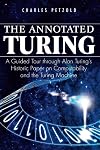
The Annotated Turing: A Guided Tour Through Alan Turing's Historic Paper on Computability and the Turing Machine (2008) 553 copies, 5 reviews
Applications = Code + Markup: A Guide to the Microsoft Windows Presentation Foundation (2006) 77 copies, 1 review
Programming the Os/2 Presentation Manager: The Microsoft Guide to Writing Applications for Os/2 Graphical Windowing Envi (1989) 4 copies
.NET Book Zero - What the C or C++ Programmer Needs to Know about C# and the .NET Framework 2 copies
Computer of the Tides 1 copy
Tagged
Common Knowledge
- Birthdate
- 1953-02-02
- Gender
- male
- Education
- Stevens Institute of Technology (BSc|Mathematics)
Stevens Institute of Technology (MSc|Mathematics) - Nationality
- USA
- Birthplace
- New Brunswick, New Jersey, USA
- Associated Place (for map)
- New Jersey, USA
Members
Reviews
The Annotated Turing: A Guided Tour Through Alan Turing's Historic Paper on Computability and the Turing Machine by Charles Petzold
I found this book to be the most enjoyable way to read a scientific paper ever. The way the book is structured is just excellent: Historical context provided but optional, scary maths not simplified but explained and also optional. On top of that, the writing is very accessible and nice to read.
The only problem I had in reading this was not so much to do with Petzold (or Turing) but with the logical syntax and the way it is presented. There is such a sheer amount of symbols in this paper show more that even to someone used to the syntax, the formulas towards the end of the paper become borderline unreadable without a legend. The finishing touch to this book would be to provide some sort of system that would make this more "reading-material" than "study-material".
Nevertheless, this was an exellent book and I think this kind of text is how fundamental research should be presented much more often. show less
The only problem I had in reading this was not so much to do with Petzold (or Turing) but with the logical syntax and the way it is presented. There is such a sheer amount of symbols in this paper show more that even to someone used to the syntax, the formulas towards the end of the paper become borderline unreadable without a legend. The finishing touch to this book would be to provide some sort of system that would make this more "reading-material" than "study-material".
Nevertheless, this was an exellent book and I think this kind of text is how fundamental research should be presented much more often. show less
The Annotated Turing: A Guided Tour Through Alan Turing's Historic Paper on Computability and the Turing Machine by Charles Petzold
I have admired and read about Alan Turings work for a long time, but never did any work of fiction or non-fiction get me this close to the actual genius of the man. Where his work on the "Turing test" lends itself to simplification and amateur philosophy, this older work on "Computable Numbers" is much harder to grasp and shows much more clearly how Turing saw the wealth of applications of automatic computing that lay ahead. And it also show how far away that future still was.
Enters Petzold. show more The man whose super-powers lie in explaining something really difficult to normal, intelligent people. I do not think anyone else could have done this for me: taking me by the hand and step-by-step gently introducing all of the concepts up to the point where you actually, completely and to the bootom understand the subject. He did it in Code, and het did it again for me in The Annotated Turing. Loved it. show less
Enters Petzold. show more The man whose super-powers lie in explaining something really difficult to normal, intelligent people. I do not think anyone else could have done this for me: taking me by the hand and step-by-step gently introducing all of the concepts up to the point where you actually, completely and to the bootom understand the subject. He did it in Code, and het did it again for me in The Annotated Turing. Loved it. show less
The Annotated Turing: A Guided Tour Through Alan Turing's Historic Paper on Computability and the Turing Machine by Charles Petzold
I don't consider myself dumb, but Turing's paper is something that I would never have adequately grasped without the help of an author much more dedicated than me. I found the annotations essential for understanding and for forming the connections to the history and mathematical theory that makes Turing's paper tick. I loved this book, its originality, and it's mind-broadening ability. The connection of Turing's conclusion to the diagonal argument is something I hadn't appreciated until show more reading this book -- brilliant. show less

I am always interested in learning new ways to teach my students the fundamentals of digital logic, not to mention I also teach a follow-up class on microcontrollers, and sometimes teaching students how they go from the digital logic they learned last semester to something that computes can be challenging. So I'll always happily grab a book aimed for laypeople to see if I can grab a few nuggets from it.
There were things I liked about this book, and things I didn't like about this book. I show more enjoyed the chapters on different types of code (Morse and Braille really), and, although dated, I did appreciate the discussion on microprocessors, (4004 and 8080, 68000), etc. Some discussions of memory I thought were good (although I teach and work with Harvard architecture microcontrollers).
I skipped over the chapters about flip-flops (which, non-clocked, are actually latches, which the author took a couple chapters to state in the book) and computing hardware as that's all review for me. I agree with other commenters in that learning about every single opCode of a non-RISC-architecture microprocessor was just way too much, so I skimmed that part.
Personally, if I were going to write a book like this, I probably would have used a RISC-architecture instruction set to explain assembly. I only know RISC-type instructions, being that I do not program or write assembly for computers, only 8-bit micocontrollers, and reading a thousand different memory addressing mode instructions for AND just made my eyes water. If it was inaccessible to me, who writes assembly for fun, then I can't imagine an average Joe reading this at the airport (not that people go to airports and travel lately, but I digress) is going to have a fun time with these instructions either. The author brings up the concept of RISC very briefly. I'm just guessing the author spends more time with complex architectures and that's probably just what he's more familiar and comfortable with.
I guess I didn't not like the chapters I skipped, I just thought they were either way TMI, or not super interesting because I already knew the content. I suppose I appreciated how the author went from modulating a flash light beam to digital logic. But I know it's not exactly that easy to teach students binary and Boolean algebra, regardless of the analogies you use. Being that I literally teach this stuff and already have a very firm grasp on the concepts, I have no idea how understandable and relatable it is with people who are not already familiar with the concepts.
Another thing to note, is that this book suffers somewhat from being 20 years old, but not a lot. When the author talks about memory and storage and clock speeds (and also how things like CD-ROMS are in "nearly every computer"), the book seriously betrays its age. I mean, back in 1999 I never thought I'd need much more than a floppy disk to store things, CDs were for playing Sim Tower and listening to the Foo Fighter's first album on my dad's really expensive portable CD player that I always "borrowed", and we finally had a 56K modem, although in the middle of rural CDNY, we couldn't actually achieve such blazingly fast speeds in practice. I never would have guessed that 20 years later, everybody would stream music, store files on "the Cloud", spend more time on phones and tablets than computers (which certainly don't have CRT monitors anymore), and all of the other things we take for granted now. I would say the worst anachronism was the focus on single processor computers, but again, back in 1999 we just figured processors would always get faster, smaller, and more powerful, and didn't really know that the future (which is only true writing this in 2020, who knows what another 20 years will bring) was more on parallelizing operations and creating multi-core processors.
But really, other than the anachronism here and there, this book does not suffer from age. Boolean logic is all still relevant, learning how you jump from a "dumb" finite state machine to a stored program computer kind of requires that you learn about the first stored program computers, regardless of how outdated they are.
Usually the end of my reviews is where I recommend the book and to whom. I have a hard time deciding whom I'd recommend this to. See, anybody who has no idea about digital logic may enjoy the chapters on how logic gates are built but might not appreciate the later chapters in the book. Anybody who already has a grasp on Boolean logic and the basics of computer hardware is going to want to skip over almost the entire first half of the book. I guess, read this book if you're interested in how computers went from taking up an entire room to merely fitting onto a large desk, and don't be the type of person who has to read every page, open yourself up to the possibility that you'll want to skim or skip some parts. show less
There were things I liked about this book, and things I didn't like about this book. I show more enjoyed the chapters on different types of code (Morse and Braille really), and, although dated, I did appreciate the discussion on microprocessors, (4004 and 8080, 68000), etc. Some discussions of memory I thought were good (although I teach and work with Harvard architecture microcontrollers).
I skipped over the chapters about flip-flops (which, non-clocked, are actually latches, which the author took a couple chapters to state in the book) and computing hardware as that's all review for me. I agree with other commenters in that learning about every single opCode of a non-RISC-architecture microprocessor was just way too much, so I skimmed that part.
Personally, if I were going to write a book like this, I probably would have used a RISC-architecture instruction set to explain assembly. I only know RISC-type instructions, being that I do not program or write assembly for computers, only 8-bit micocontrollers, and reading a thousand different memory addressing mode instructions for AND just made my eyes water. If it was inaccessible to me, who writes assembly for fun, then I can't imagine an average Joe reading this at the airport (not that people go to airports and travel lately, but I digress) is going to have a fun time with these instructions either. The author brings up the concept of RISC very briefly. I'm just guessing the author spends more time with complex architectures and that's probably just what he's more familiar and comfortable with.
I guess I didn't not like the chapters I skipped, I just thought they were either way TMI, or not super interesting because I already knew the content. I suppose I appreciated how the author went from modulating a flash light beam to digital logic. But I know it's not exactly that easy to teach students binary and Boolean algebra, regardless of the analogies you use. Being that I literally teach this stuff and already have a very firm grasp on the concepts, I have no idea how understandable and relatable it is with people who are not already familiar with the concepts.
Another thing to note, is that this book suffers somewhat from being 20 years old, but not a lot. When the author talks about memory and storage and clock speeds (and also how things like CD-ROMS are in "nearly every computer"), the book seriously betrays its age. I mean, back in 1999 I never thought I'd need much more than a floppy disk to store things, CDs were for playing Sim Tower and listening to the Foo Fighter's first album on my dad's really expensive portable CD player that I always "borrowed", and we finally had a 56K modem, although in the middle of rural CDNY, we couldn't actually achieve such blazingly fast speeds in practice. I never would have guessed that 20 years later, everybody would stream music, store files on "the Cloud", spend more time on phones and tablets than computers (which certainly don't have CRT monitors anymore), and all of the other things we take for granted now. I would say the worst anachronism was the focus on single processor computers, but again, back in 1999 we just figured processors would always get faster, smaller, and more powerful, and didn't really know that the future (which is only true writing this in 2020, who knows what another 20 years will bring) was more on parallelizing operations and creating multi-core processors.
But really, other than the anachronism here and there, this book does not suffer from age. Boolean logic is all still relevant, learning how you jump from a "dumb" finite state machine to a stored program computer kind of requires that you learn about the first stored program computers, regardless of how outdated they are.
Usually the end of my reviews is where I recommend the book and to whom. I have a hard time deciding whom I'd recommend this to. See, anybody who has no idea about digital logic may enjoy the chapters on how logic gates are built but might not appreciate the later chapters in the book. Anybody who already has a grasp on Boolean logic and the basics of computer hardware is going to want to skip over almost the entire first half of the book. I guess, read this book if you're interested in how computers went from taking up an entire room to merely fitting onto a large desk, and don't be the type of person who has to read every page, open yourself up to the possibility that you'll want to skim or skip some parts. show less
Lists
You May Also Like


Statistics
- Works
- 30
- Members
- 3,215
- Popularity
- #7,959
- Rating
- 4.1
- Reviews
- 31
- ISBNs
- 83
- Languages
- 9
- Favorited
- 1
