
Mae Reed Porter (1889–1969)
Author of Scotsman in Buckskin; Sir William Drummond Stewart and the Rocky Mountain Fur Trade
Works by Mae Reed Porter
Scotsman in Buckskin; Sir William Drummond Stewart and the Rocky Mountain Fur Trade (1963) 9 copies, 1 review
Associated Works
Tagged
Common Knowledge
- Birthdate
- 1889-11-19
- Date of death
- 1969-11-23
- Gender
- female
- Education
- Iowa State College
- Occupations
- historian
art collector
biographer - Relationships
- Porter, Clyde (husband)
- Short biography
- Mae Reed, from Des Moines, Iowa, met her future husband Clyde Porter at Iowa State College, and they married in 1910. After Clyde's service in the U.S. Army during World War I, the couple moved to Kansas City, Missouri, where Clyde rose to become an executive for the Kansas City Power & Light Company. Mae was an historian of the American West and an art collector. She was especially interested in early exploration, development, and the fur trade of the Far West, particularly of the Rocky Mountain area. She achieved national recognition when the book she co-wrote with Bernard DeVoto, Across the Wide Missouri, won the Pulitzer Prize for history in 1948. After Clyde retired from his job, he began assisting Mae with her historical research. Together they wrote the biographies Ruxton of the Rockies (1950), and an annotated version of George Ruxton's 1851 book Life in the Far West (1950); and edited Matt Field on the Santa Fe Trail (1960).
- Nationality
- USA
- Birthplace
- Des Moines, Iowa, USA
- Places of residence
- Kansas City, Missouri, USA
- Associated Place (for map)
- USA
Members
Reviews
Scotsman in Buckskin: Sir William Drummond Stewart and the Rocky Mountain Fur Trade by Mae Reed Porter
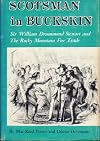
If I came across it before in my reading on the fur trade, I’d forgotten the name of Stewart. Porter says, in a concluding section on how this book came to be and the research for it, that he’s mentioned somewhat enigmatically in Bernard DeVoto’s Across the Wide Missouri and also in James Beckworth’s autobiography. That’s probably because, in the Rocky Mountain Fur Trade of the 1830s and 1840s, Stewart left no direct account of his experiences, just a couple of dull novels based on show more them. That was despite personally knowing and being friends with many of the important traders and missionaries and explorers of the time. Arguably, with one exception, he made no contribution to the settling of the American West either.
He was, however, very important in the study of that time.
Born in 1795 at Murthly Castle in Perthshire, Scotland, the second son of Sir George Stewart, 17th Lord of Grandtully. Stewart had three younger brothers, and acrimonious family relations take up a fair share of this book.
Porter and Davenport describe Stewart as a man of three dominating characteristics: a love of discipline, a love of luxury, and a love of adventure. The first was probably cemented when, as a lieutenant in the 15th King’s Hussars, he was reprimanded for attacking a regiment of French lancers against orders. Fortunately, his superior officer did not report his disobedience, and Stewart would end up with a medal because it was the last day of the Battle of Waterloo.
Stewart retired from the military in 1821 with the rank of captain. He seems to have travelled extensively in Europe, Russia, and Turkey, perhaps in some diplomatic capacity. In 1827, the Lord died, and Stewart’s older brother John inherited the estate. Gallingly, his father had set up a trust under John’s control that would give him a yearly allowance.
Sometime in 1829, Stewart started a sexual relationship with a lower-class woman and a child resulted. Hardly anything surprising for 19th century Britain except Stewart married Christina Stewart (no relation) and acknowledged his son George. Christina’s picture shows an attractive woman though a contemporary says it was the “nether limbs” of the laundress that caught Stewart’s eye. Stewart, in their long marriage, would spend little time with Christina, but theirs seems to have been an amicable relationship. He provided for her and their son by putting them up in houses in Perth and Edinburgh. She was literate and smart and they corresponded frequently, and Stewart trusted her through the years to manage his Scottish affairs when he was gone. After their marriage in 1832, Christina never insisted on asserting her right to visit Stewart’s home, wisely not wanting to encounter the hostility of her in-laws.
It was in 1832 Stewart left for America. His original intent was to get a job with the Hudson Bay Company, but in New York City he accidentally made the acquaintance of J. Watson Webb. Because of his army experience in the west, Webb introduced Stewart to several important people: William Clark and three key players in the Rocky Mountain fur trade: William Ashley, William Sublette, and Robert Campbell. Stewart decided to go to St. Louis. Plans to take a steamboat there were foiled by a cholera epidemic, so Stewart set out cross-country on his expensive horse and packing his expensive Manton rifle.
In St. Louis in 1833, Stewart would meet frontier booster Senator Thomas Hart Benton and decide he wanted to go to the 1833 rendezvous with Sublette and Campbell. They weren’t keen on taking a greenhorn on the trip, but he paid them $500 to go along.
Campbell, though, proved an able companion. He was used to privation on the move from his days in the Peninsular Campaigns. He was a crack shot, and his ideas of military discipline proved handy in enforcing things like proper sentry watches. His reputation as a hero of Waterloo didn’t hurt either.
The account of Campbell’s time at the 1833 rendezvous provides some insight to Washington Irving’s and Charles Larpenteur’s accounts. Significantly, it provides more reasons to think Captain Bonneville’s expedition wasn’t some lark to get into the fur trading business but an espionage mission commissioned by President Andrew Jackson to scope out California. However, while the book has an extensive index and bibliography, it has no footnotes, so I don’t know where this information comes from exactly.
Less significant is the matter of the man being attacked by a rabid wolf at the rendezvous and, now rabid himself, running off into the woods. It’s mentioned in Washington Irving's The Adventures of Captain Bonneville and Charles Larpenteur's Forty Years a Fur Trader on the Upper Missouri. But here we learn the man was a friend of Stewart’s, George Holmes. The two shared a bower, but Holmes was sleeping outside that night because Stewart was planning an assignation with a Blackfeet woman. In his autobiographical novel Edward Warren, Stewart said “There has never quitted my breast a reproachful remorse for the part I played that night.”
It was at the rendezvous that Stewart would befriend Antoine Clement, a man of Cree and French-Canadian origins.
We’re not sure where Stewart spent the winter of 1833-1834, but, in April of 1834, he was back in St. Louis and would make arrangements to again join Sublette and Campbell in another trip to the rendezvous. Stewart was with them when they started a project they had conceived on the previous trip: the construction of Fort Laramie.
After the rendezvous, Stewart would accompany a group of missionaries, requested by the Nez Perce, headed for the Columbia River area. There he would also meet another Scotsman, Dr. John McLoughlin, Head Factor of the Hudson Bay Company’s settlement at Fort Vancouver.
Stewart spent several months in the area and tried to return to St. Louis in February 1835 but couldn’t. Eventually, he went south to the rendezvous. There he would meet Dr. Marcus Whitman, another missionary bound for Oregon Territory.
By October 1835, Stewart was back in St. Louis. For the past several months, he had been getting intermittent news from his younger brother George on how much money their older brother John was spending on New Murthly Castle. Stewart also made the significant acquaintance of a New Orleans cotton merchant named E. B. Nichols. There was also a trip to Cuba.
By the spring of 1836, Stewart was ready to head to another rendezvous with William Sublette’s brother Milton (soon to be dead due to an amputated leg) and Thomas Fitzpatrick. Also in St. Louis was Whitman and his new wife, the beautiful Narcissa.
The book is full of lots of digressions and one of them is about the Whitmans and other missionaries on succeeding. trip. There is a lot of grumbling from “secular clerk” W. H. Gray who accompanied them. He complains a lot about Narcissa’s flirtatious ways and the men constantly gathering around her. He’s described as a sour man who doesn’t like anybody. Exactly the sort of memoirist I like, so I may look up his History of Oregon. Stewart didn’t accompany the Whitmans all the way, but his advice on where they should settle, based on his journey the previous year, is probably his largest practical contribution to American history. The story doesn’t end happily, though, for the Whitmans. They were both killed in the Whitman Massacre of 1847.
It’s unclear how Stewart spent the winter of 1836-1837, but, on returning to St. Louis, he got news his brother John was terminally ill, the same brother who was frequently late in making Stewart’s trust payments.
1837 would see Stewart’s most significant contribution to the future: he hired artist Alfred Jacob Miller to accompany him on that year’s trip to the rendezvous. Miller’s work (several black and white reproductions are in the book) are a vital record of the time and frequently show up on the covers of history books including this one. He would also present his friend Jim Bridger with a suit of armor and Miller drew the bizarre result.
In November of that year, in the Tetons, Stewart was struck by a mysterious disease. He vowed to a Jesuit missionary that, if he recovered, he would re-dedicate himself to his family’s Catholic faith and restore the chapels on the family’s estate.
After recovering and returning to St. Louis, he took steps to sue brother John for back annuities. Returning from his final trip to the fur rendezvous in 1838, Stewart received news his brother John was dead.
In May of 1839, Stewart went back to Scotland accompanied by Antoine. The following interlude has less interest for those following the fur trade but some for British history of the time. Stewart undertook a building project at the family estate, attempted a vain endeavor to overturn an entailment to some relatives, and pay off John’s debts. He would bring Miller over to do larger copies of his watercolor sketches from his trip as well as commissioned paintings from him for the chapels Stewart had vowed to repair. He also stocked the ground with imported buffalo and native plants from the North American prairie.
In August 1842, Stewart returned to America. The country was in the midst of a depression, and Stewart’s old fur trading associates were feeling the pain. William Sublette had to borrow money from Stewart. Nichols was still doing well, and Stewart visited him in November. Nichols thought the land of Texas was a good place to make another fortune, and he convinced Stewart to go with him on a trip to Galveston. Nichols had already bought up land around there and Austin. He thought more money could be made if and when Texas became a state.
In 1843, Stewart took his last trip into the American West. It was to be a last hurrah and in style. The caravan had many wagons packed with canned food, carpets, trade goods, expensive liquor, and other luxuries. Botantists, cooks, hunters, and packers were hired. Young men were recruited who the fatherly Stewart thought could benefit from the trip. A few of them left accounts. There was even an electrical device to wow Indians they met. Again, Stewart met Dr. Whitman and also the Jesuit missionary Father De Smet. Amateur dramatics and poetry recitations were held on the trip. Along was Stewart’s old friend Sublette. They travelled as far as Fort Laramie where they made a late arrival in September 1843.
Stewart spent the winter in New Orleans traveling around Louisiana and Texas. He was picking up an interest in investing in American railroads, but Nichols told him the time wasn’t right. Antoine and Stewart parted ways for good. It was back to Scotland – forever – for Stewart in the spring of 1844.
In 1848, George Stewart joined the British Army, and Nichols warned Sir Stewart that, though Texas was not a state, it was not the time to invest there. He could already sense the coming civil war.
For whatever reason, Stewart launched another legal battle: to take an entailment from his youngest brother, Archibald a spendthrift, Freemason, and fervent anti-Catholic. Predictably, the Houses of Parliament did not rule in William Stewart’s favor.
Somewhere after 1854 (this book could have really used more tags for the years or a separate timeline), Stewart had the Malakoff Arch constructed on his Murthly estate. That was to honor his son George, now a war hero like his father. Captain George Stewart not only survived the Charge of the Light Brigade but picked up a Victoria Cross. Stewart was still, despite the cautions of his friend Nichols, interested in investing in railroads in Texas. He suggested Nichols bring his family for a visit to Murthly to discuss the matter. Christina died. Gracious to the end, she turned down the suggestion of a relative to ask for anything from her family.
Nichols finally came on his visit, seemingly in 1856. His family settled in London where he sold railroad stock to British investors. Stewart invited Nichols’ sons Franc and Fred to stay with him and would even provide tutors for them. Stewart was probably lonely now that he was a widower and saw little of his son.
Fred didn’t last long. Homesick, he went back to his parents in London. But Fred loved the life on a Scottish estate. When his parents returned to America in 1861 where his father was offered the rank of general in the Confederate Army, Franc, now 15, refused to go back with them. And he didn’t go back when the war ended. Stewart and Franc became so close that Stewart legally adopted him as his son.
It was not a popular decision for the locals around the Murthly Estate nor for George Stewart. The relations between natural and adopted son were not good though there’s probably no truth to the rumor Franc killed George in October 1868.
Stewart died in 1871, a few months after starting another attempt to get rid of the entailment to his younger brother Archibald.
A rancorous, but short, legal battle ensued between Archibald and Franc. The upshot was that, despite Stewart’s will, Franc inherited no real property. He took advantage of that to take as much movable property as he could back to America, including many of the souvenirs from his adopted father’s time in America. Franc sold most of the latter off, so no Stewart collection exists anywhere for the Scotsman in Buckskin.
A well-written account despite the complaints I’ve registered and worth a look for anyone interested in the history of the American fur trade. show less
He was, however, very important in the study of that time.
Born in 1795 at Murthly Castle in Perthshire, Scotland, the second son of Sir George Stewart, 17th Lord of Grandtully. Stewart had three younger brothers, and acrimonious family relations take up a fair share of this book.
Porter and Davenport describe Stewart as a man of three dominating characteristics: a love of discipline, a love of luxury, and a love of adventure. The first was probably cemented when, as a lieutenant in the 15th King’s Hussars, he was reprimanded for attacking a regiment of French lancers against orders. Fortunately, his superior officer did not report his disobedience, and Stewart would end up with a medal because it was the last day of the Battle of Waterloo.
Stewart retired from the military in 1821 with the rank of captain. He seems to have travelled extensively in Europe, Russia, and Turkey, perhaps in some diplomatic capacity. In 1827, the Lord died, and Stewart’s older brother John inherited the estate. Gallingly, his father had set up a trust under John’s control that would give him a yearly allowance.
Sometime in 1829, Stewart started a sexual relationship with a lower-class woman and a child resulted. Hardly anything surprising for 19th century Britain except Stewart married Christina Stewart (no relation) and acknowledged his son George. Christina’s picture shows an attractive woman though a contemporary says it was the “nether limbs” of the laundress that caught Stewart’s eye. Stewart, in their long marriage, would spend little time with Christina, but theirs seems to have been an amicable relationship. He provided for her and their son by putting them up in houses in Perth and Edinburgh. She was literate and smart and they corresponded frequently, and Stewart trusted her through the years to manage his Scottish affairs when he was gone. After their marriage in 1832, Christina never insisted on asserting her right to visit Stewart’s home, wisely not wanting to encounter the hostility of her in-laws.
It was in 1832 Stewart left for America. His original intent was to get a job with the Hudson Bay Company, but in New York City he accidentally made the acquaintance of J. Watson Webb. Because of his army experience in the west, Webb introduced Stewart to several important people: William Clark and three key players in the Rocky Mountain fur trade: William Ashley, William Sublette, and Robert Campbell. Stewart decided to go to St. Louis. Plans to take a steamboat there were foiled by a cholera epidemic, so Stewart set out cross-country on his expensive horse and packing his expensive Manton rifle.
In St. Louis in 1833, Stewart would meet frontier booster Senator Thomas Hart Benton and decide he wanted to go to the 1833 rendezvous with Sublette and Campbell. They weren’t keen on taking a greenhorn on the trip, but he paid them $500 to go along.
Campbell, though, proved an able companion. He was used to privation on the move from his days in the Peninsular Campaigns. He was a crack shot, and his ideas of military discipline proved handy in enforcing things like proper sentry watches. His reputation as a hero of Waterloo didn’t hurt either.
The account of Campbell’s time at the 1833 rendezvous provides some insight to Washington Irving’s and Charles Larpenteur’s accounts. Significantly, it provides more reasons to think Captain Bonneville’s expedition wasn’t some lark to get into the fur trading business but an espionage mission commissioned by President Andrew Jackson to scope out California. However, while the book has an extensive index and bibliography, it has no footnotes, so I don’t know where this information comes from exactly.
Less significant is the matter of the man being attacked by a rabid wolf at the rendezvous and, now rabid himself, running off into the woods. It’s mentioned in Washington Irving's The Adventures of Captain Bonneville and Charles Larpenteur's Forty Years a Fur Trader on the Upper Missouri. But here we learn the man was a friend of Stewart’s, George Holmes. The two shared a bower, but Holmes was sleeping outside that night because Stewart was planning an assignation with a Blackfeet woman. In his autobiographical novel Edward Warren, Stewart said “There has never quitted my breast a reproachful remorse for the part I played that night.”
It was at the rendezvous that Stewart would befriend Antoine Clement, a man of Cree and French-Canadian origins.
We’re not sure where Stewart spent the winter of 1833-1834, but, in April of 1834, he was back in St. Louis and would make arrangements to again join Sublette and Campbell in another trip to the rendezvous. Stewart was with them when they started a project they had conceived on the previous trip: the construction of Fort Laramie.
After the rendezvous, Stewart would accompany a group of missionaries, requested by the Nez Perce, headed for the Columbia River area. There he would also meet another Scotsman, Dr. John McLoughlin, Head Factor of the Hudson Bay Company’s settlement at Fort Vancouver.
Stewart spent several months in the area and tried to return to St. Louis in February 1835 but couldn’t. Eventually, he went south to the rendezvous. There he would meet Dr. Marcus Whitman, another missionary bound for Oregon Territory.
By October 1835, Stewart was back in St. Louis. For the past several months, he had been getting intermittent news from his younger brother George on how much money their older brother John was spending on New Murthly Castle. Stewart also made the significant acquaintance of a New Orleans cotton merchant named E. B. Nichols. There was also a trip to Cuba.
By the spring of 1836, Stewart was ready to head to another rendezvous with William Sublette’s brother Milton (soon to be dead due to an amputated leg) and Thomas Fitzpatrick. Also in St. Louis was Whitman and his new wife, the beautiful Narcissa.
The book is full of lots of digressions and one of them is about the Whitmans and other missionaries on succeeding. trip. There is a lot of grumbling from “secular clerk” W. H. Gray who accompanied them. He complains a lot about Narcissa’s flirtatious ways and the men constantly gathering around her. He’s described as a sour man who doesn’t like anybody. Exactly the sort of memoirist I like, so I may look up his History of Oregon. Stewart didn’t accompany the Whitmans all the way, but his advice on where they should settle, based on his journey the previous year, is probably his largest practical contribution to American history. The story doesn’t end happily, though, for the Whitmans. They were both killed in the Whitman Massacre of 1847.
It’s unclear how Stewart spent the winter of 1836-1837, but, on returning to St. Louis, he got news his brother John was terminally ill, the same brother who was frequently late in making Stewart’s trust payments.
1837 would see Stewart’s most significant contribution to the future: he hired artist Alfred Jacob Miller to accompany him on that year’s trip to the rendezvous. Miller’s work (several black and white reproductions are in the book) are a vital record of the time and frequently show up on the covers of history books including this one. He would also present his friend Jim Bridger with a suit of armor and Miller drew the bizarre result.
In November of that year, in the Tetons, Stewart was struck by a mysterious disease. He vowed to a Jesuit missionary that, if he recovered, he would re-dedicate himself to his family’s Catholic faith and restore the chapels on the family’s estate.
After recovering and returning to St. Louis, he took steps to sue brother John for back annuities. Returning from his final trip to the fur rendezvous in 1838, Stewart received news his brother John was dead.
In May of 1839, Stewart went back to Scotland accompanied by Antoine. The following interlude has less interest for those following the fur trade but some for British history of the time. Stewart undertook a building project at the family estate, attempted a vain endeavor to overturn an entailment to some relatives, and pay off John’s debts. He would bring Miller over to do larger copies of his watercolor sketches from his trip as well as commissioned paintings from him for the chapels Stewart had vowed to repair. He also stocked the ground with imported buffalo and native plants from the North American prairie.
In August 1842, Stewart returned to America. The country was in the midst of a depression, and Stewart’s old fur trading associates were feeling the pain. William Sublette had to borrow money from Stewart. Nichols was still doing well, and Stewart visited him in November. Nichols thought the land of Texas was a good place to make another fortune, and he convinced Stewart to go with him on a trip to Galveston. Nichols had already bought up land around there and Austin. He thought more money could be made if and when Texas became a state.
In 1843, Stewart took his last trip into the American West. It was to be a last hurrah and in style. The caravan had many wagons packed with canned food, carpets, trade goods, expensive liquor, and other luxuries. Botantists, cooks, hunters, and packers were hired. Young men were recruited who the fatherly Stewart thought could benefit from the trip. A few of them left accounts. There was even an electrical device to wow Indians they met. Again, Stewart met Dr. Whitman and also the Jesuit missionary Father De Smet. Amateur dramatics and poetry recitations were held on the trip. Along was Stewart’s old friend Sublette. They travelled as far as Fort Laramie where they made a late arrival in September 1843.
Stewart spent the winter in New Orleans traveling around Louisiana and Texas. He was picking up an interest in investing in American railroads, but Nichols told him the time wasn’t right. Antoine and Stewart parted ways for good. It was back to Scotland – forever – for Stewart in the spring of 1844.
In 1848, George Stewart joined the British Army, and Nichols warned Sir Stewart that, though Texas was not a state, it was not the time to invest there. He could already sense the coming civil war.
For whatever reason, Stewart launched another legal battle: to take an entailment from his youngest brother, Archibald a spendthrift, Freemason, and fervent anti-Catholic. Predictably, the Houses of Parliament did not rule in William Stewart’s favor.
Somewhere after 1854 (this book could have really used more tags for the years or a separate timeline), Stewart had the Malakoff Arch constructed on his Murthly estate. That was to honor his son George, now a war hero like his father. Captain George Stewart not only survived the Charge of the Light Brigade but picked up a Victoria Cross. Stewart was still, despite the cautions of his friend Nichols, interested in investing in railroads in Texas. He suggested Nichols bring his family for a visit to Murthly to discuss the matter. Christina died. Gracious to the end, she turned down the suggestion of a relative to ask for anything from her family.
Nichols finally came on his visit, seemingly in 1856. His family settled in London where he sold railroad stock to British investors. Stewart invited Nichols’ sons Franc and Fred to stay with him and would even provide tutors for them. Stewart was probably lonely now that he was a widower and saw little of his son.
Fred didn’t last long. Homesick, he went back to his parents in London. But Fred loved the life on a Scottish estate. When his parents returned to America in 1861 where his father was offered the rank of general in the Confederate Army, Franc, now 15, refused to go back with them. And he didn’t go back when the war ended. Stewart and Franc became so close that Stewart legally adopted him as his son.
It was not a popular decision for the locals around the Murthly Estate nor for George Stewart. The relations between natural and adopted son were not good though there’s probably no truth to the rumor Franc killed George in October 1868.
Stewart died in 1871, a few months after starting another attempt to get rid of the entailment to his younger brother Archibald.
A rancorous, but short, legal battle ensued between Archibald and Franc. The upshot was that, despite Stewart’s will, Franc inherited no real property. He took advantage of that to take as much movable property as he could back to America, including many of the souvenirs from his adopted father’s time in America. Franc sold most of the latter off, so no Stewart collection exists anywhere for the Scotsman in Buckskin.
A well-written account despite the complaints I’ve registered and worth a look for anyone interested in the history of the American fur trade. show less
You May Also Like
Associated Authors
Statistics
- Works
- 1
- Also by
- 2
- Members
- 9
- Popularity
- #968,586
- Rating
- 4.0
- Reviews
- 1