
John Held (1889–1958)
Author of The most of John Held, Jr
About the Author
Works by John Held
Classic Spot Illustrations from the Twenties and Thirties: By James Montgomery Flagg, Gluyas Williams, John Held, Jr. and Others (2000) — Contributor — 7 copies
Crosstown 3 copies
Associated Works
The Surprising Adventures of Baron Munchausen (1785) — Illustrator, some editions — 1,375 copies, 26 reviews
Tagged
Common Knowledge
Members
Reviews
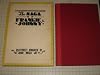
I know the ballad of "Frankie and Johnny" from the Johnny Cash song, "Frankie's Man, Johnny." But it turns out that that song about "sweethearts" that ends with, "He was Frankie's man and he still ain't done her wrong," was a highly sanitized take on earlier lyrics.
Actually, it's hard to nail down the lyrics for the song as its origins are a bit murky, with some claiming it first appeared early in the 19th century and others pointing to an actual murder in 1899 in St. Louis as the show more inspiration. Like many folk songs, there are dozens of variations floating around, though most agree that Frankie and Johnny (who is sometimes Albert) were lovers, but he done her wrong, and so the woman scorned shot him with a forty-four.
In this illustrated version, Frankie is a sex worker who gives her man Johnny money for clothes and a watch. She hears he's running around and buys a gun, then catches him in bed with Nelly Bly and fires away. The song continues on through her imprisonment, trial, execution, and this haunting conclusion:
This story has no moral.
This story has no end.
This story only goes to show
You can't trust no God-damned men.
For he was her man, and he done her wrong.
The woodcut illustrations of John Held, Jr., are a bit cartoonish and bawdy, making light of the heavy themes as the lyrics themselves do. Anyone who has read Rick Geary's books of murder and mayhem will find it very familiar in look and tone.
An aside: I first became aware of this 1930 book when I added a 1972 reprint to Goodreads for friend Drew Canole. It looked so intriguing, mixing an old favorite song with my love of illustrated books, that I quickly ordered a copy when I found it for sale on Thriftbooks for just ten dollars. Imagine my surprise when the reprint I expected turned out to be a lightly flaking first edition, " . . . limited to two thousand and fifty copies . . . " and issued " . . . in December, nineteen hundred and thirty . . . " in its original, fraying slipcase. Lucky day! show less
Actually, it's hard to nail down the lyrics for the song as its origins are a bit murky, with some claiming it first appeared early in the 19th century and others pointing to an actual murder in 1899 in St. Louis as the show more inspiration. Like many folk songs, there are dozens of variations floating around, though most agree that Frankie and Johnny (who is sometimes Albert) were lovers, but he done her wrong, and so the woman scorned shot him with a forty-four.
In this illustrated version, Frankie is a sex worker who gives her man Johnny money for clothes and a watch. She hears he's running around and buys a gun, then catches him in bed with Nelly Bly and fires away. The song continues on through her imprisonment, trial, execution, and this haunting conclusion:
This story has no moral.
This story has no end.
This story only goes to show
You can't trust no God-damned men.
For he was her man, and he done her wrong.
The woodcut illustrations of John Held, Jr., are a bit cartoonish and bawdy, making light of the heavy themes as the lyrics themselves do. Anyone who has read Rick Geary's books of murder and mayhem will find it very familiar in look and tone.
An aside: I first became aware of this 1930 book when I added a 1972 reprint to Goodreads for friend Drew Canole. It looked so intriguing, mixing an old favorite song with my love of illustrated books, that I quickly ordered a copy when I found it for sale on Thriftbooks for just ten dollars. Imagine my surprise when the reprint I expected turned out to be a lightly flaking first edition, " . . . limited to two thousand and fifty copies . . . " and issued " . . . in December, nineteen hundred and thirty . . . " in its original, fraying slipcase. Lucky day! show less
Although increasingly appreciated in fine art and stamp collecting circles, artist postage stamps, or artistamps, are more likely to be traded between the people who create them than they are to be exhibited in commercial art galleries or read about in philatelic journals. Artistamps are part and parcel of the grassroots network known as Mail Art, an alternative art of creative long-distance communication that intuited the demand for cross-cultural exchange long before the Internet. Although show more seemingly rigid, the postage stamp format allows flexible approaches in painting, watercolor, offset, photography, photocopy, rubber-stamping, engraving, digitization and sculpture. show less

This comprehensive bibliography lists nearly 2,200 sources (from 36 countries) of information on mail art from books, magazines, newspapers, and catalog essays between 1955 and 1989.
You May Also Like
Associated Authors
Statistics
- Works
- 19
- Also by
- 5
- Members
- 102
- Popularity
- #187,250
- Rating
- 3.5
- Reviews
- 3
- ISBNs
- 13
- Languages
- 1