
José Ángel Valente (1929–2000)
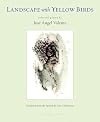
Author of Landscape with Yellow Birds
About the Author
Image credit: José Ángel Valente (Ourense, 1929-Ginebra, 2000), en una fotografía de Manuel Falces en 1994.
Works by José Ángel Valente
Ensayo Sobre Miguel de Molinos: Guia Espirritual sguida de la Defensa de la Contemplacion por vez primera impresa. (1974) 3 copies
A modo de esperanza 2 copies
Sobre el lugar del canto 1 copy
Obras completas II: Ensayos 1 copy
Nueve enunciaciones 1 copy
Nueve poemas 1 copy
ANTOLOGÍA 1 copy
Associated Works
Tagged
Common Knowledge
- Canonical name
- Ángel Valente, José
- Birthdate
- 1929-04-05
- Date of death
- 2000-07-18
- Gender
- male
- Education
- University of Santiago de Compostela
Complutense University of Madrid
University of Oxford - Occupations
- poet
essayist
translator - Awards and honors
- Premio Príncipe de Asturias (Letters, 1988)
- Nationality
- Spain
- Birthplace
- Orense, Spain
- Places of residence
- Orense, Galicia, Spain
Madrid, Spain
Oxford, Oxfordshire, England, UK
Geneva, Switzerland
Almeria, Spain
Paris, France - Place of death
- Geneva, Switzerland
- Associated Place (for map)
- Spain
Members
Reviews
First Night
Extend your heart,
bankrupt it, blind it,
until in it is born
the powerful void
of what can never be named.
I know at least
the imminent
and spent bone
Let there be night. (Stone,
nothing but nocturnal stone.)
Then raise your plea:
that the word be nothing but truth.
The poem above is from A Modo de Esperanza (In a Hopeful Mode) published in 1953 - 4, this was José Ángel Valente's first published work and it won the Adonais Prize for Poetry, his next collection Poemas a Lázaro (Poems for show more Lazarus) won the Critics Prize. Born in Galacia, North-western Spain, Valente had studied romance languages and law, graduating from the University of Madrid (1953) at the age of twenty four.
Although initially a supporter of Franco, Valente's father had fallen out of favour with the regime, and Valente would spend many years in voluntary exile, at first in Oxford, where he taught Spanish letters and received a MA degree.
Later he would live in Geneva and Paris working as a translator for the World Health Organisation and Unesco. In 1972 he was court-martialed in absentia, for remarks critical to the regime.
He wouldn't return to his homeland until ten years after Franco's death. In 1988 his work as a writer was finally recognised when he was awarded the prestigious Príncipe de Asturias prize, followed by the National Poetry prize in 1993.
Unlike many of his contemporaries, his poetry didn't directly reference the political or social forces affecting his country. His concerns were with poetry itself - that poetry explored and transcended itself: poetry as knowledge, as truth -creating a meta-poetry, using the language, the logos as a means to define the essence, for Valente poetry was a material thing or a "material memory" (title of his 1977-78 collection) and writing was like ceramics, a shaping process.
Poetry was not, as it was for earlier post-war Spanish writers, so much an act of communication as it was a process of discovery.
This places Valente as heir to the Spanish mystical tradition, with his influences ranging from the Jewish Kabbalah, Iranian Sufism, and Christian mysticism (primarily through figures such as San Juan de la Cruz or Miguel de Molinos ), Taoism and Zen Buddhism, amongst others. In his later years this process would condense his poetry stripping away any excess, creating highly distilled and introspective prose that through the process of distillation created new vistas.
Considered by many to be the major poet of post-war Spain, and yet Landscape With Yellow Birds is the first major selection of his work to appear in English, containing poetry from throughout his lifetime from A Modo de Esperanza written in 1953 to Fragmentos de un Libro Futuro (Fragments from a Future Book) 1991 -2000, tracing Valente's journey as he sought to define and shape his reality through the crafting of his verse, to realise through this process
" An aspect of reality to which there is no means of access other than through poetic language." show less
Extend your heart,
bankrupt it, blind it,
until in it is born
the powerful void
of what can never be named.
I know at least
the imminent
and spent bone
Let there be night. (Stone,
nothing but nocturnal stone.)
Then raise your plea:
that the word be nothing but truth.
The poem above is from A Modo de Esperanza (In a Hopeful Mode) published in 1953 - 4, this was José Ángel Valente's first published work and it won the Adonais Prize for Poetry, his next collection Poemas a Lázaro (Poems for show more Lazarus) won the Critics Prize. Born in Galacia, North-western Spain, Valente had studied romance languages and law, graduating from the University of Madrid (1953) at the age of twenty four.
Although initially a supporter of Franco, Valente's father had fallen out of favour with the regime, and Valente would spend many years in voluntary exile, at first in Oxford, where he taught Spanish letters and received a MA degree.
Later he would live in Geneva and Paris working as a translator for the World Health Organisation and Unesco. In 1972 he was court-martialed in absentia, for remarks critical to the regime.
He wouldn't return to his homeland until ten years after Franco's death. In 1988 his work as a writer was finally recognised when he was awarded the prestigious Príncipe de Asturias prize, followed by the National Poetry prize in 1993.
Unlike many of his contemporaries, his poetry didn't directly reference the political or social forces affecting his country. His concerns were with poetry itself - that poetry explored and transcended itself: poetry as knowledge, as truth -creating a meta-poetry, using the language, the logos as a means to define the essence, for Valente poetry was a material thing or a "material memory" (title of his 1977-78 collection) and writing was like ceramics, a shaping process.
Poetry was not, as it was for earlier post-war Spanish writers, so much an act of communication as it was a process of discovery.
This places Valente as heir to the Spanish mystical tradition, with his influences ranging from the Jewish Kabbalah, Iranian Sufism, and Christian mysticism (primarily through figures such as San Juan de la Cruz or Miguel de Molinos ), Taoism and Zen Buddhism, amongst others. In his later years this process would condense his poetry stripping away any excess, creating highly distilled and introspective prose that through the process of distillation created new vistas.
Considered by many to be the major poet of post-war Spain, and yet Landscape With Yellow Birds is the first major selection of his work to appear in English, containing poetry from throughout his lifetime from A Modo de Esperanza written in 1953 to Fragmentos de un Libro Futuro (Fragments from a Future Book) 1991 -2000, tracing Valente's journey as he sought to define and shape his reality through the crafting of his verse, to realise through this process
" An aspect of reality to which there is no means of access other than through poetic language." show less

Parece que Valente va buscando la esencia de las cosas, incluyéndose él mismo. No es demasiado original en esto, la verdad. Buscando, buscando, acaba, con la edad, encontrando a la muerte y preguntándose por la nada, que es lo más esencial. Muchas vueltas sobre lo mismo, aunque en ocasiones varía algo. La mayoría de los poetas acaban siendo algo obsesivos.
Jun 4, 2011Spanish
> Babelio : https://www.babelio.com/livres/Valente-Paysage-avec-des-oiseaux-jaunes/34522
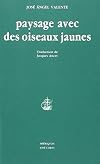
> Ce quatrième recueil de textes publié en édition bilingue chez José Corti exprime une fois encore tout le talent du poète, et de son traducteur franais, un talent fait de rigueur, de maîtrise pudique de la langue.
—Danieljean (Babelio)
> Ce quatrième recueil de textes publié en édition bilingue chez José Corti exprime une fois encore tout le talent du poète, et de son traducteur franais, un talent fait de rigueur, de maîtrise pudique de la langue.
—Danieljean (Babelio)

VALENTE, José Ángel: El fulgor. Antología poética 1953-2000. Madrid, Galaxia Gutenberg, 2001. 398 pp. 21x13 cm. Cartoné editorial.
Lists
Awards


You May Also Like


Associated Authors
Statistics
- Works
- 65
- Also by
- 3
- Members
- 331
- Popularity
- #71,752
- Rating
- 3.9
- Reviews
- 6
- ISBNs
- 70
- Languages
- 4