
David Leonhardt (1) (1973–)
Author of Ours Was the Shining Future: The Story of the American Dream
For other authors named David Leonhardt, see the disambiguation page.
Works by David Leonhardt
Associated Works
Tagged
Common Knowledge
- Birthdate
- 1973-01-01
- Education
- Yale University
- Occupations
- journalist
columnist - Organizations
- The New York Times
- Awards and honors
- Pulitzer Prize (Commentary, 2011)
Members
Reviews

Leonhardt is a New York Times columnist who does good reporting work on the economy, and this is a short piece of about 60 pages that tries to explain the federal budget deficit, its causes, and some proposed solutions in an admirably clear, calm, and numerate manner.
I'll lead with the money quote: "In the simplest terms, Republicans have won the debate on taxes, and Democrats have won the debate on benefits. We, the voters, have chosen the winner of each. In exchange, we have a federal show more government facing enormous deficits in coming decades." This short-termism is yet another product of our penny-wise pound-foolish broken political system. However, the word "benefits" in that sentence turns out to mean "benefits that go increasingly to the old and wealthy", and at this rate our funding for the military, Social Security, Medicare, and the like might render us unable to make the kinds of vital investments in infrastructure (think dams, interstate highways, the electrical grid, the school system, etc) necessary for future growth. "Eating your seed corn" is the popular phrase.
So the deceptively simple choice of higher taxes or lower benefits can be finessed in a way that in large part is the cutting edge of modern technocratic proposals from the Democratic Party: building on the medical payment reforms of Obamacare to improve care while lowing costs, tweaking the funding and payment structure of Social Security by raising revenue and the retirement age, removing wasteful tax breaks like the mortgage interest deduction, reforming the corporate tax code to reduce loophole-gaming, and the like. The long-term gap between revenues and expenditures is about 5 percent, and thought some of the changes to the Big Three of Social Security, Medicare, and the military might be arguable (e.g. raising the Social Security eligibility age would disproportionately hurt poor seniors with no other sources of retirement income, and they tend to die sooner than wealthier seniors who need Social Security less), overall he presents a good framework for thinking about budget choices.
The problem is that our political system, with its endless veto points, interest groups, and opportunities for corruption, is not well-situated to begin acting on the deficit. While it's important to understand that a large deficit is not the biggest problem in a world where the government can borrow at negative real interest rates (i.e. investors are literally paying the government money for the privilege of lending to it), this world won't last forever. The interview in the beginning with former VP candidate Paul Ryan is yet another reminder of how unserious and disconnected from reality the modern Republican Party is on any issue related to budget policy, yet they currently have the power to block any more major progress from being made. Investments in the future that will lead to economic growth are a vital policy tool, yet the Republican outcry over the stimulus gives little hope that they'll come around any time soon.
In the meantime, Leonhardt has written a clear guide that is very helpful for thinking about how to approach the fiscal side of deficit reduction. His regular columns provide useful supplements on how policymakers are either addressing or ignoring various aspects of the problem he talks about here, so this is a good place to start reading.My favorite long-term guide to thinking about the budget remains Paul Krugman's The Conscience of a Liberal, but this is a welcome and more up-to-date addition to that stable. show less
I'll lead with the money quote: "In the simplest terms, Republicans have won the debate on taxes, and Democrats have won the debate on benefits. We, the voters, have chosen the winner of each. In exchange, we have a federal show more government facing enormous deficits in coming decades." This short-termism is yet another product of our penny-wise pound-foolish broken political system. However, the word "benefits" in that sentence turns out to mean "benefits that go increasingly to the old and wealthy", and at this rate our funding for the military, Social Security, Medicare, and the like might render us unable to make the kinds of vital investments in infrastructure (think dams, interstate highways, the electrical grid, the school system, etc) necessary for future growth. "Eating your seed corn" is the popular phrase.
So the deceptively simple choice of higher taxes or lower benefits can be finessed in a way that in large part is the cutting edge of modern technocratic proposals from the Democratic Party: building on the medical payment reforms of Obamacare to improve care while lowing costs, tweaking the funding and payment structure of Social Security by raising revenue and the retirement age, removing wasteful tax breaks like the mortgage interest deduction, reforming the corporate tax code to reduce loophole-gaming, and the like. The long-term gap between revenues and expenditures is about 5 percent, and thought some of the changes to the Big Three of Social Security, Medicare, and the military might be arguable (e.g. raising the Social Security eligibility age would disproportionately hurt poor seniors with no other sources of retirement income, and they tend to die sooner than wealthier seniors who need Social Security less), overall he presents a good framework for thinking about budget choices.
The problem is that our political system, with its endless veto points, interest groups, and opportunities for corruption, is not well-situated to begin acting on the deficit. While it's important to understand that a large deficit is not the biggest problem in a world where the government can borrow at negative real interest rates (i.e. investors are literally paying the government money for the privilege of lending to it), this world won't last forever. The interview in the beginning with former VP candidate Paul Ryan is yet another reminder of how unserious and disconnected from reality the modern Republican Party is on any issue related to budget policy, yet they currently have the power to block any more major progress from being made. Investments in the future that will lead to economic growth are a vital policy tool, yet the Republican outcry over the stimulus gives little hope that they'll come around any time soon.
In the meantime, Leonhardt has written a clear guide that is very helpful for thinking about how to approach the fiscal side of deficit reduction. His regular columns provide useful supplements on how policymakers are either addressing or ignoring various aspects of the problem he talks about here, so this is a good place to start reading.My favorite long-term guide to thinking about the budget remains Paul Krugman's The Conscience of a Liberal, but this is a welcome and more up-to-date addition to that stable. show less
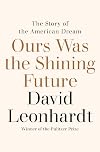
I took an elective in economics in high school after a teacher recommended it. What I most remember was being told that a high national debt was the result of a growing economy, and since it was money we owe to ourselves, we shouldn’t be worried about a high debt.
When I took that class, the economy was still good. My dad had a union job with great benefits. We had two cars and a house in the suburbs. He talked about his international lab at Chrysler, with engineers from India and show more Lebanon.
But society was also under strain. We watched helicopters flying overhead, taking National Guard to Detroit in ’67. Kids from my high school class went to an antiwar protest and fhad to run from the police. Inflation and lines at gas stations plagued my early marriage, and when we bought a house the mortgage had a 15.5% interest rate. Fast forward to 2008, and when our son graduated from college, it took two years to find a job.
What happened?
David Leonhardt’s take on the American Dream is a comprehensive history of the social and political influences that drove the growth of the middle class and later drove huge business profits at the expense of workers.
Yes, there is a lot of information, but I found it interesting reading.
He breaks the book down into “The Rise” and “The Fall.” A central theme of The Rise is the importance of unions to workers. President F. D. Roosevelt supported living wages and unions. After WWII, business believed that well paid workers was good for the economy, therefore good for business. In The Fall, he shows how the breakdown in society into separate interest groups, especially those with ‘elite’ concerns over working/middle class concerns, impacted politics and the economy, and how social disorder and crime drove people to switch political allegiance.
I found the book to be balanced, engaging, and very informative.
Thanks to the publisher for a free book. show less
When I took that class, the economy was still good. My dad had a union job with great benefits. We had two cars and a house in the suburbs. He talked about his international lab at Chrysler, with engineers from India and show more Lebanon.
But society was also under strain. We watched helicopters flying overhead, taking National Guard to Detroit in ’67. Kids from my high school class went to an antiwar protest and fhad to run from the police. Inflation and lines at gas stations plagued my early marriage, and when we bought a house the mortgage had a 15.5% interest rate. Fast forward to 2008, and when our son graduated from college, it took two years to find a job.
What happened?
David Leonhardt’s take on the American Dream is a comprehensive history of the social and political influences that drove the growth of the middle class and later drove huge business profits at the expense of workers.
Yes, there is a lot of information, but I found it interesting reading.
He breaks the book down into “The Rise” and “The Fall.” A central theme of The Rise is the importance of unions to workers. President F. D. Roosevelt supported living wages and unions. After WWII, business believed that well paid workers was good for the economy, therefore good for business. In The Fall, he shows how the breakdown in society into separate interest groups, especially those with ‘elite’ concerns over working/middle class concerns, impacted politics and the economy, and how social disorder and crime drove people to switch political allegiance.
I found the book to be balanced, engaging, and very informative.
Thanks to the publisher for a free book. show less
5828 .Ours Was the Shining Future The Story of the American Dream, by David Leonhardt (read 20 Jan 2024) This book, published in 2023, is full of good commentary re the years in America of the last 50 years, setting out how we have declined recently and what needs to be done to revivify the search for the American dream. It requires greater study than I gave it, but sets out what the author sees as necessary and what he says makes sense.
Awards

You May Also Like
Associated Authors
Statistics
- Works
- 4
- Also by
- 1
- Members
- 155
- Popularity
- #135,096
- Rating
- 3.9
- Reviews
- 4
- ISBNs
- 10