
William M. Schniedewind
Author of How the Bible Became a Book: The Textualization of Ancient Israel
About the Author
Works by William M. Schniedewind
Associated Works
Chronicler as Author Studies in Text and: Studies in Text and Texture (JSOT Supplement) (1999) — Contributor — 23 copies
The Chronicler As Historian (The Library of Hebrew Bible/Old Testament Studies) (1997) — Contributor — 21 copies
Tagged
Common Knowledge
- Birthdate
- 1962-09-05
- Gender
- male
- Education
- George Fox University (BA|1984)
Jerusalem University College (MA|Historical Geography of Ancient Israel|1986)
Brandeis University (MA, PhD|Near Eastern and Judaic Studies|1992) - Occupations
- Professor of Biblical Studies & Northwest Semitic Languages
- Organizations
- UCLA
- Nationality
- USA
- Birthplace
- New York, New York, USA
- Associated Place (for map)
- New York, USA
Members
Reviews
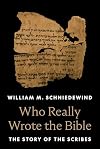
As sure as chickens come from eggs, books have authors. Knowing the author’s identity gives a book authority; that’s how we know it’s authentic. No wonder that so many people have asked the question in this book’s title. The traditional answer – it was God, obviously – may be theologically satisfying but doesn’t get you very far. Most of the Bible’s books were long linked by tradition to specific, big-name authors: Moses, David, Solomon, Paul. For centuries, scholars have show more been dismantling those attributions, often shredding biblical books into ribbons to tease out their different authors in heroic feats of textual analysis which it is quite impossible to prove either right or wrong. William Schniedewind’s book approaches the problem in a different way.
His scope is exclusively the Hebrew Bible, the ‘Old Testament’. There are also questions about the authorship of the New Testament, but that was written in Greek and Schniedewind sees ‘authorship’, in the modern sense, as a Greek idea that was a latecomer to Jewish culture. Almost none of the books of the Hebrew Bible claim to have an author, simply because that’s not how books were written in ancient Hebrew. They were the product of scribal communities, not individuals.
That is the book’s core idea, and while he shades and nuances it very expertly, the reader will have grasped the key point within the first five pages. It is not wholly original: the only wholly original ideas in biblical studies are mad. But it does allow Schniedewind to approach an old problem from an unusual perspective and, with careful analysis, to trace a non-traditional history of ancient Hebrew writing.
Read the rest of the review at https://www.historytoday.com/archive/review/who-really-wrote-bible-william-m-sch...
Alec Ryrie is Professor of the History of Christianity at Durham University. show less
His scope is exclusively the Hebrew Bible, the ‘Old Testament’. There are also questions about the authorship of the New Testament, but that was written in Greek and Schniedewind sees ‘authorship’, in the modern sense, as a Greek idea that was a latecomer to Jewish culture. Almost none of the books of the Hebrew Bible claim to have an author, simply because that’s not how books were written in ancient Hebrew. They were the product of scribal communities, not individuals.
That is the book’s core idea, and while he shades and nuances it very expertly, the reader will have grasped the key point within the first five pages. It is not wholly original: the only wholly original ideas in biblical studies are mad. But it does allow Schniedewind to approach an old problem from an unusual perspective and, with careful analysis, to trace a non-traditional history of ancient Hebrew writing.
Read the rest of the review at https://www.historytoday.com/archive/review/who-really-wrote-bible-william-m-sch...
Alec Ryrie is Professor of the History of Christianity at Durham University. show less
Smoothly written book that provides some insight into who the authors behind the Hebrew Bible and related writings were. ‘Authors’ is a misleading term here, because we spontaneously think of individual writers. And although the books of the Bible are often attributed to a specific author (the Prophets, for example), there is usually a tangle of scribal communities behind them. William Schniedewind (° 1962 University of California, Los Angeles) is an expert in the archaeology of Israel show more and the study of Hebrew. And his focus in this book is to outline exactly how the scribal communities in Israel/Palestine and the diaspora evolved and what role they played in the creation of the biblical texts. It is a commendable and very interesting approach that provides a good insight into how ancient cultures in the Ancient Near East and specifically the Levant functioned. But also how limited our view is of the specific scribal communities behind the Bible. Ultimately, I found that Schniedewind’s approach doesn’t add much to the whole debate about the historical value of the books of the Bible. More in my History account on Goodreads: https://www.goodreads.com/review/show/7473019935. show less
Lists
You May Also Like


Associated Authors
Statistics
- Works
- 9
- Also by
- 3
- Members
- 376
- Popularity
- #64,174
- Rating
- 3.9
- Reviews
- 2
- ISBNs
- 32
- Languages
- 3