
Doron Rabinovici
Author of Elsewhere
Works by Doron Rabinovici
Eichmann's Jews: The Jewish Administration of Holocaust Vienna, 1938-1945 (2000) 25 copies, 1 review
The Search for M (Studies in Austrian Literature, Culture, and Thought Translation Series) (1997) 17 copies
2017 1 copy
Associated Works
Nothing Makes You Free: Writings by Descendants of Jewish Holocaust Survivors (2002) — Contributor — 72 copies, 1 review
Die Geschichtenerzähler: Neues und Unbekanntes von Allende bis Zafón (suhrkamp taschenbuch) (2008) — Contributor — 5 copies
Tagged
Common Knowledge
- Birthdate
- 1961
- Occupations
- writer
essayist
historian - Organizations
- Grazer Autorinnen Autorenversammlung
- Awards and honors
- Heimito von Doderer Förderpreis (2000)
- Nationality
- Israel (birth)
Austria (residence) - Birthplace
- Tel Aviv, Israel
- Places of residence
- Tel Aviv, Israel
Vienna, Austria - Associated Place (for map)
- Tel Aviv, Israel
Members
Reviews
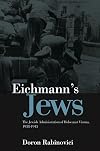
This book deals with a very controversial issue - the apparent collaboration of Austrian Jews with the Nazi Third Reich's programme for their extermination. How could they have participated in something so horrific, and why did they?
Doron Rabinovici is a Viennese Jew born after the war in Israel, but his family returned to Austria when he was 3. He has also written several novels and a collection of short stories. Eichmann's Jews was originally published in German under the title Instanzen show more der Obnmacht, which translates as Authorities of Powerlessness. It is based on his PhD thesis.
Adolf Eichmann was a senior SS figure whose job in Austria from 1938 was to implement the Final Solution, and many of his methods were also used in other countries which came under Third Reich rule, such as the use of Jewish community leaders and organisations to help carry out the dirty work.
Rabinovici describes the Jewish population of Vienna before the Anschluss brought Austria under Nazi rule in 1938 - the Vienna Israelite Community or Kultusgemeinde had responsibility for various social services, health care and educational functions as well as synagogues, and had hundreds of paid staff, and presumably lots of records and information about the city's Jewish population. Austrian Jews had faced a lot of anti-Semitism long before the Nazis - this had intensified in the 1930s, and there was substantial anti-Semitic legislation.
Eichmann's Jews were recruited by a mixture of coercion and persuasion. The community leaders involved were called to meetings where they were offered little choice. They were invited to discuss the systematic expulsion of Jews, and hoped to be able to negotiate emigration to Palestine and elsewhere for their community members. Although they were unable to fund the services they had previously run, they tried to find a way to continue running soup kitchens, vocational training to help people emigrate and prisoner support. Later, the Nazis forcibly recruited Jewish thugs and grouppenfuhrers (group leaders) to help round up Jews for deportation to concentration camps.
Rabinovici outlines how it all happened in fascinating and horrifying detail. While many of Eichmann's collaborator Jews were themselves later sent to camps and killed, those who survived were often judged, sentenced and punished for their involvement in war crimes than non-Jews - again, this is meticulously documented.
Eichmann's Jews is clearly a product of extensive academic research, backed up by over 40 pages of endnotes for a text of just over 200 pages. I don't know what the German text is like, but the English translation seems very well written, with real clarity and flow. The complexity and contradictions in the story of what happened to the Jews of Holocaust Vienna is presented in lots of short, straightforward sentences.
Given its subject matter, this is not an easy or entertaining read but a worthwhile, thought provoking and disturbing account of a particular part of Holocaust history.
I received a review copy of this book through the Amazon Vine programme. show less
Doron Rabinovici is a Viennese Jew born after the war in Israel, but his family returned to Austria when he was 3. He has also written several novels and a collection of short stories. Eichmann's Jews was originally published in German under the title Instanzen show more der Obnmacht, which translates as Authorities of Powerlessness. It is based on his PhD thesis.
Adolf Eichmann was a senior SS figure whose job in Austria from 1938 was to implement the Final Solution, and many of his methods were also used in other countries which came under Third Reich rule, such as the use of Jewish community leaders and organisations to help carry out the dirty work.
Rabinovici describes the Jewish population of Vienna before the Anschluss brought Austria under Nazi rule in 1938 - the Vienna Israelite Community or Kultusgemeinde had responsibility for various social services, health care and educational functions as well as synagogues, and had hundreds of paid staff, and presumably lots of records and information about the city's Jewish population. Austrian Jews had faced a lot of anti-Semitism long before the Nazis - this had intensified in the 1930s, and there was substantial anti-Semitic legislation.
Eichmann's Jews were recruited by a mixture of coercion and persuasion. The community leaders involved were called to meetings where they were offered little choice. They were invited to discuss the systematic expulsion of Jews, and hoped to be able to negotiate emigration to Palestine and elsewhere for their community members. Although they were unable to fund the services they had previously run, they tried to find a way to continue running soup kitchens, vocational training to help people emigrate and prisoner support. Later, the Nazis forcibly recruited Jewish thugs and grouppenfuhrers (group leaders) to help round up Jews for deportation to concentration camps.
Rabinovici outlines how it all happened in fascinating and horrifying detail. While many of Eichmann's collaborator Jews were themselves later sent to camps and killed, those who survived were often judged, sentenced and punished for their involvement in war crimes than non-Jews - again, this is meticulously documented.
Eichmann's Jews is clearly a product of extensive academic research, backed up by over 40 pages of endnotes for a text of just over 200 pages. I don't know what the German text is like, but the English translation seems very well written, with real clarity and flow. The complexity and contradictions in the story of what happened to the Jews of Holocaust Vienna is presented in lots of short, straightforward sentences.
Given its subject matter, this is not an easy or entertaining read but a worthwhile, thought provoking and disturbing account of a particular part of Holocaust history.
I received a review copy of this book through the Amazon Vine programme. show less
Lists
Awards


You May Also Like
Associated Authors
Statistics
- Works
- 17
- Also by
- 3
- Members
- 137
- Popularity
- #149,083
- Rating
- 3.7
- Reviews
- 1
- ISBNs
- 26
- Languages
- 1