
Thomas H. McNeely
Author of Pictures of the Shark: Stories
Works by Thomas H. McNeely
Associated Works
Best of the South: From the Second Decade of New Stories from the South (2005) — Contributor — 52 copies
Tagged
Common Knowledge
There is no Common Knowledge data for this author yet. You can help.
Members
Reviews

A spare and graceful collection of linked short stories about a boy, then adolescent and young man, growing up in Texas. McNeely is unsentimental about the many ways small hurts accumulate in a life and how unfairness, perpetuated in the name of love and need, seeps in over the years to define it. The portrait is sad but not sorrowful; there's hope in Buddy's story somewhere, and the fact that it's hard to pin down speaks to the strong strand of compassion running through the book and the show more fact that McNeely never loses hold of his love for his characters. show less
Pictures of the Shark by Thomas H. McNeely
Pictures of the Shark is a series of short stories whose central characters are Buddy and his embattled parents. Each story is a snapshot of their lives. Lives filled with pain and angst as they needle each other, testing, probing. Love is a weapon to withhold or to smother. Unable or unwilling to communicate their feelings, they lob verbal bombs at each other or try to convince themselves that ‘tickle torture’ is a sign of affection. Alcohol show more becomes a balm to hide from the pain until it becomes its own weapon of destruction.
Margot hadn’t planned on getting pregnant. Arlene suggested giving Buddy up for adoption. No one, not even Margot’s own mother, thought it was a good idea for Margot, a single woman nearing forty, to have a child. Jimmy had insisted on marriage. But Jimmy, it turned out, had no real interest in being married. He had hated it…
Pictures of the Shark is a painful look at a dysfunctional family. There are no happy endings here. I felt uncomfortable reading these passages, angry at Buddy’s mother for putting up with her mentally abusive husband, outrage at him for his treatment of her and Buddy, anguish for a child whose life is destroyed by those who should be protecting him. Maybe he should have been given up for adoption, at least he would has stood a chance. show less
Pictures of the Shark is a series of short stories whose central characters are Buddy and his embattled parents. Each story is a snapshot of their lives. Lives filled with pain and angst as they needle each other, testing, probing. Love is a weapon to withhold or to smother. Unable or unwilling to communicate their feelings, they lob verbal bombs at each other or try to convince themselves that ‘tickle torture’ is a sign of affection. Alcohol show more becomes a balm to hide from the pain until it becomes its own weapon of destruction.
Margot hadn’t planned on getting pregnant. Arlene suggested giving Buddy up for adoption. No one, not even Margot’s own mother, thought it was a good idea for Margot, a single woman nearing forty, to have a child. Jimmy had insisted on marriage. But Jimmy, it turned out, had no real interest in being married. He had hated it…
Pictures of the Shark is a painful look at a dysfunctional family. There are no happy endings here. I felt uncomfortable reading these passages, angry at Buddy’s mother for putting up with her mentally abusive husband, outrage at him for his treatment of her and Buddy, anguish for a child whose life is destroyed by those who should be protecting him. Maybe he should have been given up for adoption, at least he would has stood a chance. show less
Stories that will stay with you long after you turn the final page.
With so many great books yet to read, I’m not usually one to re-read many. But Pictures of the Shark: Stories may prove to be an exception. Frankly, I sat down and read this book in one sitting, and I was captivated from the start. But as I raced through, page after page, I am certain I missed things. I really feel the need to go back and do it again, slowly.
Buddy Turner’s life is presented to the reader in a unique show more fashion in this collection of stories. We see him first as a young boy, but then he appears as a teen, only to reappear later on as a child again. Each story is self-contained, so I didn’t feel confused by the back and forth even as I watched the breakdown of a marriage and the impact this wreaked on the young Buddy and its manifestation in his older self as he displayed more and more of his father’s characteristics. The non-linear storytelling may not be to everyone's taste.
The stories reveal personal dramas of the kinds happening around (or to) each of us. I’m reminded that you never know what’s going on at the house next door and don’t have any idea what other people may have endured to get to the moment you encounter them. I was emotional reading about Buddy’s life; those feelings continue to surface. These stories hit me surprisingly hard, and their memory seems to want to linger. As a mother of sons, I hope my impact on them was positive, strengthening, and affirming, but I can’t help but wonder if I couldn’t have done better myself.
I highly recommend PICTURES OF THE SHARK: STORIES to readers of literary fiction.
I voluntarily reviewed this after receiving an Advanced Review Copy from the author through Lone Star Book Blog Tours. show less
With so many great books yet to read, I’m not usually one to re-read many. But Pictures of the Shark: Stories may prove to be an exception. Frankly, I sat down and read this book in one sitting, and I was captivated from the start. But as I raced through, page after page, I am certain I missed things. I really feel the need to go back and do it again, slowly.
Buddy Turner’s life is presented to the reader in a unique show more fashion in this collection of stories. We see him first as a young boy, but then he appears as a teen, only to reappear later on as a child again. Each story is self-contained, so I didn’t feel confused by the back and forth even as I watched the breakdown of a marriage and the impact this wreaked on the young Buddy and its manifestation in his older self as he displayed more and more of his father’s characteristics. The non-linear storytelling may not be to everyone's taste.
The stories reveal personal dramas of the kinds happening around (or to) each of us. I’m reminded that you never know what’s going on at the house next door and don’t have any idea what other people may have endured to get to the moment you encounter them. I was emotional reading about Buddy’s life; those feelings continue to surface. These stories hit me surprisingly hard, and their memory seems to want to linger. As a mother of sons, I hope my impact on them was positive, strengthening, and affirming, but I can’t help but wonder if I couldn’t have done better myself.
I highly recommend PICTURES OF THE SHARK: STORIES to readers of literary fiction.
I voluntarily reviewed this after receiving an Advanced Review Copy from the author through Lone Star Book Blog Tours. show less
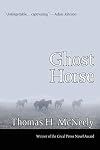
Ghost Horse
by Thomas H. McNeely
Gival Press, September 2014
260 pages, $20
Reviewed by Michelle Newby
Thomas H. McNeely’s Ghost Horse, winner of the Gival Press Novel Award, follows eleven-year-old Buddy Turner, on the cusp of puberty, as he tries to make sense of an adult Wonderland where everything is not as it seems. Buddy and his best friend Alex Torres want to make movies. The eponymous Ghost Horse is the combination animation/live action short they’re working on when Buddy’s life show more turns inside out and upside down. Knowing the illusions made possible in movies, Buddy is always trying to determine which movie of his life is the real one. His father’s version? His mother’s? His Grandmother’s? Which version is his? He uses the language and techniques of movie making to disassociate when circumstances become too much for him to process.
The movie serves as a metaphor for the upheaval in his world and the premise of the movie morphs as Buddy’s world changes, reflecting his desperate wish for a superhero to fix everything, to set the world right side up and dispense justice. Buddy expects his father to be this hero but when his father proves to be all-too-human Buddy tries to assume this responsibility. His mission is to bring his father home.
Ghost Horse is set in 1970s Houston with all the attendant strife between Anglos and Latinos. Buddy lives with his mother and attends Catholic school in a neighborhood undergoing changes as the population of Hispanics increases and White Flight accelerates. Buddy’s life is in turmoil as his separated parents attempt to straighten out their future and drag Buddy along for the unhappy ride. His father has moved in with Buddy’s grandmother, Gramma Turner, on the “right” side of town, and she has been allowed to insist that Buddy change schools because she pays the tuition. Buddy’s father, Jimmy, is engaged in a campaign of appeasement with Gramma Turner. “Look,” [he tells Buddy],”We just have to tell my mother what she wants to hear for a while, then we can do what we want.” Buddy’s new parochial school has an Anglo population and is seemingly staffed with Eagle Forum marionettes who allow a Lord of the Flies mentality to prevail. Buddy’s new (sort of) friend at this school is Simon Quine, a malevolent Eddie Haskell. Simon deals in the currency of secrets and in Buddy he has found the mother lode, “…secrets as powerful as magic.”
Ghost Horse has a simple plot that allows the complexity of the characterizations and the language to shine. The pace is slow at times, but not discouragingly so, and as the denouement draws together it picks up speed like a passenger train. McNeely has a gift for conveying the essence of a character and a situation succinctly but vividly. Buddy’s mother tells him there are two kinds of people in Houston – those that read the Post and those that read the Chronicle. Simon’s father reads the Chronicle and lobs questions at Buddy that “…paint a world, like Bible stories, of shining and embattled certainty.” A character responds to the formidable Gramma Turner, “…her voice like an animal testing a branch.” McNeely also knows when to let silence speak loudly and how to let mystery reveal. When you finish Ghost Horse you will still have a couple of questions about these characters and what really happened. Just like real life.
The atmosphere of Ghost Horse is heavy with portent and the description is appropriately stark. McNeely describes an alley as “…the world of Dumpsters and parking garages and an electrical station’s humming metal thicket, the world behind the world…” The widower Mr. Torres’ house is small, “…as close and tight as a shoeshine box.” A humid August day in the swamp is “…very warm, the sky frosted with a high, thin haze the color of beach glass.”
Adults are as cyphers to children and McNeely has a remarkable ability to viscerally recall what it was like to be an eleven-year-old boy and channel that onto the page. As children will, Buddy takes what he hears literally, not catching the innuendo and obscure references used by the adults. He listens to his parents’ phone conversations. ”Who left who? his father said. I didn’t mean to, his mother said.” His mother tries to explain to Buddy why she’s rejecting his father’s overtures, “Because this is what daddy does. He gives and gives and it’s never what you want, but somehow you always end up owing him.” His father tells him, “We just want what’s best for you, Buddy. Understand? That’s why we’re doing this. All of it’s for you.” Buddy instinctually rejects this as untrue. No wonder he’s confused.
Buddy finds himself caught between all of the warring parties – the adults he is supposed to be able to depend on to help him navigate his world – and has lost all of his emotional landmarks. His mother is depressed and overworked, his father is a weak and cowardly creature, his new school is packed with racists and bullies, and Alex is suspicious of the changes he sees in his friend. As the divorce process continues, Buddy is placed squarely in the middle, the responsibility for his father’s happiness and his mother’s happiness, those things no longer being one and the same, is placed squarely on his young shoulders. The cruelty of those he trusts is breathtaking. His father wants him to keep his secrets. “You need to promise me you won’t say anything…” His mother wants him to spill those secrets. “Buddy,” his mother says, “you’ve got to tell me the truth, honey. That’s the only way we can help daddy.” Gramma Turner wants reports on his mother. “He knows what will come next, the questions about his mother: how often does she clean? does she help him with his homework? does she drink two or three glasses of wine with dinner? does she ever have men friends over?” Buddy sees all of these as demands that he betray someone he loves. These secrets leave him feeling isolated. “…silence spread out between his mother and him…a thin sheet of glass.” Pretty soon that sheet of glass thickens and elongates to include everyone he is close to. This leaves Simon the opening he needs. Ultimately, like being pulled apart by a medieval torture rack, Buddy breaks under the pressure and the consequences leave no one untouched.
Ghost Horse flows imaginatively – as a child would process events and people from his necessarily limited perspective. Accordingly, the language and metaphors McNeely employs evoke the intimidating world of adults as seen from the child’s level. The plot is deftly constructed even though not all of the threads are tied off by the end of the story. If it seems that the characters of Simon’s family and Gramma Turner come across as slightly stereotypical, this is because the child Buddy sees them as archetypes. The conclusion of Ghost Horse is satisfying but you will be invested enough in Buddy’s world to wish you knew what happened next.
Published in Atticus Review show less
by Thomas H. McNeely
Gival Press, September 2014
260 pages, $20
Reviewed by Michelle Newby
Thomas H. McNeely’s Ghost Horse, winner of the Gival Press Novel Award, follows eleven-year-old Buddy Turner, on the cusp of puberty, as he tries to make sense of an adult Wonderland where everything is not as it seems. Buddy and his best friend Alex Torres want to make movies. The eponymous Ghost Horse is the combination animation/live action short they’re working on when Buddy’s life show more turns inside out and upside down. Knowing the illusions made possible in movies, Buddy is always trying to determine which movie of his life is the real one. His father’s version? His mother’s? His Grandmother’s? Which version is his? He uses the language and techniques of movie making to disassociate when circumstances become too much for him to process.
The movie serves as a metaphor for the upheaval in his world and the premise of the movie morphs as Buddy’s world changes, reflecting his desperate wish for a superhero to fix everything, to set the world right side up and dispense justice. Buddy expects his father to be this hero but when his father proves to be all-too-human Buddy tries to assume this responsibility. His mission is to bring his father home.
Ghost Horse is set in 1970s Houston with all the attendant strife between Anglos and Latinos. Buddy lives with his mother and attends Catholic school in a neighborhood undergoing changes as the population of Hispanics increases and White Flight accelerates. Buddy’s life is in turmoil as his separated parents attempt to straighten out their future and drag Buddy along for the unhappy ride. His father has moved in with Buddy’s grandmother, Gramma Turner, on the “right” side of town, and she has been allowed to insist that Buddy change schools because she pays the tuition. Buddy’s father, Jimmy, is engaged in a campaign of appeasement with Gramma Turner. “Look,” [he tells Buddy],”We just have to tell my mother what she wants to hear for a while, then we can do what we want.” Buddy’s new parochial school has an Anglo population and is seemingly staffed with Eagle Forum marionettes who allow a Lord of the Flies mentality to prevail. Buddy’s new (sort of) friend at this school is Simon Quine, a malevolent Eddie Haskell. Simon deals in the currency of secrets and in Buddy he has found the mother lode, “…secrets as powerful as magic.”
Ghost Horse has a simple plot that allows the complexity of the characterizations and the language to shine. The pace is slow at times, but not discouragingly so, and as the denouement draws together it picks up speed like a passenger train. McNeely has a gift for conveying the essence of a character and a situation succinctly but vividly. Buddy’s mother tells him there are two kinds of people in Houston – those that read the Post and those that read the Chronicle. Simon’s father reads the Chronicle and lobs questions at Buddy that “…paint a world, like Bible stories, of shining and embattled certainty.” A character responds to the formidable Gramma Turner, “…her voice like an animal testing a branch.” McNeely also knows when to let silence speak loudly and how to let mystery reveal. When you finish Ghost Horse you will still have a couple of questions about these characters and what really happened. Just like real life.
The atmosphere of Ghost Horse is heavy with portent and the description is appropriately stark. McNeely describes an alley as “…the world of Dumpsters and parking garages and an electrical station’s humming metal thicket, the world behind the world…” The widower Mr. Torres’ house is small, “…as close and tight as a shoeshine box.” A humid August day in the swamp is “…very warm, the sky frosted with a high, thin haze the color of beach glass.”
Adults are as cyphers to children and McNeely has a remarkable ability to viscerally recall what it was like to be an eleven-year-old boy and channel that onto the page. As children will, Buddy takes what he hears literally, not catching the innuendo and obscure references used by the adults. He listens to his parents’ phone conversations. ”Who left who? his father said. I didn’t mean to, his mother said.” His mother tries to explain to Buddy why she’s rejecting his father’s overtures, “Because this is what daddy does. He gives and gives and it’s never what you want, but somehow you always end up owing him.” His father tells him, “We just want what’s best for you, Buddy. Understand? That’s why we’re doing this. All of it’s for you.” Buddy instinctually rejects this as untrue. No wonder he’s confused.
Buddy finds himself caught between all of the warring parties – the adults he is supposed to be able to depend on to help him navigate his world – and has lost all of his emotional landmarks. His mother is depressed and overworked, his father is a weak and cowardly creature, his new school is packed with racists and bullies, and Alex is suspicious of the changes he sees in his friend. As the divorce process continues, Buddy is placed squarely in the middle, the responsibility for his father’s happiness and his mother’s happiness, those things no longer being one and the same, is placed squarely on his young shoulders. The cruelty of those he trusts is breathtaking. His father wants him to keep his secrets. “You need to promise me you won’t say anything…” His mother wants him to spill those secrets. “Buddy,” his mother says, “you’ve got to tell me the truth, honey. That’s the only way we can help daddy.” Gramma Turner wants reports on his mother. “He knows what will come next, the questions about his mother: how often does she clean? does she help him with his homework? does she drink two or three glasses of wine with dinner? does she ever have men friends over?” Buddy sees all of these as demands that he betray someone he loves. These secrets leave him feeling isolated. “…silence spread out between his mother and him…a thin sheet of glass.” Pretty soon that sheet of glass thickens and elongates to include everyone he is close to. This leaves Simon the opening he needs. Ultimately, like being pulled apart by a medieval torture rack, Buddy breaks under the pressure and the consequences leave no one untouched.
Ghost Horse flows imaginatively – as a child would process events and people from his necessarily limited perspective. Accordingly, the language and metaphors McNeely employs evoke the intimidating world of adults as seen from the child’s level. The plot is deftly constructed even though not all of the threads are tied off by the end of the story. If it seems that the characters of Simon’s family and Gramma Turner come across as slightly stereotypical, this is because the child Buddy sees them as archetypes. The conclusion of Ghost Horse is satisfying but you will be invested enough in Buddy’s world to wish you knew what happened next.
Published in Atticus Review show less
Awards


You May Also Like
Associated Authors
Statistics
- Works
- 2
- Also by
- 3
- Members
- 12
- Popularity
- #813,247
- Rating
- 3.9
- Reviews
- 5
- ISBNs
- 4